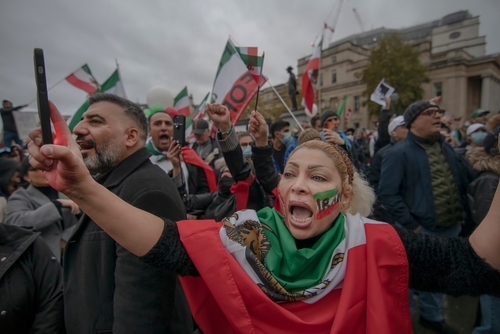

Iran’s nationwide uprising from late 2025 into early 2026 may represent the most significant political turning point in the country since the monarchy was overthrown in 1979. What initially began as protests triggered by a sharp rise in foreign exchange rates and the rapid collapse of the national currency soon transformed into a broad, countrywide movement. Official figures indicate that demonstrations spread across all 31 provinces, reaching roughly 400 cities and nearly 4,000 distinct locations. The protests quickly moved beyond economic frustration and evolved into direct challenges to the political legitimacy of the ruling system. Demonstrators rejected all forms of dictatorship and voiced demands for a democratic republic founded on popular sovereignty. In this regard, the movement can be viewed as part of Iran’s enduring historical pursuit of freedom, stretching from the Constitutional Revolution to contemporary struggles.
The forcefulness of the government’s reaction — including nationwide internet shutdowns, widespread arrests, and the killing of protesters — signaled that authorities perceived the unrest as a serious threat to their survival. This assessment appeared to be reinforced by indications of internal coordination among demonstrators. Supporters point to networks established since 2016 under the name “Resistance Units” by the People’s Mojahedin (MEK), long-standing adversaries of the clerical establishment, as evidence of a structured infrastructure capable of maintaining organized resistance. These networks are described as forming the operational foundation of an alternative political framework.
Theories of political transition suggest that periods of systemic crisis create opportunities for actors who are not central to a movement to attempt to capitalize on unrest and present themselves as potential leaders. In collective action theory, this behavior is often labeled “free riding.” The issue becomes especially delicate when claims to leadership are grounded less in domestic social structures and more in external backing or geopolitical leverage. Historical precedents demonstrate that while legitimacy derived from outside support can generate temporary visibility and attention, it often encounters difficulties in achieving durable national acceptance and institutional stability.
During the uprising, the increased media visibility of Reza Pahlavi, son of the former shah, appeared to stem largely from extensive international exposure and engagement in Western capitals rather than from a deeply rooted organizational structure within Iran itself. His public endorsement of targeted international measures against key institutions of the Islamic Republic marked a divergence from segments of protest discourse inside the country, where emphasis was placed on internal transformation and reliance on domestic social forces.
Developments within parts of the Iranian diaspora further highlighted tensions among opposition groups. Reports emerged describing physical altercations at demonstrations, along with online harassment campaigns allegedly conducted by individuals identifying as monarchist supporters. In some instances, observers pointed to overlaps with far-right rhetoric, adding another layer of complexity to an already fragmented political landscape.
At the Munich Security Conference, CNN journalist Christiane Amanpour directly challenged Pahlavi regarding allegations of online abuse carried out by some of his followers and questioned his capacity to build a sustainable coalition. Shortly thereafter, videos surfaced showing individuals claiming to back Pahlavi engaging in aggressive verbal attacks against Amanpour, heightening concerns about intolerance toward critical questioning.
The rally held on February 14, 2026, at Munich’s Theresienwiese became another point of dispute. Early accounts suggested a turnout of 250,000 participants. However, an evaluation published by the German newspaper Süddeutsche Zeitung, based on visual analysis and crowd density calculations, indicated that such figures were unlikely and presented a considerably lower estimate. Additionally, the rally’s slogan, “One Homeland, One Flag, One Leader,” drew criticism because of its structural resemblance to slogans associated with the Nazi era — a particularly sensitive issue given Germany’s historical experience.
In contrast, certain organized opposition groups contend that the uprising is accompanied by a clearly articulated political alternative. The National Council of Resistance of Iran (NCRI), under the leadership of Maryam Rajavi, has introduced a transitional vision centered on internal reform. Its ten-point proposal advocates the separation of religion and state, gender equality, abolition of the death penalty, protection of minority rights, and the establishment of free elections.
Drawing on Max Weber’s argument that political stability depends not only on the assertion of authority but also on its social legitimacy, analysts suggest that any proposed alternative lacking organic connections to society and the capacity for internal mobilization is likely to encounter substantial obstacles in consolidating power.
Ultimately, the present uprising cannot be understood merely as an attempt to replace one authoritarian structure with another. At its foundation lies a demand for a republican, democratic, and accountable political system — one in which sovereignty resides with the people rather than with an individual figure or a ruling dynasty.
Dear reader,
Opinions expressed in the op-ed section are solely those of the individual author and do not represent the official stance of our newspaper. We believe in providing a platform for a wide range of voices and perspectives, even those that may challenge or differ from our own. We remain committed to providing our readers with high-quality, fair, and balanced journalism. Thank you for your continued support.