
In the turbulent politics of the Middle East, Qatar has long attempted something few states have managed: maintaining dialogue with all sides. Doha positioned itself as a diplomatic bridge between adversaries, hosting negotiations, facilitating communication, and attempting to prevent conflicts from spiraling into war. Nowhere was this role more visible than in its efforts to ease tensions between Iran and the United States.
But Iran’s recent attack on Qatar has shattered that carefully built trust. The missiles that crossed into Qatari airspace were not merely acts of retaliation against American military assets; they were a profound betrayal of a country that had repeatedly sought to de-escalate tensions and mediate between rivals.
For Qatar, the message was unmistakable: diplomacy alone does not guarantee respect for sovereignty.
A Mediator Turned Target
For years, Qatar cultivated a policy rooted in dialogue. While hosting American forces at the strategically vital Al Udeid Air Base, Doha also maintained open channels with Tehran. This dual approach allowed Qatar to serve as a mediator during some of the region’s most sensitive crises.
Qatari leaders consistently emphasized that their country would not participate in aggression against neighboring states and would instead work to prevent escalation.
Yet despite this effort, Iran launched missiles toward facilities located on Qatari territory. Qatari air defenses were forced to intercept incoming projectiles as the capital’s skies lit up with explosions. The country that had tried to prevent confrontation suddenly found itself in the middle of it.
Iran attempted to justify the attack by claiming the missiles were aimed at American forces rather than Qatar itself. But this explanation rings hollow. When missiles enter the territory of another sovereign nation, they threaten everything within it—military installations, civilian infrastructure, and the lives of ordinary citizens.
From Doha’s perspective, there is no meaningful distinction.
Qatar Prime Minister’s Warning
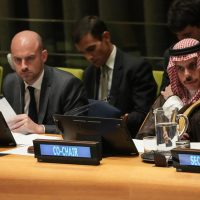
The strongest reaction came from Qatar’s Prime Minister and Foreign Minister, Sheikh Mohammed bin Abdulrahman Al-Thani. Speaking publicly about the crisis, he described the attack as creating a “big sense of betrayal.”
Those words carry enormous weight in diplomacy. Betrayal implies not merely disagreement, but a broken trust between states that had previously maintained working relations.
According to the Qatari leadership, Doha had been actively working to facilitate dialogue and diplomatic solutions in the region. Instead of encouraging those efforts, Iran’s actions effectively undermined them overnight.
The prime minister’s message was clear: Qatar was not part of the war. Yet it was treated as though it were.
Civilian Infrastructure at Risk
The threat extended beyond military installations. Qatari officials warned that a significant portion of the attacks targeted or endangered civilian facilities and infrastructure.
Such actions carry global consequences. Qatar is one of the world’s most important energy exporters and a major supplier of liquefied natural gas. Any attack that threatens its industrial or energy infrastructure risks destabilizing global markets and supply chains.
Missiles fired into Qatari territory therefore endanger far more than one country—they threaten economic stability far beyond the Gulf.
Qatar’s Right to Defend Itself
Despite the shock of the attack, Qatar’s response has been measured but firm. The government has reaffirmed its right to defend its sovereignty and protect its people.
Qatari defense systems successfully intercepted incoming threats, preventing potential damage and casualties. At the same time, Doha has continued to call for de-escalation and diplomatic solutions.
This approach reflects Qatar’s broader strategy: a country that prefers negotiation but will not tolerate violations of its sovereignty.
The Collapse of Trust
Perhaps the most lasting damage is not physical but political.
For years, Qatar maintained a pragmatic relationship with Iran, built on geography, shared energy interests, and regional stability. That relationship depended on mutual respect for sovereignty and restraint in times of crisis.
Iran’s decision to launch missiles toward facilities inside Qatar has severely undermined that foundation.
When a country that claims to be a neighbor and partner launches military strikes into another state’s territory—especially one that was actively mediating on its behalf—the credibility of its diplomatic assurances inevitably comes into question.
Trust, once broken, is extraordinarily difficult to rebuild.
A Lesson for the Region
The events surrounding the attack on Qatar carry an important lesson for the wider Middle East. Mediation requires trust from all sides. Without that trust, diplomacy becomes fragile and ultimately ineffective.
Qatar attempted to prevent escalation by engaging with all parties. Instead, it discovered that even a mediator can become a target.
This reality forces a broader reconsideration across the region. If Iran is willing to endanger a neutral state that was actively working to reduce tensions, other countries may begin to question whether Tehran can truly be relied upon in diplomatic negotiations.
Qatar’s experience represents more than a single incident in a volatile region. It exposes a deeper contradiction in Middle Eastern geopolitics: a country that sought dialogue and stability was met with missiles.
Despite this betrayal, Qatar continues to advocate for diplomacy and de-escalation. But the events of recent days have fundamentally altered perceptions.
In international relations, words matter—but actions matter more. And when a nation’s actions contradict its diplomatic assurances, trust erodes quickly.
For Qatar, the attack has delivered a painful but unmistakable lesson: peace requires partners who respect the very diplomacy they claim to support. Without that respect, mediation becomes not a path to stability—but a vulnerability.