
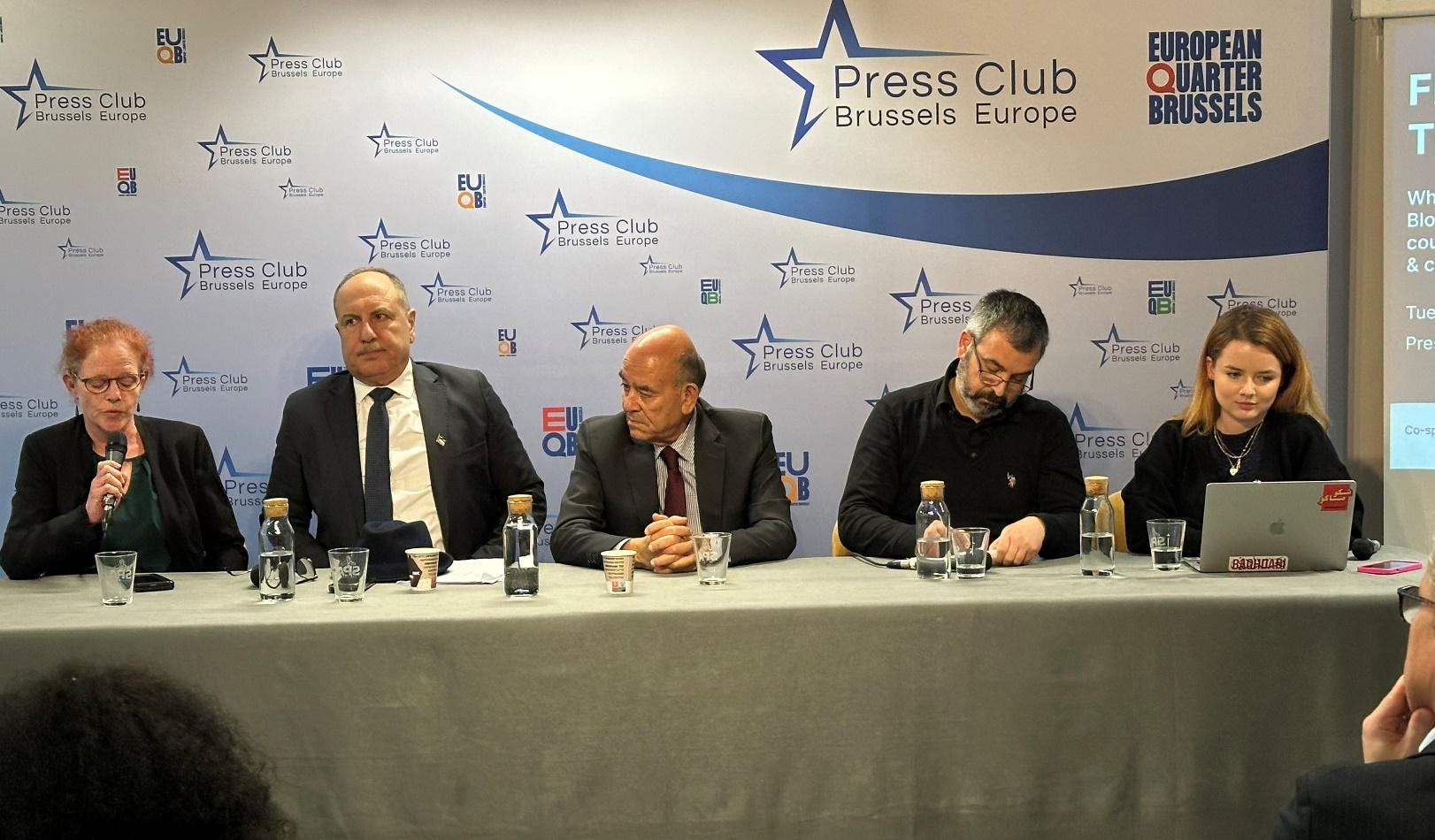
In Brussels, a powerful high-level panel of international legal experts, human rights defenders, and civil society leaders gathered to confront what many described as an unprecedented threat to the global system of accountability. At the centre of the discussion were U.S. sanctions targeting the International Criminal Court (ICC), Palestinian human rights organizations, and individuals working to document alleged war crimes and crimes against humanity.
The event, held in Brussels, brought together representatives from Palestinian NGOs, European advocacy networks, and global organizations to discuss the growing impact of U.S. sanctions on accountability mechanisms. Speakers described the situation as a turning point for international justice, with implications far beyond the Middle East.
What emerged from the panel was not simply a critique of sanctions policy, but a stark warning: the foundations of international law are under coordinated pressure, and the consequences may be irreversible if decisive action is not taken.
From Targeted Measures to Systemic Pressure
Speakers highlighted a clear evolution in the use of sanctions. What began as targeted measures against individuals has expanded into a broader strategy affecting the entire ecosystem of international justice.
Zoe, an advocacy coordinator and lead contributor to a forthcoming report, described the sanctions as: “An attack on victims, An attack on the rule of law, An attack on the independence of justice.”
According to her findings, the objective is no longer limited to influencing specific investigations. Instead, the sanctions aim to disrupt the entire chain of accountability from grassroots documentation to judicial decision-making.
This includes targeting civil society organizations gathering evidence, legal professionals and prosecutors, judges and independent UN experts. The implications are profound: if those who document and prosecute crimes are incapacitated, justice itself becomes unattainable.
The Global Reach of Financial Power
At this conference, Issam Younis, director of Al Mezan Center for Human Rights, and Raji Sourani, director of Palestinian Centre for Human Rights, raised a fundamental question: since when can a prolonged and coercive occupation be framed as an act of self-defense?
International law, including the framework established by the International Criminal Court under the Rome Statute, treats occupation in certain contexts as part of the crime of aggression. Yet, despite Europe’s long-standing commitment to the values of human rights, democracy, and the rule of law, many European leaders have affirmed Israel’s right to self-defense while remaining largely inactive in applying meaningful sanctions.
This stands in stark contrast to the swift and comprehensive measures taken following the Russian invasion of Ukraine. The inconsistency reflects a deeper issue: the persistence of politicization and the selective application of international law, shaped in part by lingering colonial mindsets, they said.
The speakers add, this selective enforcement extends to the institutions meant to uphold justice. Attacks on the credibility and functioning of the International Criminal Court did not begin recently; they have included pressure on prosecutors, their deputies, judges, and even independent experts such as UN special rapporteurs.
Those responsible for gathering evidence and documenting violations often working under extreme and dangerous conditions have faced sanctions and intimidation. These actions hinder the flow of legal information not only to the ICC but also to the International Court of Justice, undermining the very mechanisms designed to ensure accountability.
Extraterritorial Impact of Sanctions
One of the most striking themes of the discussion was the extraterritorial impact of U.S. sanctions. Though issued under U.S. law, their effects extend far beyond American borders.
Participants described how individuals and organizations many based in Europe have lost access to bank accounts and credit cards, been cut off from digital platforms such as cloud storage and communication tools, and faced barriers in travel, accommodation, and basic financial transactions.
These disruptions are not incidental. They reflect a deeper structural reality: global dependence on U.S.-linked financial and technological systems allows sanctions to function as a worldwide enforcement mechanism. As one speaker noted, the result is a form of “economic isolation” that can paralyze organizations overnight.
Palestinian Organizations Under Pressure
Representatives from Palestinian human rights organizations offered firsthand accounts of the consequences. Their testimonies painted a picture of severe operational strain: bank accounts frozen, funding streams cut off, staff unable to receive salaries, international partnerships collapsing.
Despite these challenges, many continue their work under extraordinary conditions, including displacement and ongoing conflict. At the same time, speakers described a broader pattern of pressure: public smearing and delegitimization, designation as “terrorist organizations”, direct threats and intimidation, sanctions and financial restrictions.
This escalation, they argued, is directly linked to their engagement with the ICC following Palestine’s accession to the Rome Statute in 2015.
Europe at a Crossroads
A recurring theme throughout the panel was the role of the European Union. While EU institutions have publicly criticized sanctions against the ICC, speakers expressed deep frustration at what they see as insufficient concrete action.
Particular attention was given to the EU “Blocking Statute,” a legal mechanism designed to counter the extraterritorial effects of foreign sanctions. Despite repeated calls from civil society and the European Parliament, it has yet to be activated in this context.
Critics argue that this inaction sends a troubling message: that European actor may not be protected, that external pressure can override EU commitments to international law, that political caution is taking precedence over legal principles.
The Risk of Double Standards
Several speakers pointed to what they perceive as inconsistencies in how international law is applied. The strong response to Russia’s invasion of Ukraine was contrasted with what they described as a more limited response to alleged violations in Palestine.
This perceived selectivity, they warned, risks undermining the legitimacy of international legal institutions. As one panellist put it: “If justice is selective, it ceases to be justice.”
Impunity and the Cycle of Violence
Another critical insight came from representatives of regional human rights networks, who emphasized the link between impunity and escalating violence.
Their analysis outlined a recurring pattern: crimes are committed, accountability mechanisms fail to respond, perpetrators face no consequences, violence intensifies.
In this context, sanctions targeting accountability mechanisms are not neutral they may actively contribute to the continuation and escalation of violence.
The broader picture that emerged is one of a global system under strain. Institutions such as the International Criminal Court long seen as cornerstones of international justice are facing challenges from multiple directions: political pressure, financial constraints, legal obstruction.
Calls for Action and Global Stakes
Despite the gravity of the situation, the panel was not without a sense of resolve.
Speakers called for stronger and more coordinated action from the European Union, activation of legal tools to protect affected actors, continued support for the independence of the ICC, and sustained advocacy by civil society and media.
Matt Cannock, Amnesty International said, in 2026, it has become unmistakably clear that powerful non-member states of the International Criminal Court, including the United States and Russia, pose serious challenges to the Court’s independence and effectiveness.
Defending the ICC requires more than rhetorical support it demands decisive, concrete action. The continued imposition of U.S. sanctions on the Court must be firmly opposed and lifted, and existing legal mechanisms, including blocking statutes, must be actively deployed to protect the ICC and civil society organizations.
The ICC has become a central battleground in a wider struggle over the future of international law itself, he said.
The sanctions imposed by the United States are not isolated measures; they form part of a broader and deliberate strategy to weaken the global human rights framework.
Beyond One Conflict
While much of the discussion focused on Palestine, the implications are global. If the mechanisms designed to ensure accountability can be weakened or dismantled, the consequences will be felt across all contexts from Ukraine to Afghanistan and beyond.
The Brussels panel made one thing clear: this is not only a political issue it is a test of the international community’s commitment to justice itself.
Whether that commitment will be upheld remains an open question.