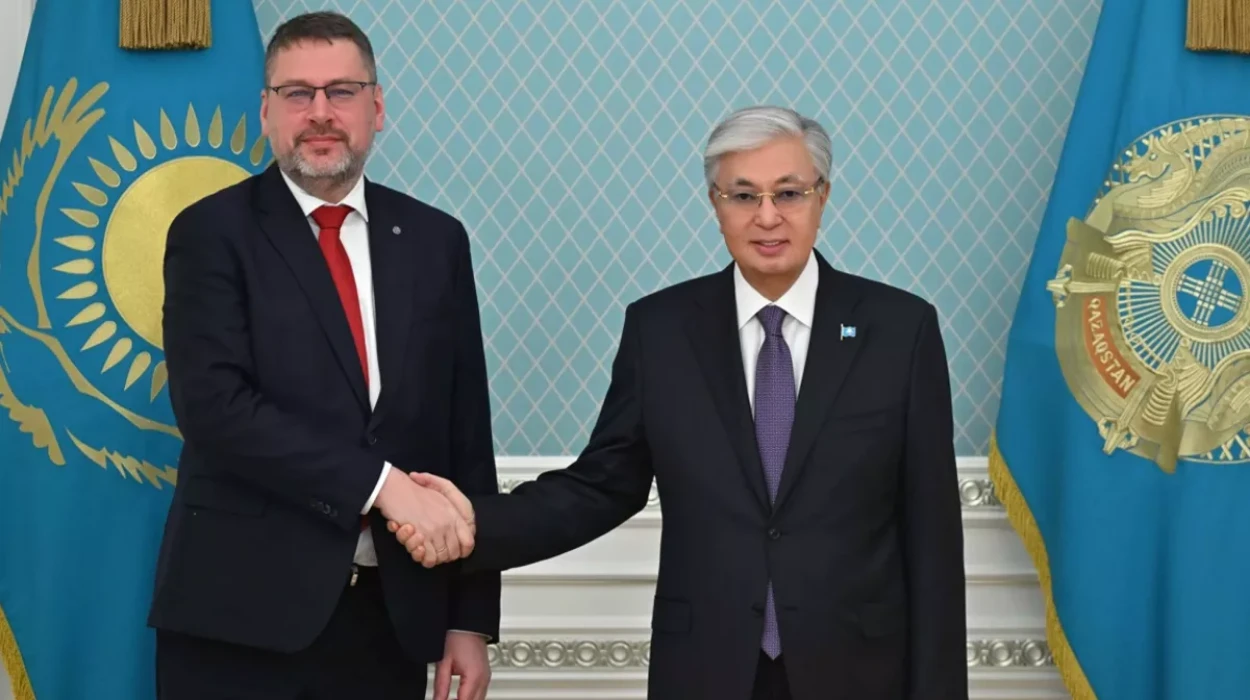
When António Costa travelled to Astana, Kazakhstan’s capital, on 4 December for his first official visit as President of the European Council, the symbolism was obvious but the underlying logic was more substantive.
His visit came directly on the heels of the 22nd meeting of the EU–Kazakhstan Cooperation Council in Brussels – the first time the format was elevated to senior ministerial level and co-chaired by Kazakhstan’s Foreign Minister Yermek Kosherbayev and Kaja Kallas, the EU’s High Representative for Foreign Affairs and Security Policy.
These back-to-back engagements suggest that the EU is deliberately strengthening relations with Kazakhstan because it has become central to three of Europe’s most pressing strategic priorities: energy and mineral security, new transit routes to Asia, and the broader pursuit of strategic autonomy in an increasingly constrained geopolitical environment.
This month marks ten years since Kazakhstan and the EU signed their Enhanced Partnership and Cooperation Agreement (EPCA), the first such “new-generation” agreement the EU ever concluded with a Central Asian state. It set out 29 areas of cooperation ranging from economy and transport to science, energy and political dialogue.
Much of that agenda has been implemented steadily over the decade: trade grew to nearly USD 50 billion last year; the EU became Kazakhstan’s largest economic partner; and over 3,000 European companies consolidated Kazakhstan as a regional base for investment.
But EPCA now operates in a radically changed strategic landscape. What was once a broad bilateral framework has evolved into a platform for managing Europe’s exposure to geopolitical shocks and restructuring the EU’s economic links across Eurasia. Kazakhstan’s role in that recalibration has become more prominent for reasons that are increasingly difficult for policymakers in Brussels to ignore.
Europe’s vulnerabilities meet Kazakhstan’s capacity
The first and most immediate driver of Europe’s renewed engagement is resource security. The EU’s energy transition and reconfiguration of its import patterns after 2022 have exposed how dependent it is on a small group of suppliers for both hydrocarbons and the critical minerals required for decarbonisation.
Kazakhstan sits at the intersection of these needs. It supplies over 70% of its oil exports directly to the European market and provides roughly 16% of the uranium consumed in the EU. But the more structural issue is minerals: Kazakhstan produces 21 of the 34 critical raw materials identified by the EU, including copper, rare earth elements, lithium, tungsten and tantalum. It is also the world’s leading uranium producer, accounting for 43% of global output.
This matters because Europe’s decarbonisation pathway requires secure, diversified and politically stable sources of inputs. Few countries outside the OECD combine geological endowment, relative political predictability, and an active willingness to develop long-term value chains with European partners.
For this reason, the 2022 EU–Kazakhstan Memo on sustainable raw materials and green hydrogen has become one of the most operational components of the relationship, with implementation roadmaps now extending into 2026 and new projects, such as graphite development in Karaganda, advancing under EU strategic project designations.
In this context, Antonio Costa’s discussions in Astana and Kosherbayev’s Brussels consultations were about securing future supply resilience, an increasingly central pillar of European strategic autonomy.
A new logistics map for Europe–Asia trade
The second driver is connectivity. Europe needs reliable land routes to Asia that do not transit Russia and that shorten delivery timelines relative to maritime shipping. The Trans-Caspian International Transport Route (TITR), or Middle Corridor, is the only east–west corridor that fulfils these criteria without creating new geopolitical dependencies. Kazakhstan is the geographical and logistical keystone of that route.
The Middle Corridor is emerging as a strategic asset in Europe’s economic security toolkit, especially as supply chains are re-routed and diversified. This shift was reflected clearly in Brussels during Kosherbayev’s visit: Commissioner Jozef Síkela outlined plans to expand EU support for the corridor, including €45 million for modernising the port of Aktau and €150 million for highway reconstruction inside Kazakhstan.
These types of infrastructure upgrades are required to reduce bottlenecks and increase throughput along the Caspian route.
The EU’s Global Gateway strategy, which earmarked €12 billion for Central Asian connectivity and raw materials cooperation, is beginning to translate into project-level actions and Kazakhstan is the principal interface through which these initiatives acquire practical relevance.
Beyond resources and transport, a third factor explains Europe’s intensified engagement: the EU is recalibrating how it manages Eurasian geopolitics. Brussels has confronted the challenge of avoiding over-concentration of supply chains in any single Asian market.
The outcome has been a broader search for “middle partners” – states that are not part of Western alliances but that possess enough economic weight and diplomatic autonomy to support European strategic transformations.
In this framework, Kazakhstan has moved from a peripheral partner to a necessary one. It occupies a significant geopolitical position: a stable state in the heart of Eurasia, connected to surrounding regions, with a track record of mediating between competing actors and upholding core principles of the UN Charter.
Antonio Costa’s visit to Astana highlighted this point. His discussions with President Kassym-Jomart Tokayev centred not only on economic cooperation but also on regional stability and Europe’s long-term role in supporting sustainable connectivity between Central Asia and Europe. In other words, the political track is beginning to catch up with the economic one.
The Brussels outcomes
It is notable that Kazakhstan’s participation in the Cooperation Council yielded concrete outcomes. The launch of formal visa facilitation and readmission negotiations on 2 December signals greater openness to structured movement of students, researchers, professionals and businesspeople. It represents the EU’s assessment that closer societal links with Kazakhstan are in its interest.
Likewise, the Council’s discussions on critical raw materials and the implementation of the EPCA suggest a shared recognition that the partnership now needs deeper mechanisms to manage both opportunities and risks. Ten years after its signing, the EPCA has moved from an expansive list of sectors to a more defined set of strategic priorities built around resilience, diversification and connectivity.
The direction of travel is clear: Europe is enhancing its relations with Kazakhstan because structural shifts in global energy markets, mineral supply chains and Eurasian transit have made Kazakhstan more relevant to Europe’s long-term strategic interests. That is why the partnership is deepening and why it is likely to remain a central feature of the EU’s Eurasian strategy for years to come.