
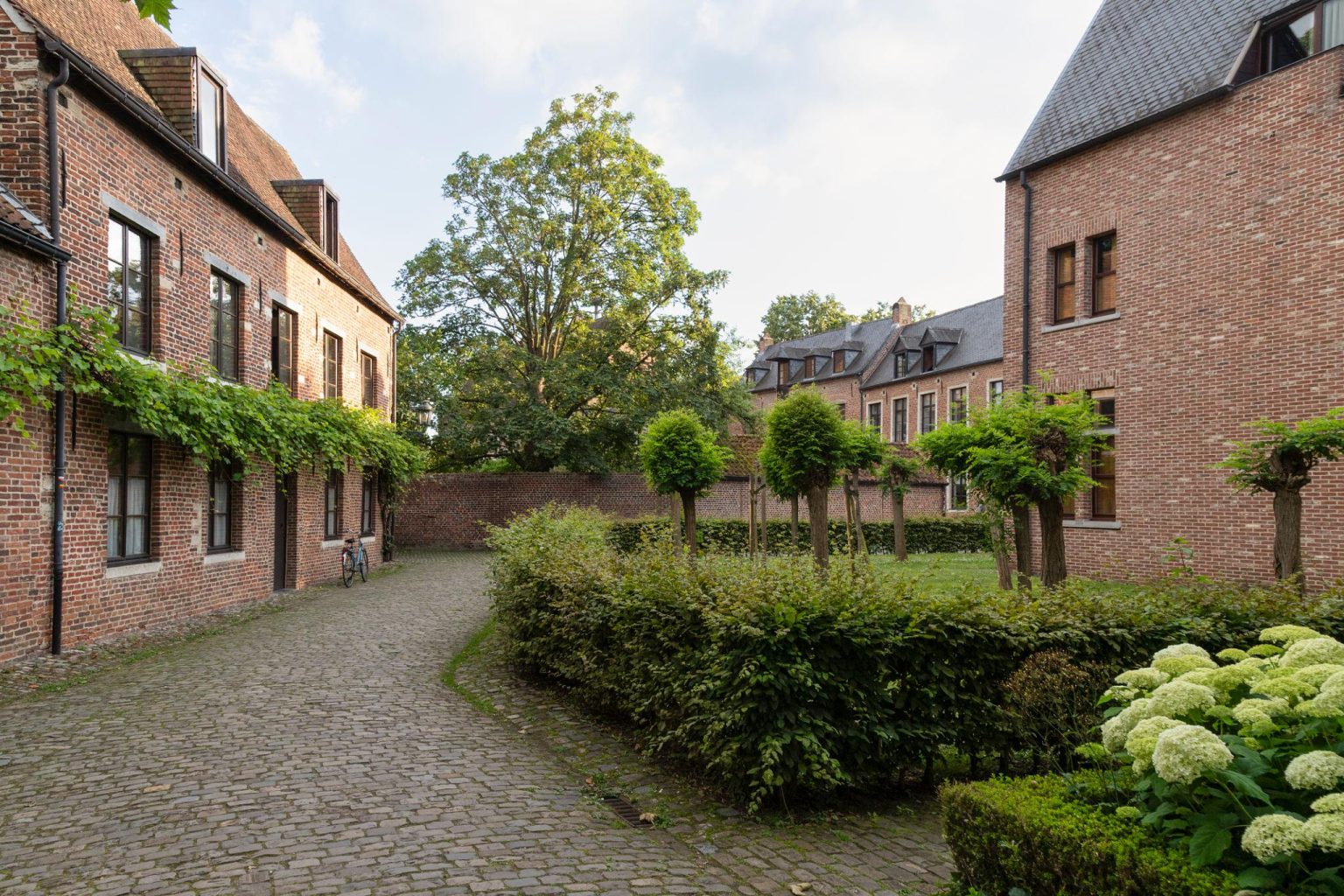
The origin of the word Beguine has been lost to history, yet the legacy of the Beguines remains deeply rooted in Belgium’s cultural and spiritual identity. To be a Beguine between the 13th and 16th centuries meant belonging to a semi monastic community of women devoted to voluntary poverty, simplicity, and caring for the sick and poor through religious commitment. The movement flourished in the Low Countries, particularly in what is now Belgium. Unlike nuns, the Beguines did not take permanent vows.
They retained the freedom to leave their communities at any time, and financial independence was central to their way of life. Many supported themselves through entrepreneurial activities such as lace making, weaving, and fine needlework. They lived together in clustered communities known as Beguinages, often described as cities within cities, enclosed spaces where spiritual reflection and practical work coexisted. By the 17th century, however, the movement began to decline due to sweeping socio economic changes including industrialization, the effects of the French Revolution, increasing secularization, and religious pressures linked to the Protestant Reformation.
Although the traditional communities eventually faded, the message of the Belgian Beguines continues to inspire contemporary artists and thinkers. In 2025, two very different creators revisited their legacy through distinct artistic mediums, bringing renewed attention to their historical importance and modern relevance.
Janet Rich Edwards, a Harvard professor of epidemiology at Brigham and Women’s Hospital in Boston, has spent her career studying patterns, causes, and long term effects of disease, particularly focusing on women’s reproductive health. With more than 300 scientific papers examining how early life factors influence chronic disease risk later in life, Edwards has built a distinguished reputation in data driven medical research.
Yet in 2025 she stepped beyond the scientific field and published her first and only work of fiction, a novel titled Canticle. Set in 13th century Bruges, the novel follows a young protagonist named Aleys who escapes an arranged marriage to join the Bruges Beguines. Aleys is portrayed as intelligent, curious, and spiritually sensitive, experiencing mystical visions that both inspire and unsettle those around her. Within the Beguinage she finds friendship, music, and meaning, flourishing in a community that values devotion and independence.
However, her attempts to translate established religious liturgy into Dutch and her reported visions draw suspicion from the male dominated Catholic hierarchy. Canticle presents a richly researched portrayal of medieval Bruges and the complex spiritual and social realities faced by women of that era. Through storytelling, Edwards explores whether fiction can reveal truths that extend beyond empirical science, offering a deeper emotional and historical understanding of the Belgian Beguines.
In contrast, Clara Spilliaert, a Japanese Belgian artist based in Ghent, approaches the Beguine legacy through visual art. Having moved to Belgium at the age of 16, Spilliaert’s work often reflects her cross cultural background and her efforts to interpret identity through artistic expression.
Her portfolio spans video, murals, animation, and ceramics. In 2025 she debuted a sculpture exhibition titled Listen Well at the University of Leuven’s Grand Beguine Abbey, a UNESCO World Heritage site founded in 1232. This Beguinage, a three hectare network of cobblestone streets and restored brick houses along the River Dijle, once sustained a religious community for more than five centuries and is now carefully preserved by the university. Spilliaert’s exhibition featured four bronze bas relief sculptures placed inside historic water wells within the Beguinage.
The works represent heart scans, drawing attention to cardiovascular disease as the leading cause of death among women in Belgium, a condition that she suggests remains underrecognized in medical training. At the center of each sculpture is a bird symbolizing a messenger, encouraging viewers to listen carefully to women’s specific health experiences. Nearby, Spilliaert highlights the Hawthorn tree, rich in folklore and symbolism.
The tree’s bark represents skin, its berries symbolize mammary glands, its leaves evoke lungs, and its roots suggest blood vessels. Through these layered metaphors, visitors are invited to lean over the wells and observe the trees, metaphorically listening to the bodies and stories connected to Leuven’s historic Beguinage.
Both Edwards and Spilliaert, working in literature and sculpture respectively, illuminate the enduring relevance of the Belgian Beguines. Edwards, grounded in epidemiology, explores spiritual and historical dimensions of women’s lives in medieval Bruges, questioning whether storytelling can convey truths beyond statistical analysis. Spilliaert, through symbolic sculpture, urges contemporary audiences to examine women’s health realities with renewed awareness.
Though separated by discipline and nationality, the two artists converge in their focus on female experience and resilience. Their 2025 works demonstrate how the wisdom and independence embodied by the Beguines continue to resonate centuries later.
Several notable facts underscore this renewed interest. Janet Rich Edwards’ Canticle, released in December 2025, received favorable critical attention, earning recognition as a New York Times Editors Choice and being named an Amazon Best Book of December. Clara Spilliaert’s Listen Well exhibition formed part of the 600th anniversary celebration of KU Leuven University.
The last traditional Beguine in Belgium, and indeed the world, was Marcella Pattyn, who died in April 2013 at the Beguinage in Kortrijk at the age of 92. Upon her passing, the mayor of Kortrijk reportedly remarked that she was a piece of world heritage, and a museum in the town now honors her life and legacy. Through history, literature, and sculpture, the inspiring story of the Belgian Beguines continues to bridge past and present, reminding modern society of the power of independence, devotion, and attentive listening.