
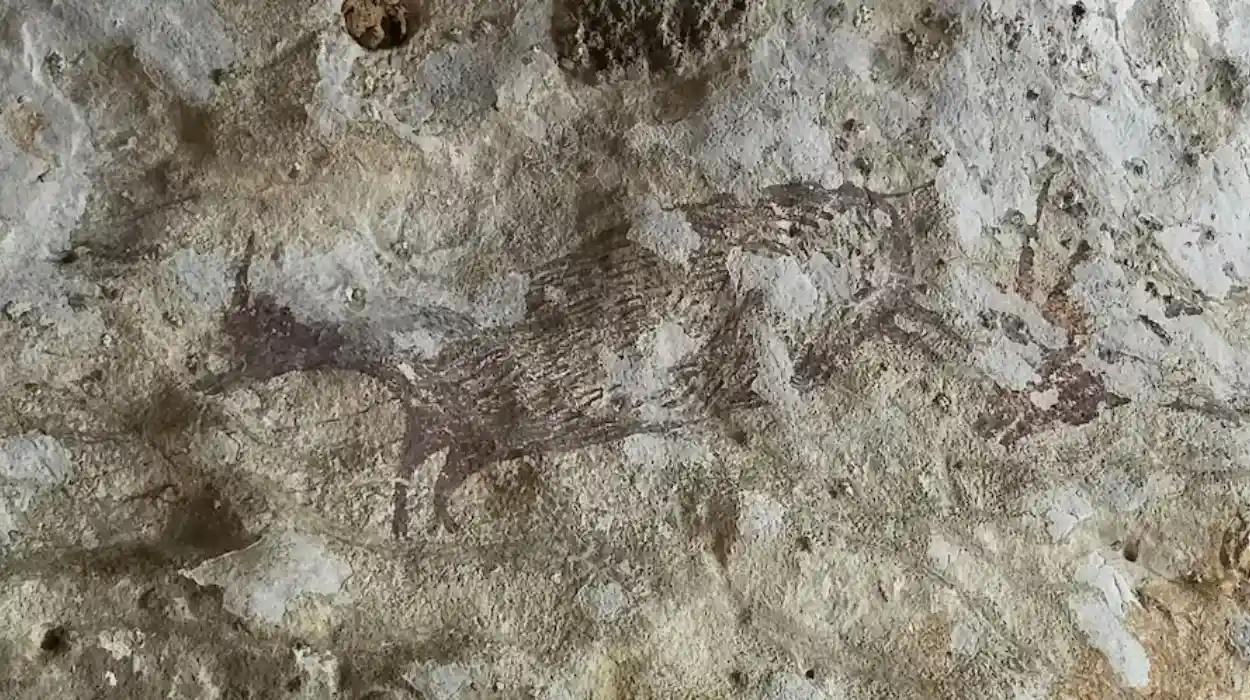
Jakarta (Brussels Morning Newspaper) October 23, 2026 – The world’s oldest known cave paintings in Indonesia are facing severe threats as intense wildfires sweep across the region. Researchers have warned that extreme heat and smoke from the country’s worst forest fires in more than a decade risk accelerating the permanent deterioration of prehistoric artworks dating back over 67,000 years.
- Escalating Wildfire Crisis Across Indonesian Forests and Peatlands
- Direct Threat to Prehistoric Artworks in Sulawesi and Maros-Pangkep
- Scientific Concerns Regarding Soot Accumulation and Structural Damage
- Emergency Firefighting Operations and National Park Devastation
- Urgent Calls for Tactical Mitigation and Heritage Protection
Escalating Wildfire Crisis Across Indonesian Forests and Peatlands
Indonesia is currently contending with its most severe forest and land fire crisis since 2015. Severe weather conditions, driven by exceptionally dry weather associated with the El Niño phenomenon, have driven up temperatures and drastically reduced rainfall throughout the archipelago. These arid conditions have left extensive forest and peatland areas highly vulnerable to intense blazes, which have progressively spread to regions containing critical archaeological treasures.
Among the affected regions is the island of Sulawesi, where prominent prehistoric sites harbour some of the earliest evidence of human artistic expression. Authorities and emergency responders have been deployed to combat the relentless spread of flames through tinder-dry vegetation, facing difficult terrain and adverse meteorological conditions.
Direct Threat to Prehistoric Artworks in Sulawesi and Maros-Pangkep
The advancing wildfires have drawn dangerously close to irreplaceable archaeological locations. Within the Maros-Pangkep region on Sulawesi, active fires have burned within 800 metres of rock art sites that have been scientifically dated to at least 51,200 years old. Furthermore, neighboring areas such as Muna island feature ancient hand stencils and depictions that have been verified to date back to at least 67,800 years.
Researchers monitoring the situation have highlighted that the danger to these artifacts extends beyond direct physical contact with flames. The intense thermal radiation and heavy smoke generated by nearby fires pose a severe chemical and physical threat to the fragile limestone canvas and pigment layers.
Scientific Concerns Regarding Soot Accumulation and Structural Damage
Archaeologists and conservation specialists have expressed grave concern over the immediate impact of smoke exposure. Basran Burhan, an archaeologist from Griffith University, explained the specific mechanism of potential damage during the ongoing crisis.
“They create soot on the paintings and cover them, so that the paintings will become blurred and difficult to identify,”
Burhan stated, emphasizing the vulnerability of the ancient pigments. In addition to soot obscuring the visual integrity of the motifs, rapid temperature fluctuations caused by nearby combustion can induce thermal stress in the limestone rock surfaces, potentially causing micro-fracturing and the eventual flaking off of the pigment-bearing rock layers.
Emergency Firefighting Operations and National Park Devastation
Efforts to contain the blazes have been ongoing across the affected conservation zones. Official reports from the national parks indicate that over 270 hectares of protected parkland burned between September 30 and October 18.
Firefighter Muhammad Ikfar provided details regarding the ongoing containment operations, confirming that suppression crews continued active work through Thursday and Friday to beat back active fronts under persistently dry conditions. Ground teams have been utilizing localized tactical maneuvers to construct firebreaks and deploy water suppression where accessible, though the sheer scale of the landscape and the dry fuel load have severely challenged containment efforts.
Urgent Calls for Tactical Mitigation and Heritage Protection
With the wildfire season persisting, researchers have issued urgent appeals to government agencies and disaster management bodies for specialized interventions. Experts maintain that safeguarding these prehistoric sites requires immediate, dedicated resources and coordinated tactical mitigation plans tailored specifically to cultural heritage protection.
“If we don’t do something about this quick, if there isn’t any tactical mitigation efforts for this incident we will lose one of the most amazing evidence of human history in Maros-Pangkep,”
stressing the international significance of the heritage at risk.
“And that is a great shame.”
As firefighting personnel continue their round-the-clock operations on the ground, international scientific communities and local authorities remain on high alert, monitoring both weather forecasts and fire progression lines to prevent further loss to humanity’s earliest known record of artistic storytelling.