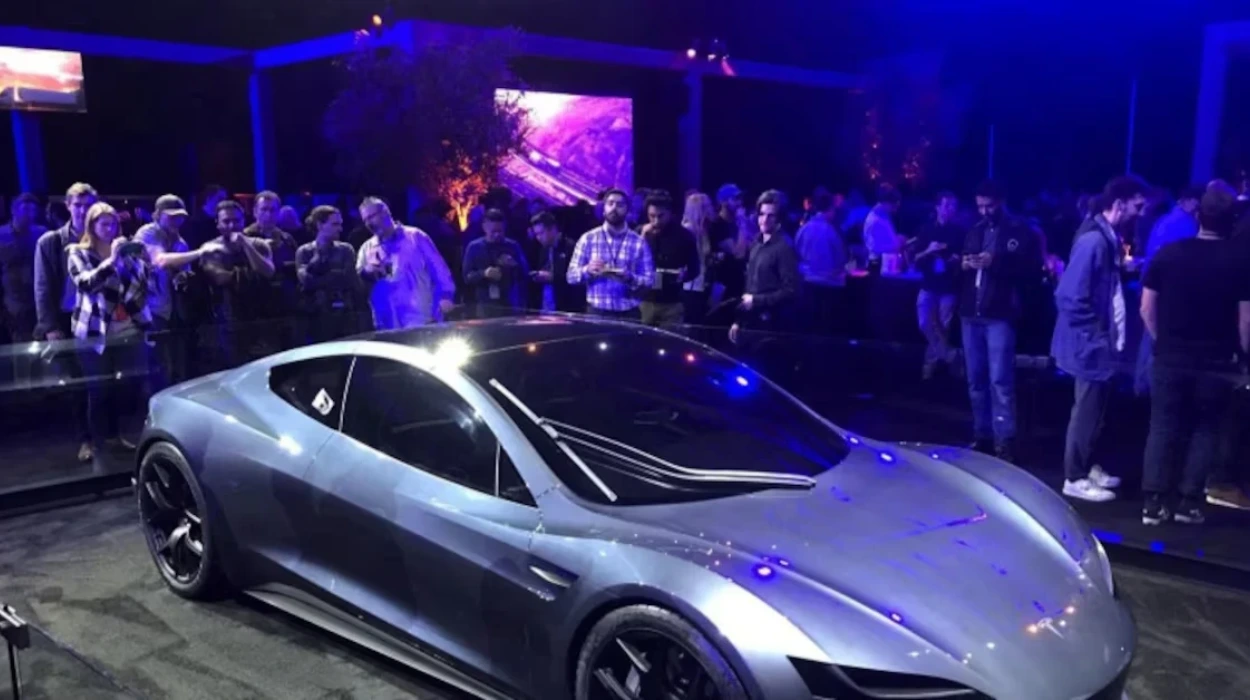
McGregor (Brussels Morning Newspaper) October 16, 2026 – Tesla Chief Executive Elon Musk has unveiled a prototype of the long-delayed second-generation Tesla Roadster, demonstrating flying capabilities powered by cold-gas rocket thrusters developed in collaboration with SpaceX. During an outdoor demonstration in Texas, the two-seater vehicle used ground-effect suction to drive upside down on an inverted ramp structure before deploying thrusters to execute mid-air rotations, vault over stationary automobiles, and make controlled landings. Commercial production of the sports car is planned for 2028, with pricing exceeding $200,000 and flight-capable variants subject to strict regulatory and road-use restrictions.
Remote-Controlled Thruster Demonstration at SpaceX Test Facility
Tesla Inc. hosted a live demonstration of its second-generation Roadster sports car at the SpaceX rocket development and testing facility in McGregor, Texas. The event, attended by media, investors, and brand supporters, showcased the vehicle performing aerial maneuvers using cold-gas rocket thrusters supplied by SpaceX.
During the presentation, the prototype vehicle was operated remotely to ensure safety. The demonstration featured a curved overhead ramp structure, which the vehicle navigated upside down using an integrated underbody fan system designed to generate ground-effect suction force exceeding 2G. Upon exiting the ramp, the vehicle engaged thrusters to elevate, rotate mid-air, leap across a line of parked Tesla production models, and return to the ground on its wheels.
Addressing the audience, Chief Executive Officer Elon Musk described the vehicle’s maneuverability and propulsion setup.
“Flying cars are real. It’s got altitude controls, thrusters and main thrusters in the rear. So it can basically fly like a rocket, it can do rolls, crazy gymnastics,”
Musk said during the presentation.
Technical Specifications and SpaceX Propulsion Engineering
The updated Roadster prototype incorporates technology derived directly from SpaceX aerospace designs. The propulsion system features rear-mounted main thrusters alongside attitude-control thrusters positioned around the chassis to stabilize the vehicle during aerial maneuvers.
According to performance figures released by Tesla, the vehicle is capable of accelerating from zero to 60 miles per hour in under one second—specifically 0.81 seconds for the top-tier configuration—with a projected top speed exceeding 230 miles per hour.
The underbody suction system utilizes internal fans to stick the car to surfaces, counteracting lift forces at high speeds or allowing inverted transit along specialized track structures. Elon Musk noted that the current iteration prioritized raw performance and experiential capabilities over standard vehicle safety conventions, remarking that the prototype was
“not necessarily a safety optimised car but it takes the fun meter to 11.”
Timeline, Production Schedule, and Deposit Structure
First announced as a concept in 2017, the second-generation Tesla Roadster has experienced multiple delays regarding its production timeline. Following Thursday’s demonstration, Tesla confirmed that serial production is currently targeted to commence in 2028.
Following the event, Tesla updated its global customer reservation system to reflect tiered deposit structures for the upcoming vehicle variants:
-
Standard Performance Variant: Base vehicle models carry a starting price in excess of $200,000 (£150,000), requiring a £50,000 deposit for expression-of-interest reservations in select regional markets.
-
Thrust Variant: Equipped with specialized cold-gas acceleration systems, this configuration requires a $250,000 deposit.
-
Rocket Variant: A single-seat iteration featuring a complete flight control and thruster system is listed as available exclusively via direct invitation.
Tesla updated its documentation to specify that operating the vehicle in full flight mode is strictly prohibited on public roadways.
Legal, Regulatory, and Public Road Constraints
The unveiling raised regulatory questions regarding the road-legality and airworthiness of thruster-assisted passenger vehicles. Existing motor vehicle regulations across international jurisdictions lack frameworks for non-standard propulsion systems, such as compressed-gas rocket thrusters, operating on public thoroughfares.
During the presentation, Elon Musk acknowledged the jurisdictional and regulatory barriers facing the vehicle’s flight systems.
“I’m not sure it’s necessarily legal in all jurisdictions,”
Transportation and aviation authorities have not issued official approvals for the operation of thruster-assisted ground vehicles on public roads or within controlled airspace. Consequently, high-altitude and airborne thruster functions remain restricted to private property and dedicated testing environments.
Strategic Implications and Market Context
The demonstration of the Roadster 2 comes at a period when Tesla is expanding its focus toward autonomous vehicles, artificial intelligence, and robotics, following the recent unveiling of its Cybercab robotaxi platform. Analysts from automotive and financial research firms observed that the collaboration between Tesla and SpaceX highlights shared engineering resources across Elon Musk’s corporate enterprises.
Market analysts noted that while the thruster-equipped Roadster showcases extreme automotive engineering, its immediate commercial applications remain limited due to cost, technical complexity, and legal hurdles. Tesla maintains that the vehicle serves as a flagship performance model designed to challenge the limits of electric vehicle drivetrain and acceleration capabilities.