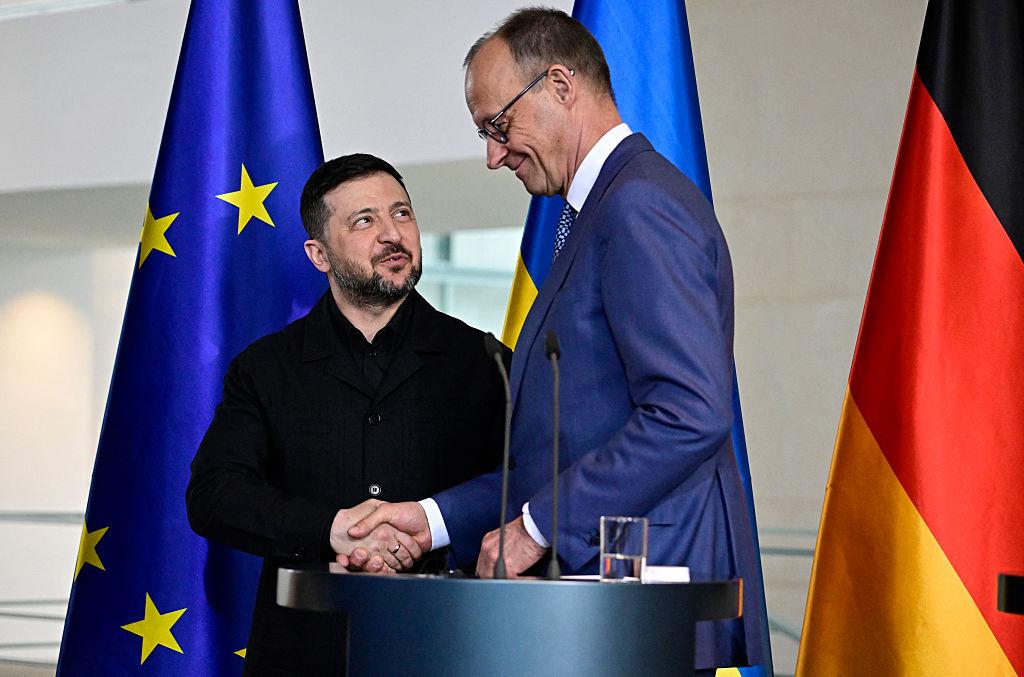
Berlin, 4 October, (Brussels Morning Newspaper) – Germany and Ukraine are expanding Germany-Ukraine weapons cooperation through long-range strike capabilities, defence investment and joint production, strengthening a military-industrial partnership that has grown significantly since Chancellor Friedrich Merz and Ukrainian President Volodymyr Zelenskyy announced new agreements in Berlin in May 2025.
The initiative is designed to increase Ukraine’s ability to manufacture its own long-range systems while drawing on German financing and industrial support. Berlin has kept key operational details confidential, including specifications and production volumes, citing security considerations.
Berlin backs Ukraine’s long-range strike production
The partnership took a significant step forward on 28 May 2025, when Merz announced that the German and Ukrainian defence ministers would sign a declaration of intent covering the procurement of Ukrainian-produced long-range weapons, described by Berlin as “Long-Range Fires”.
According to the German government, the systems would not be subject to German-imposed range restrictions. Merz presented the arrangement as the beginning of a new form of military-industrial cooperation between the two countries.
Ukraine’s presidential office separately said Germany had agreed to additional investment in Ukrainian defence manufacturing, including missile technology, drones and other long-range capabilities.
The strategy gives Kyiv another way to expand domestic production rather than depending solely on weapons transferred from the inventories of allied governments.
Germany keeps sensitive weapons details secret
Important technical details surrounding the Germany-Ukraine weapons programme remain classified or undisclosed.
German authorities have not publicly identified all the weapons manufacturers involved, the number of systems being produced or the maximum operational ranges of the weapons covered by the programme.
Merz subsequently confirmed that Germany and Ukraine were implementing long-range fire projects while explaining that the two governments had agreed not to reveal detailed information about the systems.
The secrecy also means the programme should not automatically be characterised as a German transfer of Taurus cruise missiles. Berlin has treated questions concerning Taurus separately and has declined to disclose sensitive details about some elements of its military assistance.
Joint defence projects broaden in 2026
German-Ukrainian defence cooperation has expanded beyond the original long-range initiative.
A strategic partnership declaration published following German-Ukrainian government consultations in April 2026 referred to contracts involving Ukrainian-designed Anubis long-range strike drones and Seth-X medium-range strike drones.
The declaration also covered additional air-defence cooperation and plans for a joint working group focused on strengthening defence-industry ties.
Ukraine announced another significant development in June, saying German and Ukrainian partners would cooperate on anti-ballistic capabilities and interceptor missiles. Kyiv said the initiative was intended to improve protection against ballistic missile attacks while contributing to Europe’s broader defensive capabilities.
Why the partnership matters for European defence
The expanding relationship has implications beyond the Ukrainian battlefield. Joint manufacturing can combine Ukrainian operational experience with German financing, engineering and industrial capacity while potentially increasing Europe’s ability to produce critical defence equipment domestically.
Germany has emerged as one of Ukraine’s major military supporters. Zelenskyy’s office said in May 2026 that German military assistance since Russia launched its full-scale invasion in February 2022 had reached more than €28.6 billion.
For European governments, the partnership also comes amid broader efforts to increase defence production, replenish military inventories and reduce industrial bottlenecks exposed by the war.
Long-range cooperation enters a deeper industrial phase
The next stage of Germany-Ukraine weapons cooperation is expected to remain focused on defence manufacturing, drones, missile technology, air defence and anti-ballistic capabilities.
However, detailed information about individual long-range systems may remain unavailable because Berlin and Kyiv have explicitly chosen to limit public disclosure of sensitive military projects.
What has been officially established is a broader industrial strategy: Germany is financing and supporting Ukrainian capabilities while the two countries increasingly pursue joint development and production rather than relying exclusively on conventional weapons transfers.
That approach could make the partnership an increasingly important component of Europe’s long-term effort to expand its defence-industrial capacity while Ukraine continues to strengthen its domestically produced long-range capabilities.