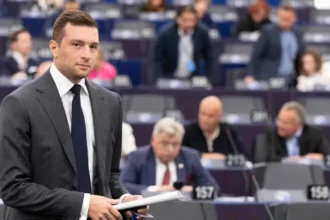
Washington, March 26, 2026 (Brussels Morning Newspaper) Houthi military threat is rapidly emerging as a defining factor in the escalating US-Iran conflict, coinciding with the resignation of a top counterterrorism official who stepped down in protest of current military strategy. The move has triggered alarm across intelligence circles, as Yemen’s Houthi forces signal readiness to support Iran if necessary.
- Rising Houthi Military Threat Alters Strategic Landscape
- Internal Divisions Deepen Within US Security Leadership
- Houthis Signal Readiness to Escalate Conflict
- Global Security Concerns Intensify
- Risk of Multi-Front Conflict Grows
- Diplomatic Efforts Under Pressure
- What Comes Next?
- Houthi Military Threat Signals Turning Point
The resignation underscores growing unease within national security leadership, where insiders suggest that the expanding Houthi military threat is complicating already fragile geopolitical dynamics. Officials warn that the situation is evolving faster than expected, with regional alliances becoming more aggressive.
“The expanding Houthi military threat is not just regional—it has global implications that policymakers cannot ignore,”
a senior analyst said.
Rising Houthi Military Threat Alters Strategic Landscape
The Houthi military threat has gained renewed attention following reports that the group is prepared to intervene directly in support of Iran. This development has raised fears of a broader regional conflict that could extend beyond traditional flashpoints.
Experts emphasize that the Houthis have significantly advanced their capabilities, including drone warfare and long-range missile strikes. Their involvement would likely expand the conflict into multiple fronts, increasing risks to key maritime routes and global trade.
The timing of the resignation has intensified speculation that intelligence assessments regarding the Houthi military threat may differ from public statements. Analysts believe the departure could reflect deeper concerns about the trajectory of current policies.
Internal Divisions Deepen Within US Security Leadership
As the Houthi military threat continues to grow, divisions within U.S. security leadership have become more apparent. Sources indicate that disagreements over how to address the evolving crisis have been ongoing for months.
The top counterterrorism official resigns at a moment when policymakers face mounting pressure to reassess their approach. Some insiders argue that the current strategy risks escalating tensions rather than containing them.
Others within the administration reportedly advocated for diplomatic engagement as a way to mitigate the Houthi military threat. However, those recommendations appear to have faced resistance amid calls for stronger military responses.
Houthis Signal Readiness to Escalate Conflict
The Houthi military threat is no longer viewed as a secondary concern. Regional sources confirm that the group has publicly signaled its willingness to support Iran if hostilities intensify.
This shift significantly raises the stakes. The Houthis have demonstrated their ability to target infrastructure and disrupt supply chains, particularly in the Red Sea region. Their involvement could have immediate and far-reaching consequences.
“If the Houthi military threat materializes into active engagement, the conflict could expand beyond control,”
a defense expert warned.
The possibility of coordinated actions between Iran and its allies adds a new layer of complexity to an already volatile situation.
Global Security Concerns Intensify
The resignation of a senior official amid the rising Houthi military threat is being closely watched by international allies. Such departures often signal deeper concerns within intelligence and defense communities.
Global leaders are increasingly worried about the potential for escalation. The involvement of additional actors could transform the conflict into a wider regional crisis with global repercussions.
Energy markets are particularly vulnerable. Any disruption linked to the Houthi military threat could impact oil supplies, shipping routes, and economic stability worldwide.

Risk of Multi-Front Conflict Grows
The expanding Houthi military threat has heightened fears of a multi-front conflict. The Middle East’s complex network of alliances means that any escalation could quickly involve multiple nations.
Strategists warn that even limited engagements could spiral into broader confrontations. The presence of advanced weaponry and evolving tactics further increases the risk of miscalculation.
The resignation of a top counterterrorism official highlights the seriousness of these concerns. It suggests that internal assessments may view the current path as increasingly dangerous.
Diplomatic Efforts Under Pressure
As the Houthi military threat continues to evolve, diplomatic efforts are facing significant challenges. International calls for restraint have intensified, but progress remains limited.
Trust between key players has eroded, making negotiations more difficult. Each new development adds pressure to an already strained diplomatic environment.
The resignation may also impact confidence in ongoing strategies. Leadership changes during crises can create uncertainty and disrupt policy continuity.
What Comes Next?
The Houthi military threat is likely to remain a central issue in the unfolding conflict. Analysts suggest that future developments will depend on both military actions and diplomatic initiatives.
If tensions continue to rise, the involvement of groups like the Houthis could reshape the region’s balance of power. This would have lasting implications for global security and economic stability.
Observers emphasize that the coming weeks will be critical. Decisions made now could determine whether the situation stabilizes or escalates further.
Houthi Military Threat Signals Turning Point
The growing Houthi military threat, combined with the resignation of a top counterterrorism official, marks a pivotal moment in the US-Iran conflict.
This development reflects deep concerns within security leadership and highlights the increasing risk of a broader regional confrontation. With the Houthis signaling readiness to act, the stakes have risen dramatically.
The world now faces a critical juncture, where strategic decisions will shape the future of global stability and security.