

Sofia (Brussels Morning Newspaper) January 13, 2026 – As of November 30, 2025, over 4.33 million non-EU citizens fleeing Ukraine held temporary protection status across the European Union, according to Eurostat data. Bulgaria registered 76,675 Ukrainians under this status, maintaining relative stability. Germany hosted the largest number at 1,241,000, followed by Poland with 968,750 and Czechia with 392,670.
- Country Breakdown of Ukrainian Temporary Protection Beneficiaries
- Recent Trends in Monthly Approvals and Increases
- Legal Framework and Recent Extension of Protection
- Demographic Composition of Beneficiaries
- Bulgaria’s Stable Role in Hosting Ukrainian Displaced Persons
- EU-Wide Data Reporting and Methodological Considerations
The total number of beneficiaries rose by 30,615, or 0.7 per cent, from the end of October 2025. Among 26 EU countries reporting data, 21 recorded increases, led by Germany with +11,040, Poland with +3,745, and Spain with +2,810. France and Lithuania saw the largest drops, at -870 and -575, respectively.
New temporary protection decisions in November totalled 53,735, down 32.5 per cent from September and 27.8 per cent from October. This decline returned approvals to pre-August 2025 levels, following Ukraine’s decree allowing men aged 18 to 22 to leave without restrictions.
Country Breakdown of Ukrainian Temporary Protection Beneficiaries
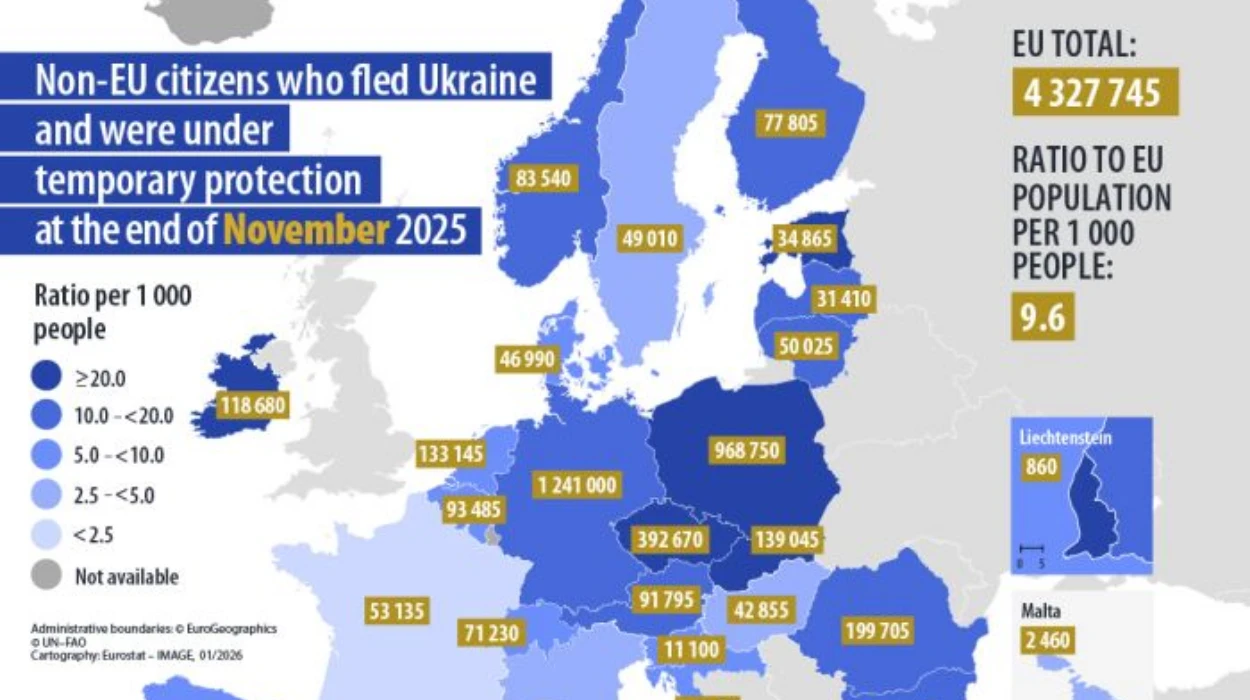
Germany accounted for 28.7 per cent of the EU total with 1,241,000 people. Poland held 22.4 per cent or 968,750, while Czechia had 9.1 per cent at 392,670. Bulgaria’s 76,675 placed it among significant hosts, with numbers stable month-on-month.
Other notable hosts included Spain, with increases noted, and countries like Italy, Romania, the Netherlands, and Slovakia exceeding 100,000 each in prior reports. Per thousand residents, Czechia led at 36.0, followed by Poland at 26.5 and Slovakia at 25.7, against an EU average of 9.6.
Ukrainians comprised over 98.4% of all beneficiaries. Adult women formed 43.6%, minors nearly one third at 30.7%, and adult men 25.7 %.
Recent Trends in Monthly Approvals and Increases

The November drop in new decisions followed peaks earlier in the autumn. September saw 79,205 approvals, the highest since 2023, linked to Ukraine’s border policy change for young men. EU aggregates for November estimated Luxembourg data from August.
Increases occurred in most countries, with Spain up 1.1 per cent. Decreases in France equated to -1.6 per cent, and in Lithuania, -1.1 %. Deregistration procedures vary by country, potentially causing fluctuations.
Legal Framework and Recent Extension of Protection
Temporary protection stems from Council Implementing Decision 2022/382 of March 4, 2022, addressing the mass influx due to Russia’s war against Ukraine. The scheme activates under Directive 2001/55/EC for displaced persons unable to return.
On June 13, 2025, the European Council extended protection from March 4, 2026, to March 4, 2027. This unanimous decision by interior ministers reaffirmed solidarity, allowing residence and work without standard asylum processes.
The extension covers over 4.3 million, providing stability amid ongoing conflict. It includes plans for transitions to other statuses and reintegration support.
Demographic Composition of Beneficiaries
Ukrainian nationals dominate at over 98.4 per cent. Adult women represent the largest group at 43.6 per cent, followed by minors at 30.7 per cent. Adult men account for 25.7 per cent, reflecting patterns since 2022.
Earlier data from June 2025 showed similar ratios: adult women 44.7 per cent, minors 31.2 per cent, men 24.1 per cent. France excludes minors in counts; Spain, Cyprus, and Greece include some expired statuses.
Bulgaria’s Stable Role in Hosting Ukrainian Displaced Persons
Bulgaria’s figure of 76,675 remained steady as of November 30, 2025. This positions it solidly among EU hosts, behind leaders but ahead of several others. Prior reports noted Bulgaria at higher levels, like 169,845 in older data, indicating adjustments.
The country features among those with notable per capita ratios historically, such as 26.1 per thousand in 2023. Current stability aligns with broader EU trends of gradual shifts.
EU-Wide Data Reporting and Methodological Considerations
Eurostat compiles data from member states via migr_asytpsm and migr_asytpspop datasets. Structures by age and sex exclude unknowns. Percentages may not sum to 100 due to rounding.
November lacks Luxembourg and Iceland data; EU totals estimate using Luxembourg’s August figures. Ongoing releases track the impacts of the Ukraine war on migration statistics. Temporary protection avoids overburdening asylum systems during mass influxes, prioritising efficient operation for applicants.