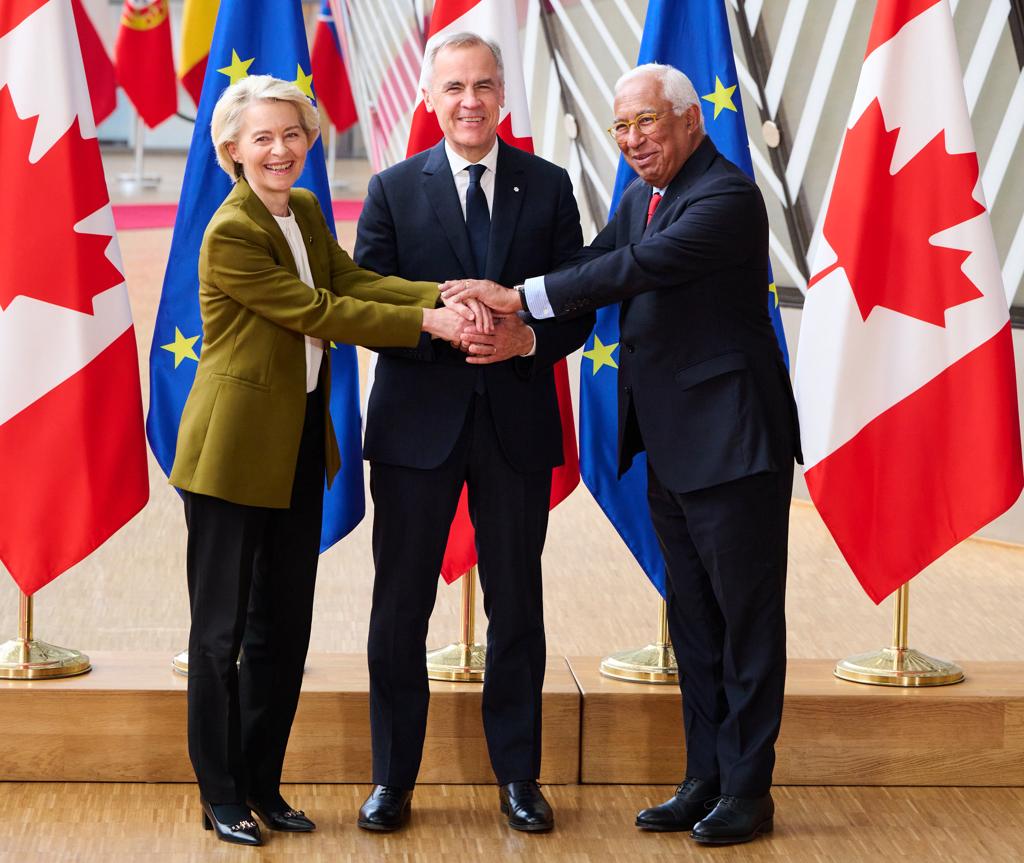
Montreal, Canada, 30 October, (Brussels Morning Newspaper) – European Union and Canadian leaders are holding a high-level EU–Canada summit in Montreal to strengthen cooperation on technology, trade, defence and economic security, as both sides pursue a more ambitious strategic partnership.
European Commission President Ursula von der Leyen, European Council President António Costa and Canadian Prime Minister Mark Carney are participating in the two-day meeting on 29–30 October.
The discussions focus on a proposed Alliance for the Future, intended to deepen economic ties, strengthen industrial competitiveness and expand cooperation on emerging technologies.
The initiative reflects growing efforts by both partners to strengthen their economic resilience and develop more secure international supply chains.
EU and Canada Prioritise Technology and Innovation
Technology cooperation is a central priority, with discussions covering artificial intelligence, quantum computing, cybersecurity and advanced digital infrastructure.
Canada has established expertise in emerging technologies and significant critical mineral resources, while the European Union offers extensive research capabilities, industrial expertise and access to a large single market.
Closer cooperation could support joint research, technological development and investment in strategically important industries.
The discussions build on the EU–Canada Digital Partnership established in November 2023, which provides a framework for cooperation on artificial intelligence, semiconductors, quantum technologies and digital governance.
Both sides have also explored stronger collaboration on secure connectivity, high-performance computing and digital innovation.
European Leaders Support Stronger Strategic Relations
European Council President António Costa welcomed the opportunity to deepen cooperation ahead of the Montreal meeting.
In an official statement published on 27 October, Costa said:
“The EU and Canada have long been close friends, major partners and strategic allies. Our bond is strong and it is growing stronger.”
The proposed Alliance for the Future is intended to strengthen political, economic and institutional cooperation between the partners.
Canadian Prime Minister Mark Carney has also emphasised the importance of developing international partnerships that support economic resilience and technological competitiveness.
However, the precise legal and institutional arrangements of the proposed alliance remain subject to further discussions.
EU–Canada Trade Reaches €130 Billion
Economic relations provide a substantial foundation for closer cooperation.
According to the European Council, bilateral trade in goods and services reached approximately €130 billion in 2025, representing growth of more than 80% compared with 2016.
The Comprehensive Economic and Trade Agreement, commonly known as CETA, has supported commercial relations since its provisional application began in September 2017.
Defence cooperation has also expanded.
During their June 2025 summit in Brussels, the EU and Canada signed a Security and Defence Partnership to strengthen cooperation on shared security priorities.
The latest discussions aim to build on these existing arrangements while exploring opportunities for greater industrial and technological integration.
Why the Alliance Matters for European Businesses
A stronger partnership could provide new opportunities for European manufacturers, technology companies, researchers and investors.
Cooperation on critical minerals could help strengthen supply chains supporting clean energy, advanced manufacturing and digital technologies.
Canadian companies could also benefit from closer research partnerships, investment opportunities and access to European industrial networks.
For European policymakers, the initiative forms part of wider efforts to diversify economic relationships and reduce vulnerabilities arising from international trade disruptions.
The practical economic benefits will depend on the commitments agreed and their subsequent implementation.
What Happens Next After the Montreal Summit?
The Montreal summit is scheduled to conclude on 30 October, with leaders expected to outline the next stage of cooperation in a joint statement.
The proposed Alliance for the Future could provide a framework for further negotiations covering technology, trade, defence and institutional cooperation.
However, specific implementation measures will depend on the summit’s final outcomes and any necessary follow-up decisions.
The discussions mark another stage in the development of EU–Canada relations, with both partners seeking closer cooperation amid changing international economic and security conditions.