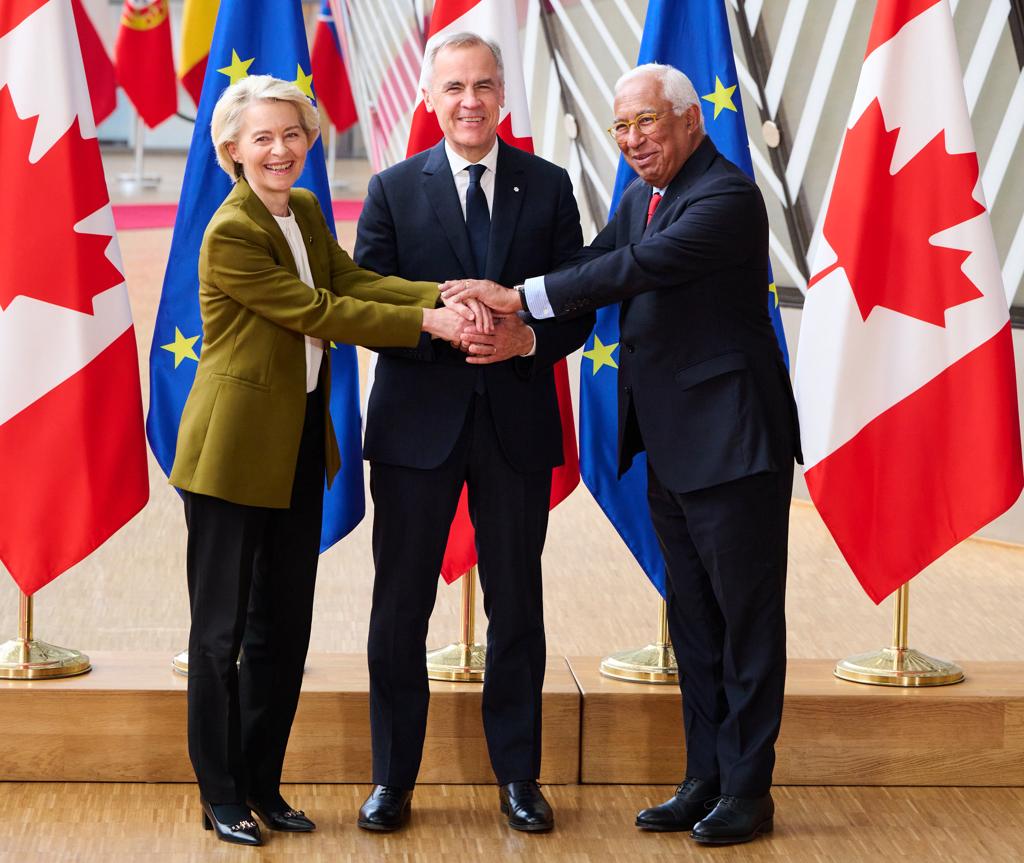
MONTREAL, Canada, 30 October, (Brussels Morning Newspaper) – The European Union’s proposal to establish an unprecedented partnership with Canada has encountered significant opposition from several member states, exposing divisions over how Brussels should strengthen relations with international allies without granting full EU membership.
The dispute over Canada EU ties has intensified during the EU-Canada summit in Montreal on 29–30 October, where European Commission President Ursula von der Leyen and Canadian Prime Minister Mark Carney are pursuing a broader political, economic and security partnership.
Germany, France, Italy and Greece raised objections to the proposed designation of Canada as an EU associate member, prompting negotiators to remove the controversial terminology from the summit declaration.
Despite the disagreement, European and Canadian leaders remain committed to expanding cooperation on trade, artificial intelligence, defence, energy and critical raw materials.
Germany Leads Opposition to Historic EU-Canada Proposal
The central disagreement concerns the legal and political implications of associate membership, a designation not formally established under existing EU treaties.
Germany has argued that European governments should first determine the practical responsibilities and benefits of a new partnership before agreeing to an institutional label.
France, Italy and Greece also questioned the wording during negotiations over the summit declaration.
Following diplomatic discussions, EU governments agreed to replace the proposed membership designation with a commitment to developing an “ever closer association” between Brussels and Ottawa.
The revised wording preserves the ambition for stronger cooperation while avoiding immediate commitments to a new membership structure.
Ursula von der Leyen Defends Stronger Partnership
European Commission President Ursula von der Leyen has continued to support a closer relationship despite objections from national governments.
Speaking in Montreal on 29 October, she said:
“Our idea is simple: it is an association without accession.”
She also argued that both partners could establish a relationship closer than previous arrangements with countries outside the EU.
Canadian Prime Minister Mark Carney has placed greater emphasis on the practical benefits of cooperation than on the proposed membership designation.
The discussions form part of a wider effort to strengthen economic security and reduce vulnerabilities in international supply chains.
EU-Canada Trade and Technology Cooperation Expands
The proposed alliance builds on longstanding economic relations between the European Union and Canada.
According to the European Council, bilateral trade in goods and services reached approximately €130 billion in 2025, representing an increase of more than 80% compared with 2016.
The Comprehensive Economic and Trade Agreement, known as CETA, has been provisionally applied since September 2017.
Both partners also cooperate on digital technologies, research, cybersecurity and innovation.
The Montreal summit includes discussions on critical minerals, energy security, defence procurement and opportunities for businesses and researchers.
These sectors have become increasingly important as European governments seek reliable international partners amid geopolitical uncertainty.
Why the Membership Debate Matters for Brussels
The disagreement highlights wider concerns about the European Union’s institutional framework and future enlargement policies.
Some governments fear that introducing an undefined membership category could create uncertainty for countries already pursuing EU accession, including Ukraine.
Others are concerned about the implications for existing European partners that maintain close economic relationships without joining the bloc.
For Canadian and European businesses, however, stronger cooperation could create opportunities in technology, manufacturing, research and strategic supply chains.
What Happens Next for Canada and the EU?
The 21st EU-Canada summit is scheduled to conclude on 30 October, with leaders expected to outline further commitments under their proposed Alliance for the Future.
Discussions on the precise scope of the partnership are expected to continue ahead of the next summit in 2027.
Although the associate membership designation has been excluded from the agreed draft declaration, von der Leyen has not abandoned the broader concept.
The immediate challenge for Brussels and Ottawa is to translate their shared political ambitions into practical agreements acceptable to EU governments.
The outcome could influence how the European Union develops strategic partnerships with countries beyond its borders.