Jerusalem (Brussels Morning Newspaper) October 19, 2026 – Severe funding shortfalls have forced the United Nations World Food Programme (WFP) to terminate monthly food assistance for 500,000 Palestinians in Gaza, reducing the agency’s overall reach from 1.6 million to 1.1 million recipients. The scaling back includes reductions in ration packages, community hot meals, and market cash stipends as winter approaches. With over two-thirds of the population facing acute food insecurity and limited economic activity, humanitarian officials warn that recent fragile gains against severe hunger are now at risk.
The United Nations World Food Programme (WFP) announced on Monday that critical funding deficits have compelled the organisation to drastically scale back its emergency food operations in the Gaza Strip. Starting this October, the agency has discontinued monthly food support to 500,000 Palestinians, dropping the total number of aid recipients in the enclave from 1.6 million to 1.1 million people.
The aid reduction arrives as total funding secured for the agency’s Palestinian operations in 2026 has dropped by more than half compared to prior years. WFP officials confirmed that the decision is driven entirely by a lack of financial resources rather than obstacles concerning physical or logistical access within the territory.
WFP Funding Deficits Force Nationwide Reductions in Assistance
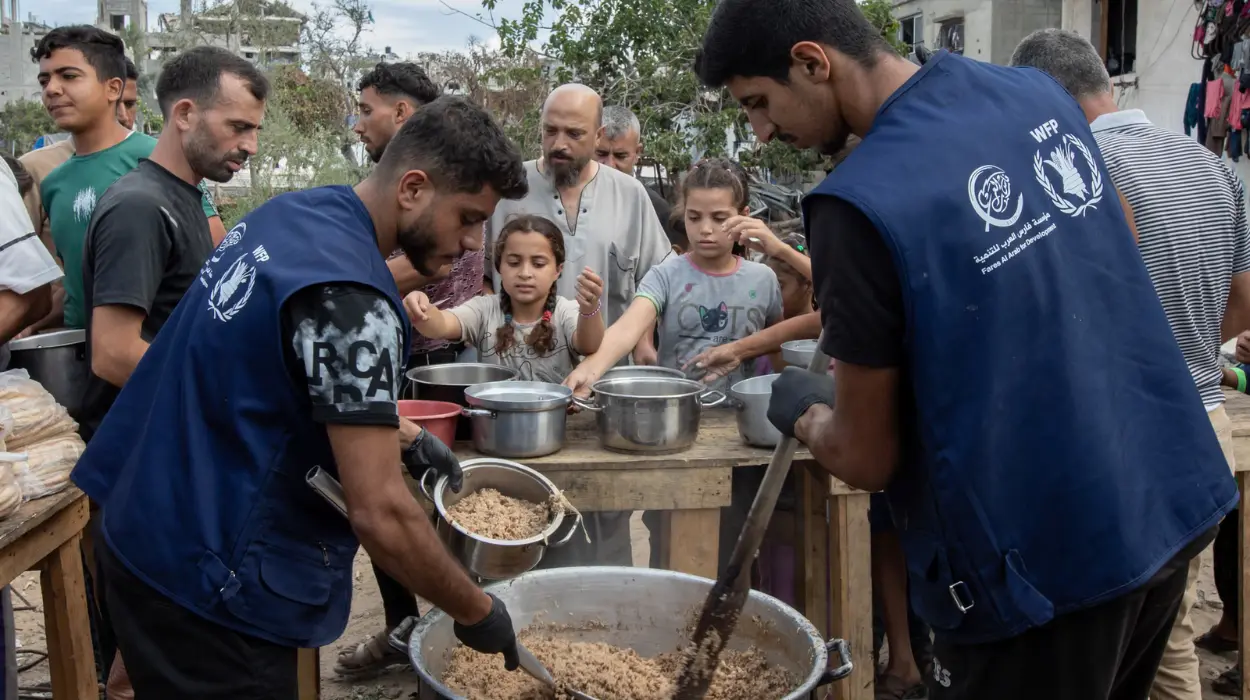
To adjust to the budget shortfalls, the WFP has implemented sweeping reductions across its core relief initiatives. Affected families are now receiving halved ration boxes—typically one package per household instead of two—alongside reduced quantities of wheat flour. The agency has also lowered its daily community kitchen distributions from 250,000 to 150,000 hot meals, while decreasing the monetary value of electronic cash vouchers allocated to 75,000 vulnerable families.
Despite the broad cutbacks, the agency confirmed it will maintain essential support for commercial bakeries supplying roughly one-third of Gaza’s bread requirements, alongside specialized nutritional support for 300,000 pregnant women, nursing mothers, and young children, and school meal distributions reaching 200,000 students.
“Now, rather than being able to sustain and scale up that assistance, we’re actually having to reduce it,”
said Shaun Hughes, WFP country director and representative for Palestine.
“And that’s not because we don’t have humanitarian access to deliver food; that’s because we don’t have funding. We’re going from assisting about 75 percent of the population with good and substantial rations to perhaps less than 50 percent of the population with smaller rations.”
The organisation stated that it urgently requires $450 million to maintain essential humanitarian operations across both Gaza and the occupied West Bank through the next six months.
Deteriorating Economic Conditions and High Unemployment In Enclave
More than a year after a ceasefire agreement took effect in late 2025, economic recovery in Gaza remains stagnant. Promised large-scale reconstruction initiatives led by international actors have not yet materialized, leaving broad swathes of the population entirely reliant on international food handouts for daily survival. United Nations data indicates that unemployment across the territory stands at approximately 80 percent, leaving most households without independent sources of income.
Local agricultural infrastructure, which previously made the territory self-sufficient in fruit and vegetable production prior to the outbreak of hostilities, remains largely disabled. Key greenhouse operations, irrigation networks, and farmland remain degraded or inaccessible. Furthermore, coastal fishing operations remain constrained due to ongoing maritime security restrictions enforced by the Israeli Navy, curtailing access to vital marine protein sources.
According to United Nations humanitarian assessments, approximately 67 percent of Gaza’s population—amounting to 1.4 million people—is currently experiencing crisis-level food insecurity, classified as Phase 3 or higher on the Integrated Food Security Phase Classification (IPC) scale. An estimated 200,000 people remain in IPC Phase 4, designated as an emergency level of hunger just short of famine conditions.
Long-Term Health Vulnerabilities and West Bank Reductions
Humanitarian evaluations highlight rising concerns for vulnerable groups, including infants and mothers, who face long-term health risks from chronic undernutrition. Surveys conducted by the United Nations Children’s Fund (UNICEF) reveal that one in eight children in Gaza suffers from chronic malnutrition or stunting, which can lead to permanent physical and cognitive development issues.
The funding crunch affecting the WFP extends beyond Gaza into the occupied West Bank. In September, the agency was forced to halve its aid coverage in the West Bank from 400,000 to 200,000 recipients, citing budget restrictions alongside rising local displacement and food insecurity.
Humanitarian administrators emphasize that emergency food distributions cannot serve as a permanent solution in the absence of sustainable economic recovery.
“We need to invest in recovery; this humanitarian operation isn’t affordable or sustainable in the long term,”
Hughes stated.
“Ultimately that’s also what everyone in Gaza is telling us. They really don’t want to be reliant on these handouts… They want to have some chance of stability and recovery.”