London (Brussels Morning Newspaper) October 19, 2026 – The Institute for Public Policy Research has published a report arguing that the United Kingdom cannot effectively address major geopolitical challenges without rejoining the European Union. The centre-left thinktank highlighted issues such as Russian aggression, political unpredictability in the United States, and growing assertiveness from China as key reasons for seeking full membership. The publication comes amid growing discussion within political circles regarding the UK’s long-term relationship with Europe.
Call for Full European Union Membership Amid Escalating Geopolitical Instability
The policy paper published by the Institute for Public Policy Research (IPPR) contends that attempting to navigate shifting global dynamics outside the European bloc leaves the United Kingdom at a significant strategic disadvantage. According to the report, individual bilateral agreements and incremental diplomatic adjustments are insufficient to secure British interests on the world stage.
Harry Quilter-Pinner, executive director of the IPPR, stated that while recent efforts to repair UK-EU relations were positive, they did not go far enough. He noted that membership in the European Union remains the optimal long-term path for the UK’s relationship with Europe, emphasizing that the process should focus on building political support at home and across continental Europe rather than calling for an immediate referendum.
Reassessing Strategic Autonomy and Previous Government Policy Frameworks
The IPPR paper explicitly critiques the policy framework previously set out by former Prime Minister Keir Starmer. Under that stance, the UK sought closer diplomatic and trade ties with Brussels while ruling out returning to the European single market, the customs union, or full EU membership. The thinktank asserts that maintaining absolute formal sovereignty without the practical capability to exercise influence does not equal strategic autonomy, characterizing hedging between larger global powers as a survival mechanism rather than a strategy for long-term national success.
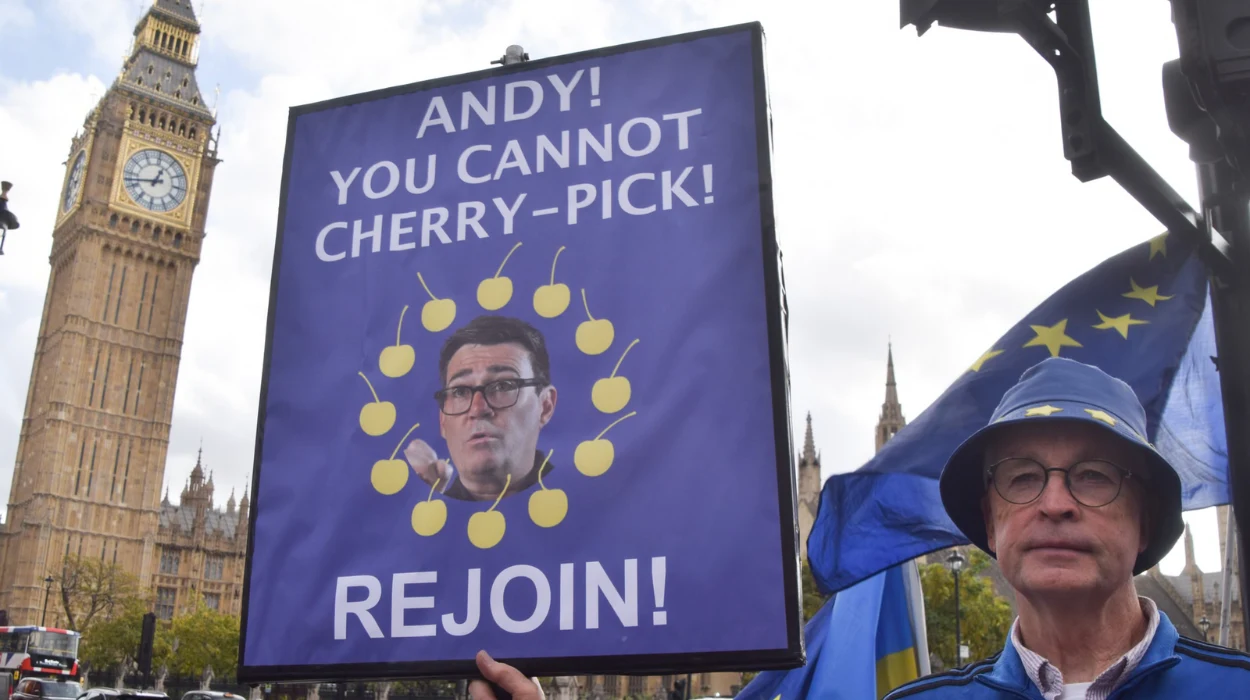
The proposal from the IPPR follows public statements from regional leaders, including Greater Manchester Mayor Andy Burnham, who recently indicated a desire to examine all available options regarding the UK’s future posture towards Europe. The publication also coincides with momentum generated by a similar report issued weeks earlier by the Tony Blair Institute, which urged British policymakers to prepare for re-entry into a reformed European Union.
Public Opinion Data and Emerging Drivers for European Union Alignment
Addressing potential domestic perceptions, the IPPR argues that returning to the bloc would not constitute a simple reversal of the 2016 vote or a return to the pre-2020 status quo. Given the extensive changes in the geopolitical landscape over recent years, the thinktank frames the proposal as becoming a member of a fundamentally transformed European Union.
To support its recommendations, the thinktank released new public opinion polling conducted by Persuasion UK. The survey indicates that 52 per cent of voters back rejoining the European Union, compared to 29 per cent who oppose re-entry. The data suggests that practical daily benefits, particularly the prospect of reduced processing times and shorter queues at European passport control checkpoints, rank among the most compelling incentives for voters, ahead of broad macroeconomic gains and the restoration of freedom of movement rights.
Proposed Strategic Roadmap and Intermediary Integration Measures
Laura Chappell, associate director at the IPPR, remarked that whether the focus is protecting households against cost-of-living volatility, revitalising industrial capacity, or ensuring national security, the UK lacks the independent scale to act effectively on its own. She added that in the current international climate, maintaining an outsider status in Europe hinders the nation’s ability to retain meaningful control over its own affairs.
To facilitate a gradual alignment, the IPPR outlines several intermediary measures prior to formal re-application. The recommendations include establishing a dedicated UK-EU industrial council, rejoining European defence framework initiatives such as the SAFE defence fund, and strengthening joint security, energy, and democratic resilience programs. The thinktank maintains that these incremental steps would allow the UK government to construct a solid foundation for full membership over time.