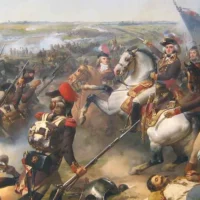

The Battle of Waterloo, fought on June 18, 1815, near the village of Waterloo in present-day Belgium, marked one of the most decisive moments in European history. This pivotal battle ended the rule of Napoleon Bonaparte and shaped the future contours of Europe for decades.
Introduction: The Final Clash of the Napoleonic Wars
After escaping exile on Elba in early 1815, Napoleon returned to power in France for a period known as the Hundred Days. Determined to reassert his dominance, he mobilized the French Army to confront the coalition forces arrayed against him.
The opposing side combined a British-led Anglo-allied army under the Duke of Wellington with Prussian forces commanded by Field Marshal Gebhard Leberecht von Blücher. Their coalition aimed to stop Napoleon’s resurgence before he could re-establish French hegemony over Europe.
The Battle of Waterloo was the culminating engagement of the Waterloo campaign a contest of strategy, stamina, and sheer will decisively ending Napoleon’s bid for power and marking the conclusion of the era of continuous European wars stretching back to the French Revolution.
Commanders and Forces Involved
The battle featured several key military leaders:
- Napoleon Bonaparte led the French Imperial Army, composed of about 72,000 troops infantry, cavalry, and artillery. His forces included experienced veterans loyal to him, but his command was stretched and some officers had limited cohesion from previous reorganizations.
- Arthur Wellesley, Duke of Wellington, commanded the Anglo-allied army of roughly 68,000 soldiers. This force was an uneasy coalition of British, Dutch, Belgian, Hanoverian, Brunswick, and Nassau troops. Wellington’s leadership capitalized on defensive tactics honed throughout the Peninsular War.
- Field Marshal Gebhard Leberecht von Blücher led the Prussian army of approximately 50,000 troops. Despite recent setbacks, the Prussian forces were experienced and well-led, playing a crucial role in the battle’s outcome.
Strategic Background: The Waterloo Campaign

The campaign began with Napoleon’s hope of striking quickly at the coalition armies, defeating them separately before they could unite. On June 16, 1815, his forces won a tactical victory against the Prussians at Ligny but failed to decisively destroy them. Simultaneously, Prussian forces withdrew in good order toward Wavre, maintaining communication with Wellington’s Anglo-allied forces.
Wellington’s army held the crucial crossroads at Quatre Bras, repelling French attempts to sever the Anglo-Prussian link. On June 17, both Wellington and the Prussians fell back to better defensible positions near Waterloo, awaiting reinforcements and preparing for the impending fight.
Terrain and Battle Positioning
Wellington chose to defend a ridge near the village of Mont-Saint-Jean, close to Waterloo. This ridge provided tactical advantage: the slope concealed his troops behind it (“reverse slope defense”), limiting French artillery and infantry effectiveness.
Key fortified positions including Hougoumont farmhouse, La Haye Sainte farmhouse, and the village of Papelotte anchored his flanks, creating strongpoints against French assault.
Napoleon’s forces approached from the south, forming lines along the Brussels road. Despite their numerical and cavalry strengths, French forces faced difficult terrain, heavy rain, and muddy conditions that hampered movements, particularly of cavalry and artillery.
The Battle Unfolds
The battle began late owing to the wet conditions. Napoleon launched initial attacks centered on Hougoumont, intended as a diversion to draw British reserves. However, this engagement escalated and drew in significant French resources throughout the day.
Next followed massive artillery bombardments from Napoleon’s “Grande Batterie,” targeting Wellington’s center and left flank. The French infantry then launched fierce assaults, notably those led by Marshal Ney’s corps against British and allied center and left. Wellington’s troops employed disciplined infantry formations and began pushing back French attacks despite heavy casualties and loss of generals such as Sir Thomas Picton.
Throughout the afternoon, French assaults continued but were increasingly countered and blunted by steadfast Anglo-allied infantry and artillery fire. The defense of La Haye Sainte and Hougoumont played outsized roles in preventing the French from breaking Wellington’s line.
The Arrival of the Prussians and the Imperial Guard’s Defeat
Napoleon expected to fight and defeat Wellington’s forces before the Prussians could intervene. However, the Prussian army, under Blücher, despite being previously defeated, managed to regroup and advance to Waterloo’s battlefield in time.
By late afternoon, massive Prussian forces began attacking Napoleon’s right flank, critically weakening French positions. The pressure from the Prussians, combined with Wellington’s resilient defense and timely counterattacks, turned the tide.
In a last-ditch effort, Napoleon committed his elite Imperial Guard to a decisive assault late in the evening. This was repulsed by furious British guard units and allied infantry fire. The failure of the Imperial Guard marked the collapse of French military resistance.
Aftermath and Legacy
The French army rapidly disintegrated under advance and pursuit from combined Anglo-Prussian forces. Napoleon abdicated four days later, ending his reign and the First French Empire. He was exiled to the remote island of Saint Helena, where he died years later.
Waterloo marked a milestone closing an era of nearly continuous European wars and ushered in a period referred to as the Pax Britannica a century of relative peace enforced by British naval supremacy. The battle’s legacy endures not only in history but in popular culture; “meeting one’s Waterloo” has become a byword for a final and decisive defeat.
The coalition victory also had wide geopolitical effects, reshaping the European order through the Congress of Vienna and influencing international diplomacy for decades.
The Battle of Waterloo was won by the allied coalition forces the Anglo-led army under the Duke of Wellington supported decisively by the Prussian army commanded by Field Marshal Blücher. The French, despite their valor and tactical efforts under Napoleon, ultimately succumbed to joint forces on terrain favoring Wellington’s defensive strategy and through the critical timing of Prussian reinforcements.
This decisive victory ended Napoleon’s final attempt to dominate Europe and set the stage for over a century of relative stability. Waterloo remains a symbol of coalition cooperation, military strategy, and decisive leadership in the face of overwhelming challenge.
Dear reader,
Opinions expressed in the op-ed section are solely those of the individual author and do not represent the official stance of our newspaper. We believe in providing a platform for a wide range of voices and perspectives, even those that may challenge or differ from our own. We remain committed to providing our readers with high-quality, fair, and balanced journalism. Thank you for your continued support.