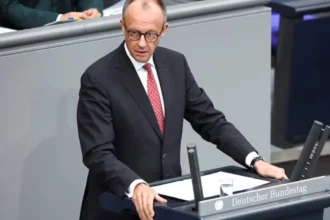
Berlin (Brussels Morning Newspaper) – German Chancellor Friedrich Merz stated on Thursday that he plans to urge the European Union to utilise Russian assets frozen in the West to issue a 140 billion euro loan to Ukraine, supporting its war effort at the upcoming EU summit.
“We do not want to do this in order to prolong the war, but to end it,”
Merz said in a speech to the Bundestag lower house of parliament.
“(Russian President Vladimir) Putin must realise that our support for Ukraine will not wane, but will grow, and that he cannot count on outlasting us.”
How will the EU use frozen Russian assets for Ukraine?
Currently, approximately $300 billion of Russian Central Bank assets are frozen internationally. A significant portion—around $229 billion—is held in the European Union, primarily through the Belgian clearing house Euroclear.
The sum would be made available to Ukraine as an interest-free loan that would be “repaid once Russia has compensated Ukraine for the damage” the war has caused.
According to reports, Ukraine would be restricted to using the funds solely for purchasing weapons, not for budgetary expenses. Payments to Kyiv would be dispersed in instalments, and EU member states, together with Ukraine, would decide which materials to procure.
How has Berlin shifted its stance on frozen assets?
In a September op-ed for the Financial Times, German Chancellor Friedrich Merz made a notable policy shift by calling on the EU to use $160 billion of frozen Russian assets to support Ukraine, particularly for continued weapon supplies.
Previously, Berlin hesitated to utilise the funds due to legal and financial worries. Merz, however, took a more direct approach, stating,
“This must not hold us back,” and encouraged the EU to think about “circumventing these ” obstacles and problems.”
Merz stated that these actions were essential to help Ukraine show ‘greater staying power” in the war, aiming to pressure the Kremlin into the negotiation table.
He also said,
“I am advocating the mobilisation of financial resources on a scale that will secure Ukraine’s military resilience for several years.”