
Greece (Brussels Morning) For decades, Greece struggled to articulate a clear sense of identity, a living continuity between its historical culture and the demands of the present. Today, however, interest in reconnecting with the past is no longer a uniquely Greek concern. Across Europe and beyond, history has returned to the centre of cultural, political, and strategic attention.
In this context, an increasing number of places where landmark historical events once unfolded are stepping up, crafting their own public diplomacy agendas. What Davos, a Swiss town of just 10,000 residents, so successfully established as a global benchmark, a small place turned into a powerful international brand, is now inspiring similar forums at the national and regional level, with ambitions that increasingly extend onto the global stage.
Τhe Thermopylae legacy
The Thessaloniki International Relations Forum, the Delphi Economic Forum, and, more recently, the Thermopylae Forum stand as compelling examples of how historically significant sites beyond a nation’s capital can shape social, diplomatic, and economic discourse. Thessaloniki long served as the crossroads of the Balkans; Delphi was once the nerve centre of Greek political life; and Thermopylae endures as a symbol of pride, an enduring lesson in integrity and collective responsibility.
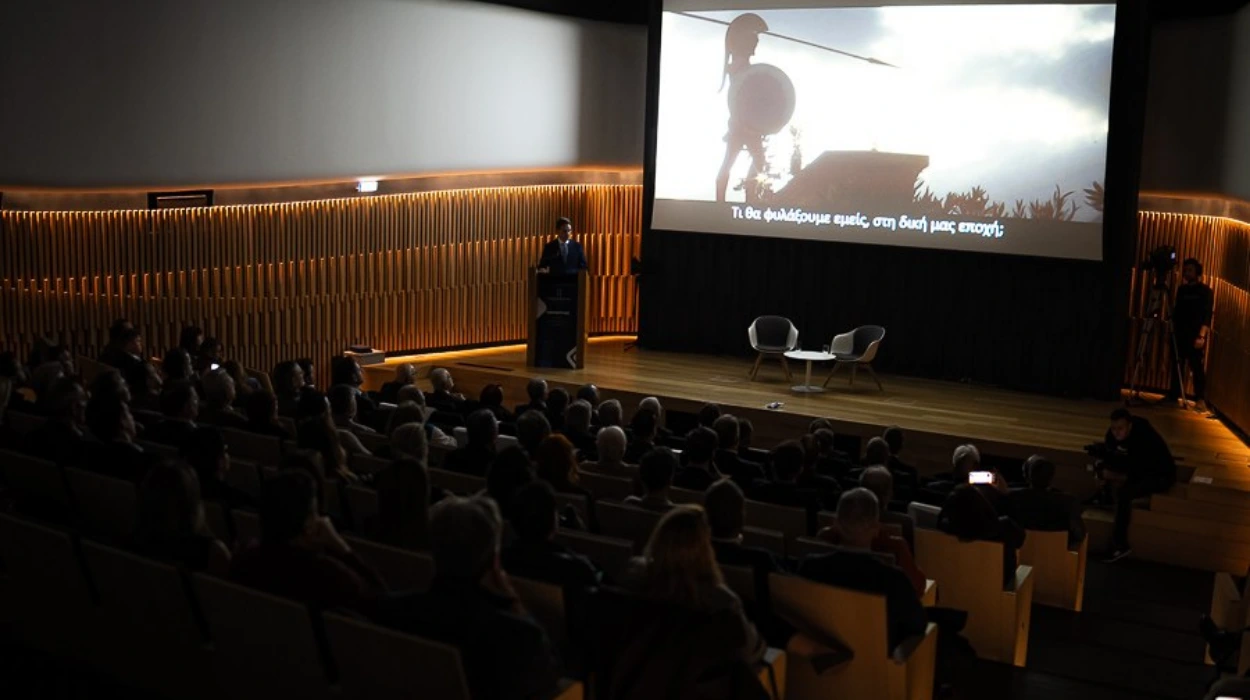
Such symbolic power was bound to be recognized. Its potential was simply too great to remain untapped. At the very site where Leonidas and his 300 Spartans made their stand against the vastly superior forces of the Persian Empire, a modern forum has taken root, one inspired by the same values of integrity, freedom, and courage that have come to define the Thermopylae legacy.
The forum’s growing profile has also drawn recognition from philhellenes across Europe, the United Kingdom, and the United States, where the Greek diaspora has been firmly established since the early 20th century. At its most recent gathering, the event was attended by Christos G. Marafatsos, chairman of Greek Americans for Trump and an adviser to the U.S. ambassador in Athens.
Mr. Marafatsos underscored the forum’s relevance to Greek-American relations and invited its organizers to present their vision in Washington. In remarks that blended history with contemporary politics, he likened President Trump to a modern-day Leonidas, framing the president’s agenda as an ongoing struggle for what he described as America’s political renewal.
A long-term public diplomacy footprint
Strategically, Thermopylae’s value is threefold: it internationalizes a distinctly Hellenic narrative at moments of geopolitical competition; it converts symbolic capital into convening power and policy output; and it leverages diaspora linkages to channel influence into Washington and European capitals. As small places like Davos and Delphi have shown, the soft power of place can be engineered, and Thermopylae is now a deliberate, growing example of that craft.
Beyond rhetoric, the forum has translated symbolism into programming: annual conferences, workshops and satellite events that connect local stakeholders with international practitioners and diasporic communities, aiming to project regional priorities onto a broader geopolitical stage.
Thermopylae’s appeal for European audiences lies in its capacity to root transnational challenges, security, democratic renewal, sustainable growth, in a localized narrative that resonates across the continent. By echoing models used by other successful regional fora and satellite events, organizers amplify Greece’s cultural diplomacy while fostering pragmatic policy exchanges.
Dear reader,
Opinions expressed in the op-ed section are solely those of the individual author and do not represent the official stance of our newspaper. We believe in providing a platform for a wide range of voices and perspectives, even those that may challenge or differ from our own. We remain committed to providing our readers with high-quality, fair, and balanced journalism. Thank you for your continued support.