
The EU hosts a vast and varied agricultural sector composed of approximately 9.1 million agricultural holdings. Despite a steep decline in farm numbers—down 37% between 2005 and 2020—the amount of land used for farming remains stable at around 157 million hectares, which is about 38% of the EU’s total land area. These farms vary widely in size and type, ranging from very small family-run plots to large commercial enterprises.
- Which Country is the Biggest Agricultural Producer in the EU?
- Characteristics of the Biggest Agricultural Producer: France
- Other Major Agricultural Producers in the EU
- Trends and Distribution of Farms in the EU
- Farm Types by Specialization
- The Economic Footprint of EU Agriculture
- Challenges and Future Directions
Family farms dominate the EU’s agricultural scene, accounting for around 93% of all holdings. Most farms are relatively small; nearly two-thirds cover less than 5 hectares, particularly prevalent in countries like Romania, Malta, Cyprus, and Greece. However, it is the larger farms—those over 50 hectares—that manage the majority of the EU’s utilized agricultural area, reflecting an ongoing consolidation trend where fewer but larger farms manage more land.
Which Country is the Biggest Agricultural Producer in the EU?
When it comes to agricultural output and land use, France is the biggest agricultural producer in the European Union. France leads with the largest utilized agricultural area (UAA), covering approximately 27.4 million hectares, which represents around 17.4% of the total agricultural land in the EU. This extensive land base supports a diverse and productive agricultural sector, encompassing both crop farming and livestock.
Following France in agricultural production are Spain and Germany, with Spain covering about 23.9 million hectares (15.2% of EU agricultural land) and Germany with 16.6 million hectares (10.5%). These countries form the core of European agricultural output, contributing a significant share of the EU’s food and raw material supply.
Characteristics of the Biggest Agricultural Producer: France
France’s agricultural dominance stems from several factors:
- Large Land Area: France has the largest farming area in the EU, enabling high-volume crop production and extensive livestock rearing.
- Diverse Farming Types: French farms vary from large-scale cereal and oilseed production in the north, to wine and fruit cultivation in regions like Bordeaux and Burgundy, as well as mixed livestock farming.
- Developed Agricultural Economy: French agriculture benefits from advanced infrastructure, technologies, and well-established supply chains that maximize output efficiency.
- Family Farms and Larger Enterprises: While family farms comprise the majority, France also has a significant share of non-family and larger corporate farms, which contribute disproportionately to total output.
Other Major Agricultural Producers in the EU
Besides France, the agricultural powerhouses of Italy, Poland, and Spain occupy significant roles. Italy, with 12.5 million hectares of utilised agricultural area, is renowned for horticulture, vineyards, and olive groves, producing high-value crops. Poland, with 14.8 million hectares, has witnessed a modernization wave driving increased productivity, especially in cereals and animal farming.
Spain’s agricultural sector is notable for its Mediterranean climate crops such as citrus fruits, olives, and vegetables, along with significant livestock production in regions like Catalonia and Andalusia.
Trends and Distribution of Farms in the EU
The European Union’s farms can be broadly classified into three main categories. Firstly, semi-subsistence farms are small holdings primarily focused on producing food for the farmers’ own consumption and are especially common in eastern European countries. Secondly, small and medium family farms predominate across much of Europe; these are typically family-run businesses that blend traditional farming methods with modern techniques.
Lastly, large agricultural enterprises, although fewer in number, are highly productive commercial farms or cooperatives that contribute most significantly to the EU’s overall agricultural output. In countries with vast agricultural areas such as France, Germany, and Denmark, these large farms tend to dominate the landscape and are responsible for a substantial share of total production.
Farm Types by Specialization
Farms across the EU exhibit distinct specialization patterns influenced by regional climates and geography. Nearly six in ten farms primarily focus on crop production, with field crops such as cereals, root vegetables, and oilseeds being the most common. Permanent crops like vineyards, orchards, and olive groves are prevalent in Mediterranean member states, reflecting the favorable climate for such cultivation.
In contrast, livestock farming is more widespread in northwestern Europe, including countries like Ireland and the Netherlands, where dairy, cattle, pig, and poultry production dominate. Complementing these specialized farms are mixed operations that combine both crop cultivation and livestock rearing, providing a diverse agricultural landscape throughout the EU.
The Economic Footprint of EU Agriculture
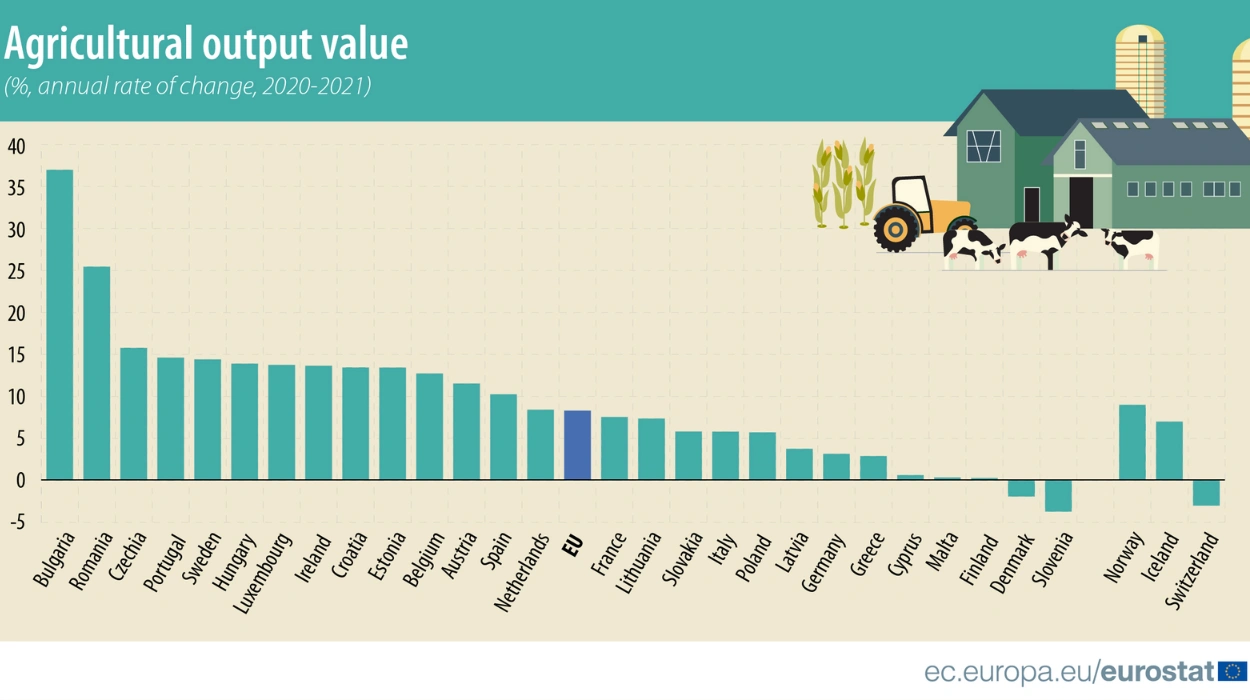
Despite the decline in numbers of farms, agricultural production remains economically robust. In 2020, the combined agricultural output of France, Italy, Germany, and Spain accounted for over 60% of the EU’s total agricultural production value. Large farms, although a small proportion of total holdings, generate more than half of the EU’s agricultural economic output, reflecting efficiencies of scale and investment.
Challenges and Future Directions
Agriculture in the EU faces multiple challenges, including climate change, sustainability demands, rural development needs, and global market pressures. The Common Agricultural Policy (CAP) plays a critical role in steering agricultural transformation towards greener, more competitive, and innovative farming systems.
As part of this, efforts focus on environmental care, biodiversity protection, and supporting generational renewal among farmers.France stands as the largest agricultural producer in the European Union, managing approximately 27.4 million hectares of farmland, which accounts for 17.4% of the EU’s total agricultural land. France, Spain, Germany, Italy, and Poland are also key players in the EU’s agricultural sector.
While family farms constitute the majority of agricultural holdings, it is the larger commercial farms that contribute the most to overall production output. Farming within the EU is regionally specialized, with activities varying between crop cultivation, livestock rearing, and mixed farming systems depending on local conditions.
Despite a noticeable decline in the number of farms over recent years, the total agricultural land use has remained relatively steady due to consolidation into larger holdings. Agriculture remains a critical sector for the EU economy, supporting rural communities and ensuring food security across the region.
Dear reader,
Opinions expressed in the op-ed section are solely those of the individual author and do not represent the official stance of our newspaper. We believe in providing a platform for a wide range of voices and perspectives, even those that may challenge or differ from our own. We remain committed to providing our readers with high-quality, fair, and balanced journalism. Thank you for your continued support.