
Brussels (Brussels Morning) – EU Parliament committee approves draft law mandating large businesses to monitor supply chains for forced labour and environmental harm, aiming for ethical commerce.
A committee of lawmakers in the European Parliament on Tuesday approved a draft law requiring large businesses in the bloc to check if their supply chains employ forced labour or cause environmental damage.
The rules, understood as the Corporate Sustainability Due Diligence Directive, have been watered down by EU states to overwhelm a lack of support from Germany and other member countries, concerned about piling red tape on companies.
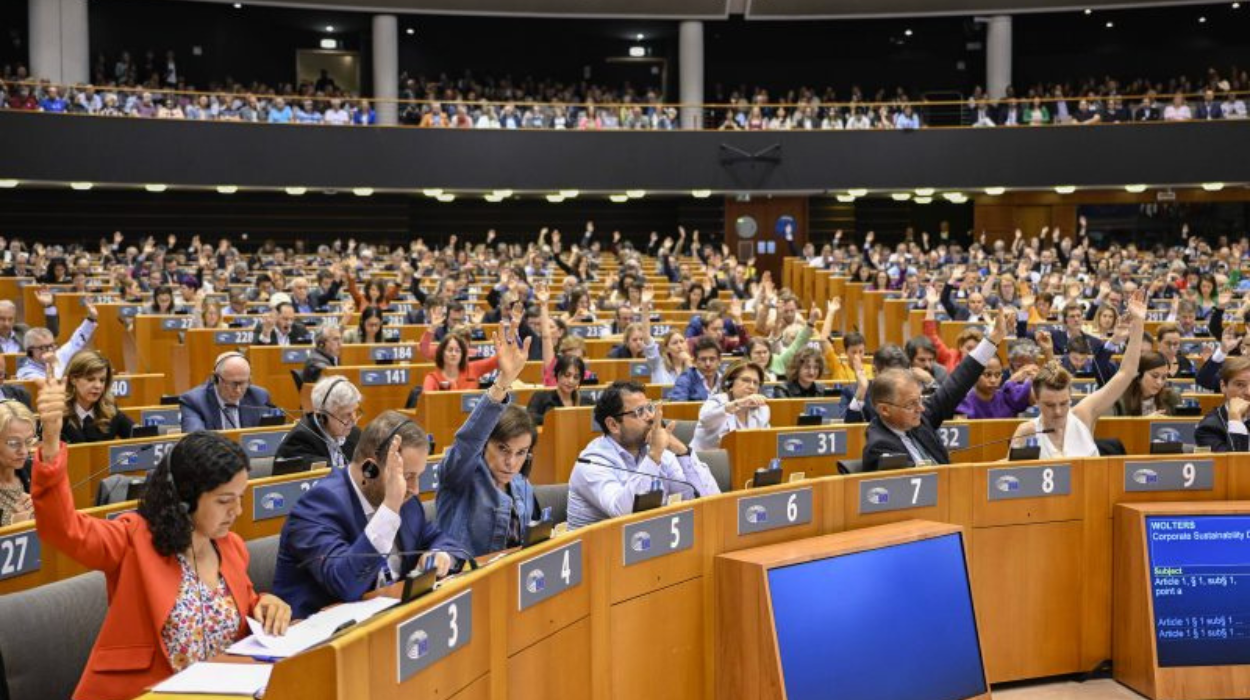
The legal affairs committee voted 20 in acceptance, 4 against and no abstentions, on the scaled-back version approved by EU states last week. Full parliament is anticipated to approve the deal on April 24.
“It is high time that this lawmaking is adopted, to stop corporate misusage and to give companies clarity in what is anticipated of them,” stated Lara Wolters, a centre-left Dutch lawmaker on the committee who conducted negotiations with EU states on the draft law. “I’m looking forward to the full vote and confident that it will be adopted swiftly.”
The rules are expected to come into force in 2028, involving companies operating in the EU that have more than 1,000 workers and a net worldwide turnover above 450 million euros. The rules initially sought to target businesses with more than 500 employees and a turnover of 150 million euros.
The provision to prevent, stop or mitigate harm to human rights and the atmosphere, such as child labour and biodiversity upset, applies to a company’s “upstream” associates in design or manufacture, and “downstream” partners who charm, store and spread products.
Financial companies, however, will only have to suppose”upstream” partners in their reviews. An earlier draft had also contained some downstream activities. Companies will have to schedule plans setting out how they resolve the transition to a low carbon economy, including deadlines for fulfilling targets, with key activities and investments required to reach them. Penalties for not conceding with the rules can include penalties of up to 5% of net worldwide turnover.
On 15 March, European Union governments supported a law requiring big companies in the bloc to check their supply chains for forced labour or environmental harm. Italy’s switch helped achieve a ‘qualified majority’ of 15 EU countries, with no objections, to move the corporate sustainability due diligence directive (CSDDD) to a final European Parliament vote.
Belgium, holding the EU presidency, faced challenges securing backing previously, but Italy’s involvement in complex negotiations, including packaging waste laws, led to consensus. The law, praised by Anti-Slavery International, aims to combat forced labour affecting over 20 million globally. EU lawmaker Lara Wolters called it a step towards justice, though Germany’s Free Democrats opposed, fearing bureaucratic burden.
The European Parliament’s advancement of the Corporate Sustainability Due Diligence Directive signifies a significant step towards corporate accountability. The draft law, aimed at large businesses, mandates monitoring of supply chains to curb forced labour and environmental damage, aligning with ethical commerce goals.
Despite initial concerns and amendments to address red tape worries, the law received overwhelming support from EU states. This move, expected to be finalized on April 24, emphasizes the importance of transparency and responsibility in business practices. With penalties for non-compliance set to ensure adherence, the directive underscores the EU’s commitment to protecting human rights and the environment while fostering sustainable economic growth.