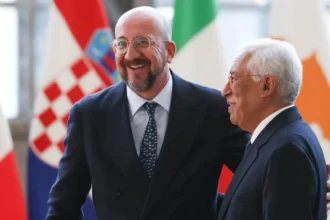

Brussels (Brussels Morning Newspaper) – European Council President Antonio Costa on Monday rejected any US attempts to interfere in Europe’s politics, following Washington’s release of a new security strategy that sharply criticised the continent’s policies.
Last week, the new US National Security Strategy criticised Europe as over-regulated and censorious, accusing it of lacking ‘self-confidence’ and risking ‘civilizational erasure’ due to immigration.
“What we cannot accept is the threat to interfere in European politics,”
Costa told a conference in Brussels, AFP reported.
Honoré d’ouvrir la conférence annuelle de @DelorsInstitute. Une occasion de faire le bilan de ma première année de mandat et de discuter des défis qui attendent l’UE: situation en Ukraine, compétitivité, élargissement, engagement avec le reste du monde. https://t.co/Vl9nBxm6gt
— António Costa (@eucopresident) December 8, 2025
What role does freedom of information play in Costa’s critique?
“The US cannot replace European citizens in choosing which parties are good and which are bad,”
Costa said.
“There can be no freedom of expression without freedom of information,”
and added,
“Freedom of expression cannot exist if citizens’ access to information is sacrificed to protect American tech oligarchs.”
He further said that there were long-standing differences with the Trump administration on matters such as climate change, but the new strategy “goes beyond that”.
“This strategy continues to talk about Europe as an ally. That’s fine, but if we are allies, we must act as allies,”
he said.
“The US remains an important ally, the US remains an important economic partner, but Europe must be sovereign.”
Why does Costa find Russia’s backing of the US peace proposal for Ukraine concerning?
Costa also noted that Russia’s acceptance of Washington’s new outlook as “largely consistent” with its own vision was a concerning sign.
He stated that the strategy’s approach to the war in Ukraine did not align with Europe’s longstanding goal of pursuing a “just and durable” peace.
“It is only for the end of confrontations and stable relations with Russia,”
he said.
How is Von der Leyen responding to US pressure on Ukraine?
Similarly, Ursula von der Leyen, European Commission President, has criticised the US approach to the Ukraine peace plan multiple times in late 2025, emphasising non-negotiable principles like Ukraine’s territorial integrity, no military reductions, and Europe’s central role in any deal.
On November 23, 2025, von der Leyen stated Ukraine’s borders cannot be changed by force, or its army reduced, rejecting elements of the US-Russia 28-point proposal seen as favouring Moscow. She outlined three conditions at the G20 summit: respect for borders, no limits on Ukraine’s forces, and EU involvement, amid US pressure on Kyiv.