
Bogotá, 2026 — Streets across Colombia have filled with demonstrators after President Gustavo Petro urged citizens to mobilize against what he described as mounting pressure and threats from Washington. According to reporting highlighted by Brussels Morning Newspaper, the demonstrations represent one of the most significant moments of civic mobilization in recent Colombian history. At the center of the unfolding debate is Colombia protests US policy, a phrase that has quickly come to define both the political moment and the wider recalibration of Colombia’s relationship with the United States.
What began as a political statement from the presidency rapidly evolved into mass action, drawing tens of thousands into public squares. The protests are not only about diplomacy but also about national identity, sovereignty, and Colombia’s future direction in a changing global order.
Background to Colombia US Relations
For decades, Colombia and the United States maintained one of the closest partnerships in Latin America. Cooperation on security, trade, and counter narcotics policy shaped bilateral relations, particularly during the late twentieth and early twenty first centuries.
However, President Petro has questioned many of these long standing frameworks. His administration argues that past strategies failed to deliver social justice or lasting peace. This shift has laid the groundwork for Colombia protests US policy, as supporters believe the country must redefine its global posture on its own terms.
Petro’s Call for Demonstrations
In a nationally broadcast speech, Petro called for peaceful demonstrations, framing public protest as a democratic tool rather than an act of hostility. He emphasized that Colombians should defend sovereignty without resorting to violence.
By explicitly encouraging street mobilization, Colombia protests US policy moved from civil society into the heart of state discourse. The president’s message resonated strongly with labor unions, student groups, and rural organizations that have long advocated for a more independent foreign policy.
Scale and Geography of the Protests
Demonstrations erupted simultaneously in Bogotá, Medellín, Cali, Barranquilla, and smaller regional capitals. In Bogotá, Plaza Bolívar became the symbolic epicenter, with crowds waving Colombian flags and chanting slogans calling for dignity and independence.
Observers noted that Colombia protests US policy drew participants from diverse social backgrounds, including students, public sector workers, indigenous groups, and small business owners. The breadth of participation suggested that the issue cut across traditional political divisions.
Domestic Political Reactions
The protests have sharply divided Colombia’s political class. Progressive parties and left leaning movements praised the demonstrations as an expression of popular sovereignty. They argue that public mobilization strengthens democracy by forcing transparency in foreign policy decisions.
Opposition leaders, however, accused Petro of politicizing diplomacy. Critics warned that Colombia protests US policy could undermine investor confidence and distract from domestic challenges such as inflation, unemployment, and public security.

Security and Policing Response
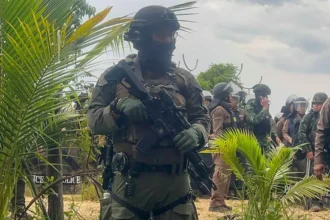
Authorities deployed police to manage crowds, emphasizing de escalation and crowd control rather than force. Officials reported minimal violence, reinforcing the government’s insistence on peaceful demonstration.
The orderly nature of events strengthened the legitimacy of Colombia protests US policy, countering claims that the mobilization would descend into chaos or unrest.
Economic Implications
Colombia’s economy is deeply linked to the United States through trade, investment, and financial flows. Business leaders expressed concern that prolonged diplomatic tension could affect exports, currency stability, and foreign direct investment.
Economists caution that while Colombia protests US policy may energize domestic politics, sustained confrontation could carry economic costs if not carefully managed through diplomatic channels.
Impact on Security Cooperation
One of the most sensitive aspects of bilateral relations is security cooperation. The United States has long supported Colombia’s military and police in combating organized crime and armed groups.
Analysts say Colombia protests US policy raises questions about how future cooperation will be structured. Petro’s government has signaled interest in shifting away from militarized approaches toward social investment and rural development.
Regional Context in Latin America
The protests reflect a broader regional trend. Across Latin America, governments are reassessing relationships with Washington, seeking greater autonomy in economic and diplomatic decision making.
In this context, Colombia protests US policy is viewed by regional observers as part of a wider movement challenging traditional power dynamics in the Western Hemisphere.

International Diplomatic Reactions
International response has been cautious. US officials emphasized continued partnership and dialogue, avoiding escalation. Several Latin American leaders expressed understanding of Petro’s stance, while urging restraint.
European diplomats highlighted the importance of stability, noting that Colombia protests US policy underscores the need for respectful engagement between allies.
Role of Social Media and Digital Activism
Social media platforms played a crucial role in organizing and amplifying demonstrations. Videos and images from protests spread rapidly, shaping national and international narratives.
Online discourse has ensured that Colombia protests US policy remains visible beyond physical demonstrations, influencing public opinion and media coverage.
Media Framing and Narrative Competition
Domestic media outlets offered contrasting portrayals. Some framed the protests as a democratic awakening, others as political spectacle. International coverage often contextualized the demonstrations within broader Latin American shifts.
Through headlines and commentary, Colombia protests US policy has become shorthand for a deeper debate about sovereignty and globalization.
Civil Society and Grassroots Voices
Civil society organizations emphasized that protests should lead to dialogue rather than confrontation. Many groups called for inclusive discussions on foreign policy, trade, and development priorities.
For grassroots activists, Colombia protests US policy represents an opportunity to reshape national priorities from the bottom up.
Youth and Student Participation
Students played a prominent role in demonstrations, reflecting generational attitudes toward foreign policy and global engagement. Many young Colombians view sovereignty and social justice as interconnected issues.
Their participation reinforced the idea that Colombia protests US policy is as much about the future as it is about current diplomatic disputes.
Historical Comparisons
Colombia has experienced waves of protest before, often centered on economic reform or peace processes. What distinguishes the current moment is its focus on foreign policy.
Historians note that Colombia protests US policy marks a rare instance where international relations become the primary driver of mass mobilization.

One Key Quote
One political sociologist observed,
“These demonstrations show that foreign policy is no longer an elite conversation but a public one shaped by collective voice.”
Term Political Consequences
The protests may reshape how future governments approach diplomacy. Public opinion has become a visible factor in foreign policy decisions, limiting room for unilateral action.
Whether Colombia protests US policy results in concrete policy change or remains symbolic will depend on negotiations and domestic consensus.
Risks of Escalation
Despite largely peaceful demonstrations, analysts warn of risks if rhetoric escalates. Miscommunication or economic retaliation could deepen divisions.
Managing the aftermath of Colombia protests US policy will require careful diplomacy and political restraint on all sides.
Opportunities for Dialogue
Supporters argue that protests create leverage for renegotiating terms of cooperation with the United States. They see civic pressure as a catalyst for more balanced relations.
If channeled constructively, Colombia protests US policy could open space for renewed dialogue grounded in mutual respect.
When Public Protest Redraws Foreign Policy Lines
The demonstrations sparked by President Petro’s call have transformed Colombia’s political landscape. By bringing foreign policy into the streets, citizens have asserted a direct role in shaping international relations.
As Colombia protests US policy continues to influence debate, Colombia faces the challenge of balancing assertiveness with pragmatism. The outcome will shape not only bilateral relations with Washington but also Colombia’s role in a rapidly evolving global order.