Brussels, 26 October, (Brussels Morning Newspaper) – The City of Brussels has announced a major Brussels square redesign following a tree collapse during Storm Austen that injured three people near the historic Grand-Place. The redevelopment will introduce additional greenery, improve pedestrian conditions and address safety concerns after municipal authorities removed the remaining trees from the square.
- Storm Austen Tree Collapse Injures Three in Central Brussels
- Brussels Officials Confirm Major Green Redevelopment
- Officials Defend Emergency Tree Removal Decision
- Environmental Groups Question Brussels Tree Policy
- Why the Square Redevelopment Matters for Brussels
- What Happens Next for the Brussels Square?
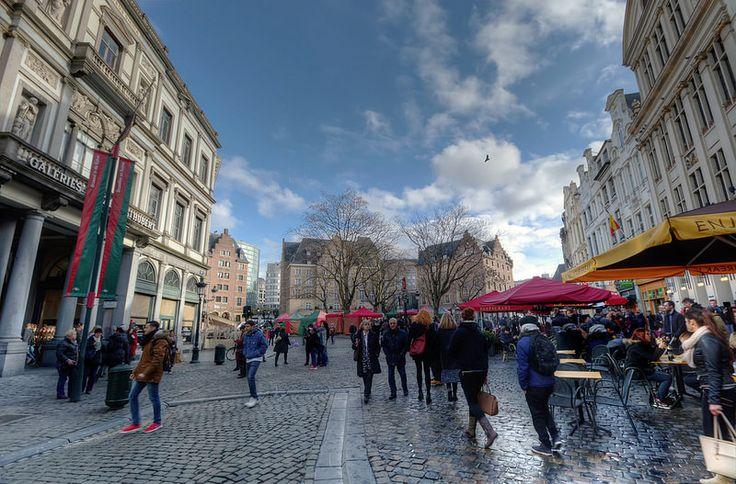
The announcement follows growing criticism of the emergency tree removals at Grasmarkt, also known as Rue du Marché aux Herbes, where strong winds brought down a large tree onto a restaurant terrace on Friday, 23 October.
Storm Austen Tree Collapse Injures Three in Central Brussels
The incident occurred at approximately 2.40 pm when a tree fell onto the terrace of Brasserie Ommegang.
Three people were injured and taken to hospital, including one who sustained serious injuries. Officials subsequently confirmed that the seriously injured victim was no longer in a life-threatening condition.
Following an inspection, the City of Brussels ordered the removal of the remaining trees from the square, citing an immediate danger of further collapses.
Municipal authorities said the emergency decision was based on assessments of tree stability and the condition of surrounding roots.
Brussels Officials Confirm Major Green Redevelopment
Anaïs Maes, the city’s alderwoman responsible for public space, announced plans to redevelop the square with more trees than previously existed.
According to Belgian broadcaster BRUZZ, Maes said the planning process would begin during the week of 26 October.
The proposed improvements will focus on additional planting, better conditions for pedestrians and cyclists, and a public space more resilient to environmental pressures.
The location is particularly significant because it provides access to the historic centre surrounding the UNESCO-listed Grand-Place.
However, the city has not yet published a final design, construction budget or completion timetable.
Officials Defend Emergency Tree Removal Decision
Florence Frelinx, Brussels alderwoman responsible for green spaces, defended the decision to remove the remaining trees.
She explained that municipal engineers and an insurance expert had identified internal decay in the fallen tree, while neighbouring trees showed signs of uprooting.
According to Frelinx, those findings indicated an immediate safety risk, prompting her to request an emergency removal order.
The city has also committed to planting replacement trees as quickly as possible, although no confirmed planting date has been announced.
Environmental Groups Question Brussels Tree Policy
The removal decision has attracted criticism from Ecolo-Groen representatives and urban tree campaigners.
Brussels politician Lotte Stoops questioned whether less drastic measures could have protected public safety while allowing further inspections.
Environmental advocates have also raised concerns about the loss of mature trees, which help reduce urban temperatures, absorb rainwater and support biodiversity.
Ecolo-Groen has renewed calls for a coordinated tree-management strategy covering Brussels’ 19 municipalities, with consistent standards for assessing tree health and stability.
Why the Square Redevelopment Matters for Brussels
The Grasmarkt is a busy area connecting Brussels-Central railway station with the city’s historic tourist district.
Its redevelopment could affect residents, commuters, visitors and businesses operating around the square.
Additional trees could eventually improve shade and environmental conditions, while pedestrian-focused improvements may make the public space easier to navigate.
The project also highlights the challenge facing European cities as they seek to preserve urban greenery while responding to increasingly demanding public safety and infrastructure requirements.
What Happens Next for the Brussels Square?
The Brussels square redesign is entering its initial planning phase, with city officials expected to develop proposals for new planting and public-space improvements.
Detailed decisions about the square’s layout, traffic arrangements, construction schedule and funding have not yet been announced.
For now, the municipality’s confirmed objective is to create a greener, safer and more accessible public space following the October storm damage.
The next stage will determine how those commitments are translated into a practical redevelopment plan for one of central Brussels’ busiest historic locations.