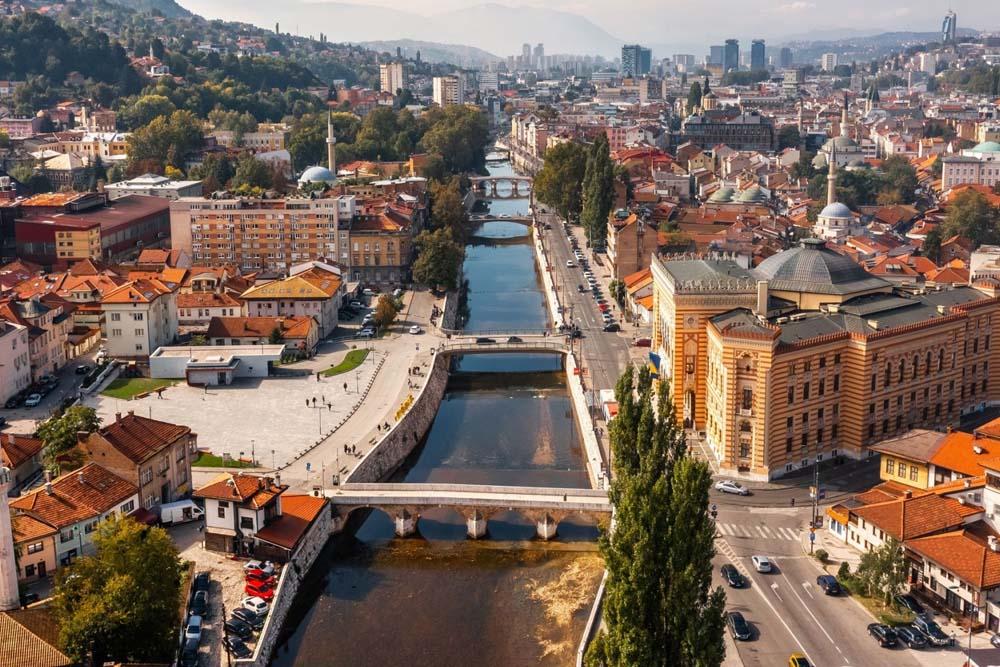
Sarajevo, Bosnia and Herzegovina, 4 October, (Brussels Morning Newspaper) – Bosnians are voting today in a closely watched Bosnia election, choosing national and regional leaders in a contest with significant implications for political stability, stalled reforms and the country’s ambition to join the European Union.
Polling stations opened at 07:00 local time and are scheduled to close at 19:00. Bosnia and Herzegovina’s Central Election Commission said 3,414,364 voters were registered when the Central Voters’ Register was concluded in May.
What Bosnians are voting for in crucial national contest
Sunday’s ballot is a general election rather than an election to an EU institution.
Voters are directly choosing members of Bosnia and Herzegovina’s three-member Presidency and the House of Representatives of the Parliamentary Assembly.
Elections are also being held for the House of Representatives of the Parliament of the Federation of Bosnia and Herzegovina, the National Assembly of Republika Srpska, the president and vice-presidents of Republika Srpska and the cantonal assemblies within the Federation.
The breadth of the ballot reflects Bosnia and Herzegovina’s highly decentralised political system, which emerged from the constitutional arrangements established after the 1992-95 war.
EU membership ambitions raise stakes for Bosnia
The Bosnia election comes at an important moment in the country’s relationship with Brussels.
Bosnia and Herzegovina received EU candidate status in 2022, and EU leaders agreed in March 2024 to open accession negotiations. Progress towards membership, however, depends on further political, judicial and governance reforms.
Reuters reported ahead of Sunday’s vote that political paralysis and economic stagnation have fuelled public frustration, while reforms required for the country’s EU accession process have stalled.
The election therefore matters well beyond the immediate contest for political office. The leaders and parliamentary groupings emerging from the ballot will have considerable influence over whether reform legislation needed to advance European integration can move forward.
Election authority sets strict voting rules
The Central Election Commission confirmed that election silence began at 07:00 on Saturday and continues until polling stations close on Sunday evening.
During that period, political parties and candidates are prohibited from public campaign activity. Restrictions also apply to publication of election-related opinion polls.
Voters must present a valid Bosnian identity card, driving licence or passport before casting their ballots, while the secrecy of voting is guaranteed under election procedures.
Political divisions remain central to campaign
Bosnia’s politics continue to reflect divisions among its Bosniak, Serb and Croat communities alongside competition from parties seeking broader multi-ethnic support.
Reuters reported that the campaign has featured the Bosniak Party of Democratic Action, the Serb Alliance of Independent Social Democrats and the Croatian Democratic Union of Bosnia and Herzegovina, as well as multi-ethnic political forces including the Social Democratic Party.
Foreign policy has added another dimension, with Bosnia’s EU ambitions unfolding alongside competing Western and Russian influence in the Western Balkans.
Why today’s vote matters for Brussels
For the European Union, the election will help determine the political environment in which Bosnia’s accession reforms proceed.
The EU enlargement process requires candidate countries to meet extensive standards covering democracy, rule of law, public administration and economic governance. Bosnia’s ability to adopt and implement those reforms depends heavily on cooperation among institutions operating across its complex political system.
That makes the Bosnia election particularly relevant to Brussels as the EU considers its broader enlargement strategy across the Western Balkans.
What happens after Bosnia’s polls close?
Polling stations are scheduled to close at 19:00 local time, after which ballots will be counted and election authorities will begin publishing results.
Attention will then turn to the distribution of political power across the presidency, national parliament and entity-level institutions.
The results will not themselves determine whether Bosnia joins the European Union. They will, however, determine which political leaders and parties are responsible for tackling the reforms and institutional disputes that have slowed the country’s European integration.
For Brussels, the immediate question after the votes are counted will be whether Bosnia’s next political leadership can translate the election result into the reforms required to move its long-running EU membership bid forward.