
Brussels (Brussels Morning Newspaper) – NATO Secretary-General Mark Rutte stated on Wednesday, prior to a meeting with defence ministers, that the military alliance and the European Union are collaborating to establish a drone wall aimed at safeguarding member countries from drone threats incursions.
When asked if they were increasing efforts, Rutte explained that the EU and NATO have distinct roles: NATO offers military capabilities, while the EU focuses on soft power through the internal market and financial support.
What threats prompted Europe to build a drone wall?
NATO is seeking methods to strengthen its vulnerable air defences amid increasing drone swarms and Russian jets openly entering its airspace.
In recent weeks, suspicious drones have entered Belgian, German, Danish, and Norwegian airspace. Russian drones were also tracked over Romania and shot down over Poland. Additionally, the military alliance had to send fighter jets after three Russian MiG-31 planes lingered in Estonian airspace for 12 minutes.
On Wednesday, defence ministers from the 32-member alliance will meet in Brussels. A key issue will be whether national rules are obstructing NATO’s top military officer from effectively addressing aerial threats.
Defence ministers are also likely to discuss collaborative projects between the EU and NATO. The EU is leading multiple defence efforts, such as the €150 billion SAFE loans-for-weapons program, and is anticipated to present a comprehensive defence strategy for 2030 this Thursday.
How will the drone wall strengthen European security?
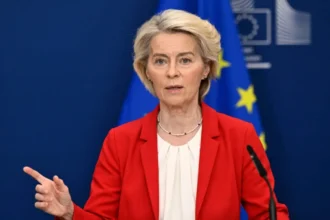
Last month, European Commission President Ursula von der Leyen vowed to build a “drone wall” to defend frontline nations from Russia. The European Commission will work on technical and financial components to construct a drone wall to protect Europe against Russia.
A few weeks ago, the European Commission assembled defence ministers from Bulgaria, Estonia, Finland, Latvia, Lithuania, Poland and Romania. Hungary, Slovakia and the Danish Council presidency were also represented. During a separate session with NATO observing, Ukraine’s Defence Minister Denys Shmyhal highlighted his country’s “battle-tested expertise.”
How does the plan counter growing Russian drone incursions?
Participants agreed that the drone wall should be equipped with detection, tracking, and interception capabilities, according to the Commission. Other assets should encompass ground-based defences like anti-mobility systems, maritime security, and space-based situational awareness.
Shmyhal stated that Ukraine, with over three years of combat experience against Russian drones, is prepared to take part and offer expertise, including dispatching technical teams to train EU and NATO armed forces.