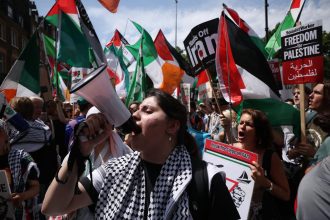
On September 6, tens of thousands of Iranians and supporters of the National Council of Resistance of Iran (NCRI) will gather in Brussels for the Free Iran March—a landmark event that comes at a pivotal moment. This is the first major rally of the Iranian opposition in Brussels since 2019, and much has changed in Iran and the broader Middle East over the past five years. What the Iranian Resistance has been warning about for decades has now unfolded before the world’s eyes, leaving no room for denial.
A Nation in Revolt, A Regime in Decline
Since 2019, Iran has witnessed multiple nationwide uprisings—most notably in November 2019, January 2020, and the women-led protests of 2022. These movements have shaken the regime to its core, signaling that Iranian society is no longer willing to tolerate clerical rule. The ascension of Masoud Pezeshkian to the presidency in August 2024 has done nothing to moderate the regime’s brutality. Instead, repression has escalated sharply: nearly 1,600 executions in just 12 months, including women, juvenile offenders, and dissidents. In July alone, at least 162 people were hanged, many in public.
Among those targeted are members of the People’s Mojahedin Organization of Iran (PMOI/MEK), the NCRI’s principal constituent group. Cases like those of Behrouz Ehsani and Mehdi Hassani, sentenced to death after sham trials lasting mere minutes, have sparked urgent international appeals. Over 530 jurists, Nobel laureates, and former UN officials have demanded the United Nations act to prevent another massacre akin to that of 1988, when 30,000 political prisoners—mostly MEK members—were executed.
In an effort to erase history, authorities in Tehran have begun destroying Section 41 of Behesht-e Zahra Cemetery, where many victims of the 1980s executions lie buried. Graves have been bulldozed to make way for a parking lot, and families are barred from mourning. This act of desecration is more than vandalism—it is a continuation of crimes against humanity, and it shows the fear of the regime, to open this chapter of Iran’s post revolution history.
Regional Shifts and the Regime’s Strategic Defeats
Beyond Iran’s borders, the clerical regime has suffered severe setbacks. In the wake of escalating conflict in the Middle East, Iran’s network of militias has been decimated, its influence in the region, especially after the fall of Assad in Syria, severely weakened. Meanwhile, its nuclear program has been crippled, and the European Union has now triggered the snapback mechanism to reimpose UN sanctions. What Tehran long denied—and what the Iranian Resistance long predicted—has become true: the regime is not an engine of stability but a threat to peace.
As Maryam Rajavi, president-elect of the NCRI, recently stated on her X account:
“The clerical regime’s state-sponsored terrorism and relentless warmongering across the region can only be answered through one course: the overthrow of the regime by the people of Iran and the Iranian Resistance.”
Why Europe Must Listen Now
What the Iranian opposition described for years—the regime’s brutality at home, its expansionism abroad, its nuclear deceit—has now been proven in full view. Europe no longer has the luxury of skepticism or delay. The Brussels gathering on September 6 is more than a rally; it is a moral imperative. It is a chance for European leaders to hear, directly from tens of thousands of voices, the only viable path to peace and democracy in Iran is neither war, nor appeasement, but support for the Iranian people and their organized Resistance to overthrow the regime and establish a democratic republic of Iran.
Dear reader,
Opinions expressed in the op-ed section are solely those of the individual author and do not represent the official stance of our newspaper. We believe in providing a platform for a wide range of voices and perspectives, even those that may challenge or differ from our own. We remain committed to providing our readers with high-quality, fair, and balanced journalism. Thank you for your continued support.