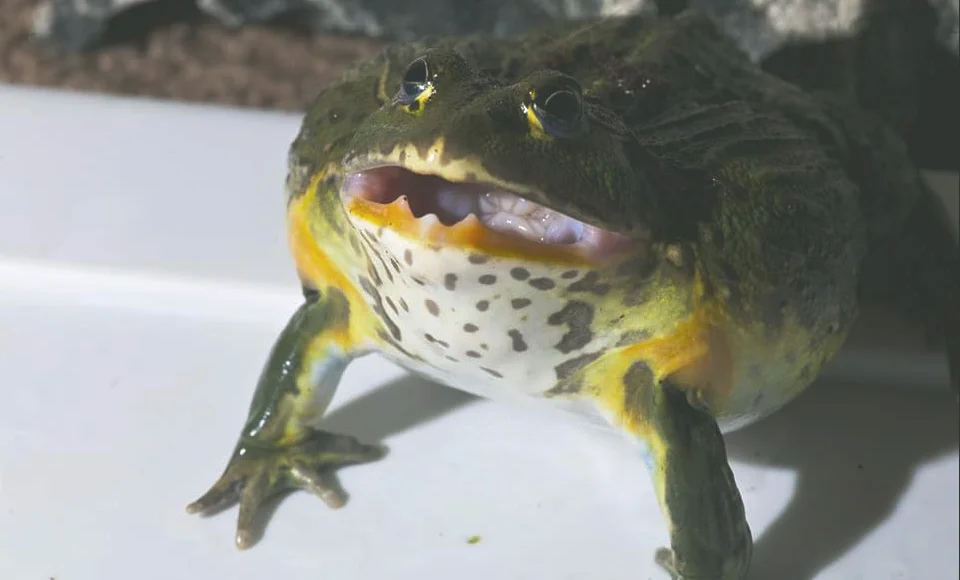
Bullfrogs do have teeth, but their dental structure is quite unique compared to many other animals. These amphibians possess maxillary teeth located all along the edge of the upper jaw and vomerine teeth positioned on the roof of their mouth. However, unlike mammals, bullfrog teeth are small and primarily used for gripping and holding prey rather than chewing.
Their teeth are sharp and curved backward, which helps them secure prey like insects, rodents, reptiles, and even small birds and fish, preventing escape once caught. Additionally, some species of bullfrogs, such as the African bullfrog, have bony projections called odontoids on their lower jaw which function like fangs to help subdue larger prey.
The teeth of bullfrogs are made mostly of dentin with a small enamel tip, and while they look formidable, frogs swallow their meals whole rather than chewing. The vomerine teeth, though not true teeth in the conventional sense, assist in keeping prey in place. This dental arrangement is an important adaptation that suits their predatory diet and ecological role as both predator and prey in their habitats, ranging from ponds and lakes to marshes across many continents.
Bullfrogs have teeth designed more for prey capture and retention rather than chewing, reflecting their carnivorous feeding habits and lifestyle. Their specialized teeth, including maxillary, vomerine, and odontoids in some species, contribute to their reputation as formidable amphibious predators despite their understated dental morphology.
Do Bullfrogs Have Teeth?
Initially, one might expect the bullfrog to have sharp, dangerous teeth based on its carnivorous habits. But not so. Bullfrogs are different from the typical mammalian teeth, including human teeth. Teeth are normally made of materials that are strong, like enamel, dentin, and cementum, and are secured in the jawbone. Bullfrogs, however, are different. They have two different types of teeth, which are the maxillary and vomerine teeth, which are each intended for different uses.
Unlike the more widely known African Bullfrog, which is an exception to the rule, most bullfrogs are continuously shedding and replacing teeth throughout their lives. Dropping a tooth is less of a concern because a new tooth is always lined up to replace it.
Confirmed Presence of True Teeth in Bullfrogs
Bullfrogs( Lithobates catesbeianus) do have small, pedicellate, bicuspid teeth on their upper jaws, or maxillary teeth, as well as vomerine teeth on the roof of their mouths. These teeth are n’t meant for biting but are rather used to grip and hold their slippery prey similar as fish before swallowing. This emphasizes a clear understanding of the basic structure of dentition in bullfrogs which are distinguishable for their unique pedicellate structure, which is different from the common mammalian tooth.
Maxillary Teeth: A Closer Look
Maxillary teeth, found in the upper jaw, may not be easy for the viewer to see due to their small size. They are hard to see even with the mouth wide open. While teeth in other species come in all shapes and sizes, bullfrogs have all maxillary teeth that are equally conical in shape. These small teeth are found in a circular arrangement on the outer margin of the upper jaw and actually serve a strange function.
It is quite different from being chewed with, the maxillary teeth don’t aid in mastication but assist in positioning prey in the frog’s mouth and helping it stay in place as it is swallowed. The frog’s feeding mechanism is also notable as it will use its tongue to catch prey and then the tongue is used to push the prey into the frog’s mouth and it never chews at all!
Vomerine Teeth: The Hidden Artillery
Though maxillary teeth are relatively inconspicuous, vomerine teeth take invisibility to an extreme. Located partially beneath a mucous membrane, vomerine teeth can be difficult to detect. The term “vomerine teeth” is derived from their position on the vomer bone in the skull, which is part of the nasal region. These teeth reside on the roof of the mouth and appear as tiny, sharp, pointed teeth, usually in pairs. However, vomerine teeth are not used for grinding prey as one might think.
Vomerine teeth are used to help swallow prey, rather than conducting grinding. These tiny spots of pointed teeth help grab the prey to keep it from escaping and help propel prey while swallowing.
Remarkable Discovery of Lower Jaw Teeth in a Frog Species
All bullfrogs and modern frogs warrant lower jaw teeth; still, new scientific exploration linked a rare frog species, Gastrotheca guentheri, that has re-evolved true lower jaw teeth. The fact that a true lower jaw tooth structure re-evolved after loss, especially in anurans( frogs and toads), challenges the long- held thesis that anurans nowadays recaptured that dental structure once it was lost. While bullfrogs don’t have lower jaw teeth, the work does showcase the evolutionary complexity of frog dentition.
Tooth Development Timing and Evolution in Frogs
Most frogs develop teeth only on the upper jaw and palate shortly after metamorphosis, which is referred to as delayed odontogenesis. The lower jaw of most frogs does not develop teeth and in the tadpole stage functional teeth substitutes made of keratin allow them to successfully consume food during larval life. The developmental pattern of frog teeth through delayed odontogenesis is an evolutionary adaptation that facilitates feeding strategies throughout life stages.
Tooth Replacement and Regeneration
Bullfrog teeth are replaced routinely throughout their entire life and are essential to the overall effectiveness of their dentition to successfully grasp prey. Tooth replacement is necessary to compensate for normal wear or damage of the teeth associated with their carnivorous feeding behavior. The continual replacement of teeth highlights an adaptive feature of these amphibians for capture of prey with teeth, as they do not chew food.
Functional Role of Teeth in Feeding
Bullfrog teeth serve to retain prey and forgo chewing, consistent with their diet and feeding behavior. The function of maxillary and vomerine teeth holds captured food and supports swallowing, minimizing any potential loss of consumed food. As a feeding ecology provides distinction as to why frog teeth appear structurally as teeth and do not serve the function as chewing, it is important to recognize distinctions.
Ancient Echoes And Modern Wonders
The enchanting narrative of bullfrog teeth does not stop at contemporary species; there are also fascinating dental adaptations in extinct frogs from the distant past. For example, the recently extinct frog species from Madagascar, Beelzebufo ampinga, had remarkable oral structures that closely resembled tusks rather than teeth. These oral adaptations more than likely served for fighting or intimidating displays and are an indication of the different ways frogs have evolved.
Evolutionary Loss and Occasional Re-Emergence of Frog Teeth
Frog ancestors had full dentition from upper and lower jaws, but teeth were lost and re-evolved independently numerous times over 200 million years of evolution. This evolutionary history is the reason we observe the lower jaw teeth selected against so rarely today and the range of dental specializations found across anuran species.
Do Bullfrogs Have Teeth?
Within the vastness of all of nature’s wonders, bullfrog teeth represent a unique chapter. These amphibians are often presumed to have teeth because of their carnivorous behavior, yet the teeth of this species are not for chewing food; instead, they are designed for grabbing prey.
The specific patterns of both maxillary and vomerine teeth exemplify how these adaptations allow bullfrogs to access food. As bullfrogs do not chew food, they have developed an exceptional manner of feeding and swallowing whole. This discovery emphasizes how creative nature is when devising solutions to challenges of survival.
So, next time you wonder, “Do bullfrogs have teeth?” Take note that your question is not purely about the presence of different structures; instead, it unveils a fascinating story about adaptation and creativity, and this again reminds us of the remarkable “wonders” our world possesses.