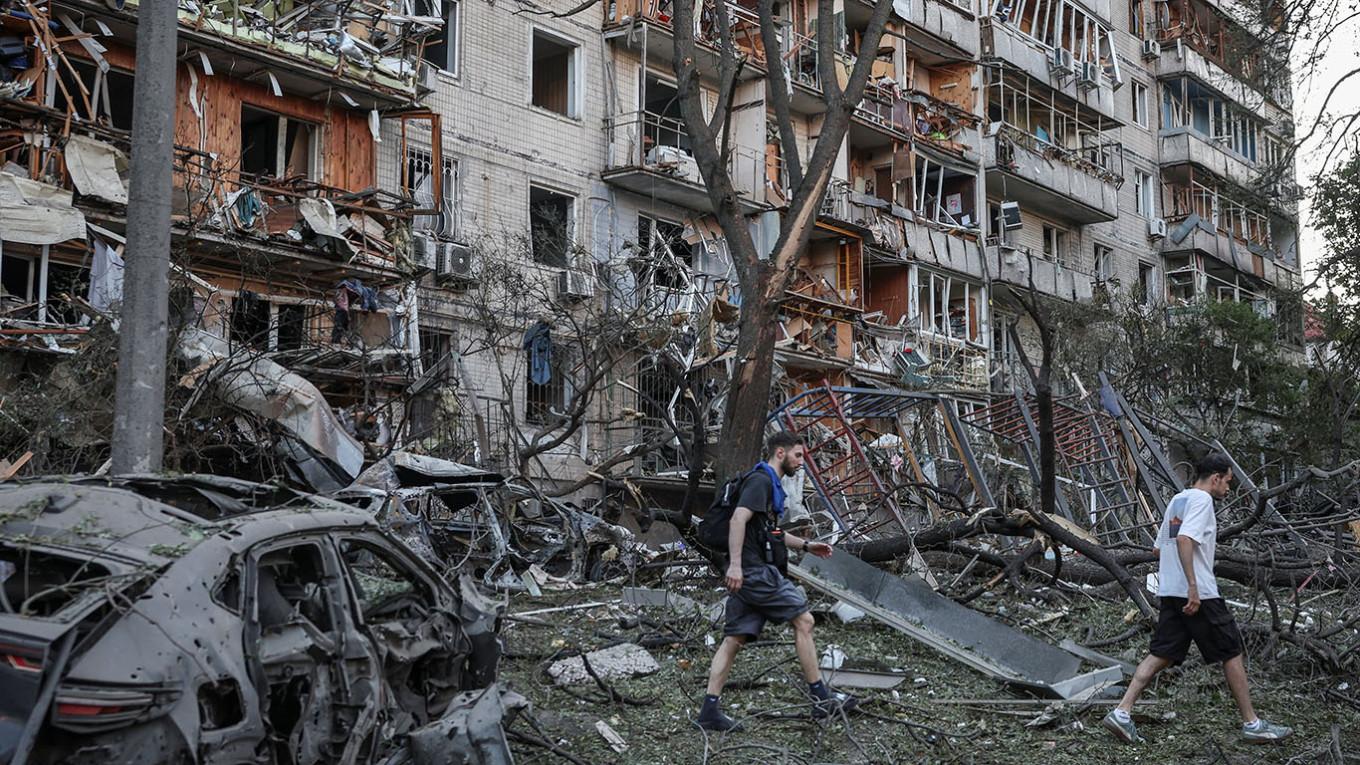
Before dawn on 1 August, Russian ballistic missiles killed at least nine people in Kyiv and forced Volodymyr Zelensky to concede the one thing a wartime leader least wants to say aloud: Ukraine had run out of air-defence interceptors. Hours earlier in Washington, Donald Trump had said the United States had “not agreed to” let Ukraine build its own Patriot interceptors, walking back a pledge he had made weeks before. A week later another overnight strike on the capital region killed four more, among them a three-year-old boy and his grandparents in Brovary. Ten days after that, a missile strike on the Kharkiv region village of Pechenihy killed ten and wounded seventeen; Kyiv answered within hours with nearly 800 drones aimed at the Moscow region, its second-largest such raid of the year.
None of this, by now, is surprising. What deserves closer attention in Europe’s capitals is where the pressure on Zelensky is quietly coming to rest. Nearly four years into the war, the Ukrainian president is being pressed from three directions at once: by Moscow’s missiles, by Washington’s diplomacy, and by a corruption scandal that has torn through his inner circle. That much has been reported to exhaustion. The part Europe keeps missing is that every strand of the squeeze now runs back to a European desk, and that Europe is still behaving as though this were an American problem to manage.
Consider the peace on the table. Late last year the United States and Russia drafted a twenty-eight-point framework whose terms leaned heavily towards Moscow: Ukraine would surrender the Donbas, cap its army, and give up the industrial east in exchange for guarantees that would arrive only after it had withdrawn. Zelensky answered with a twenty-point counter of his own, offering a demilitarised zone rather than ceded land, security guarantees meant to mirror NATO’s Article 5, a joint arrangement over the Zaporizhzhia plant, and a national referendum to ratify whatever ending was reached. By late December he called ninety per cent of it agreed — a figure that, eight months on, nobody in Kyiv, Washington or Moscow has updated.
The unfinished ten per cent is where Europe should be looking. The plan names European states as guarantors and signatories. It folds eventual EU membership into the security guarantees, with Zelensky himself floating 2027 or 2028 as a target. It also carries a separate reconstruction package that talks of mobilising as much as $800 billion, stacked on top of a security guarantee Zelensky says the US has pegged at fifteen years — sums no one imagines Washington fully underwriting and Moscow certainly will not. Yet the question of who actually signs on Europe’s behalf is still, by the negotiators’ own account, undecided. Europe is being handed the bill, the guarantees and the risk of a settlement drafted in Washington and Moscow, and it has not decided who holds the pen.
The Zaporizhzhia plant makes the point concrete. It is Europe’s largest nuclear facility, it sits near the front under Russian control, and Washington and Kyiv are still trading rival ownership splits for it — one proposal giving Russia, Ukraine and the US a third each, another giving Ukraine and the US half apiece. Whatever arrangement emerges, the safety of a reactor on the continent’s own map will be governed by terms Europe did not set.
Washington had wanted the whole framework concluded by June. June passed, the Abu Dhabi round of shuttle diplomacy resolved nothing on the two questions that matter, territory and guarantees, and the deadline dissolved with nothing signed. By mid-August Kyiv was still relaying fresh proposals to Washington rather than closing a text, with American mediators not having visited the Ukrainian capital since January. The talks have since drifted while the missiles have not.
Then there is the wound at home, which may prove the deepest. Ukraine’s own anticorruption investigators uncovered a kickback scheme running through Energoatom, the state nuclear monopoly, that allegedly funnelled ten to fifteen per cent of contractor payments to insiders. The scheme’s alleged organiser, Timur Mindich, a film producer and former business partner of the president, fled the country as the raids began; a Kyiv court has since ordered him detained in absentia. Two ministers were dismissed within days, and the former energy minister among them was later detained trying to leave Ukraine.
In late November investigators raided the residence of Andrii Yermak, Zelensky’s chief of staff and lead negotiator, and by that evening he was gone. In May, prosecutors went further and charged Yermak with money laundering over a riverside cottage complex; a court ordered him held on bail he says he cannot afford. He denies the charges. Losing Yermak stripped Zelensky of his closest adviser at the precise moment he needed a negotiator, and handed his critics an opening they had waited years for. Lawmakers who had held their tongues for the sake of wartime unity broke into open revolt.
And here the European dimension turns awkward. The European Union, which Ukraine wants to join and depends on to survive financially, has tied its money to a crackdown on graft. That conditionality is right in principle. Its effect, arriving as the scandal peaks and the president’s circle empties, is to press Kyiv hardest at its weakest. Brussels’ cleanest instinct has become another source of strain.
The fact is that Zelensky’s every difficulty now converges on a choice Europe would rather not own. A weaker Ukrainian president is easier to push towards the Donbas. A president pushed towards the Donbas is weaker still before his own parliament, whose mandate to keep him in office rests on a martial law that has suspended the elections his term needed back in 2024.
None of this means he is finished. He is cornered, which is not the same thing. Ukrainian drones still reach Russian refineries deep in Samara and Krasnodar. Putin’s own army is paying for its gains: Ukraine’s general staff put Russian losses at nearly 43,000 in July alone, the highest monthly toll of the year, and his appetite for a quick, sellable victory is itself a vulnerability. The referendum Zelensky keeps returning to is not only a device to make a painful peace survivable; it is a way to refresh a mandate that expired two years ago. These are real cards. They are also wasting assets, and the clock on them is not set in Kyiv.
Winter is coming again, and with it the season when Russia aims for the power grid and the cold finishes the work. Ukraine will meet it with emptier magazines and a thinner circle around its president. The choice narrowing in front of Zelensky is between a bad peace and a worse war, and in either case the guarantees, the reconstruction money and the consequences come to rest on Europe. The longer its capitals treat this as Washington’s file, the less say they will have in how it ends.
Leave it to Washington and Moscow, and Europe will find itself signing a document it did not write, to keep a peace it cannot police, on a border it cannot move