London, 18 August (Brussles Morning Newspaper) Russia has warned Britain that there will be “consequences” over UK drones to Ukraine, after reports that British-made unmanned aircraft have been used by Kyiv to carry out long-range strikes inside Russian territory. The warning marks a fresh deterioration in relations between London and Moscow as drone warfare plays an increasingly prominent role in the conflict.
Moscow says Britain is escalating its role in the war
The Russian Embassy in London issued the warning after reports emerged that Ukrainian forces had used unmanned aircraft manufactured by British companies during attacks deep inside Russia.
Moscow accused the UK of “deliberately opting for an escalation of the Ukraine crisis” and claimed Britain was acting as an “accomplice and co-perpetrator” by supplying equipment subsequently used against Russian targets.
The embassy also warned that Britain would have a “higher price to pay” for its support.
What Moscow did not do was explain what that warning meant in practical terms. No specific retaliatory action against Britain was announced, leaving the nature of the threatened consequences unclear.
The language nevertheless represents another escalation in an already deeply hostile relationship between the two countries.
British-made drones reportedly used deep inside Russia
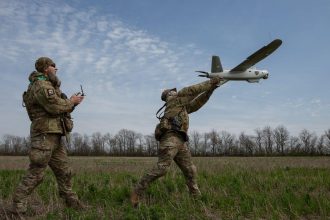
The dispute follows reporting that British-manufactured drones have been deployed in Ukraine’s expanding long-range campaign against targets across Russia.
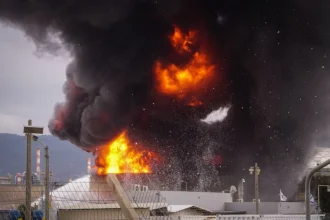
The Sunday Times reported that unmanned aircraft produced by two British companies had been used in deep-strike operations. Ukraine has increasingly targeted Russian military and industrial facilities, oil refineries and logistics infrastructure far beyond the front line.
Those operations have intensified in recent weeks. Ukraine launched one of its largest aerial attacks of the war over the weekend, sending hundreds of drones towards targets across Russia, according to Russian officials and Ukrainian accounts.
The growing reach of Ukrainian drones has become a significant problem for Moscow, forcing Russia to defend infrastructure hundreds of miles from the battlefield.
Britain says support for Ukraine will continue
The Ministry of Defence has given no indication that the Russian warning will alter Britain’s policy.
Responding to Moscow’s latest statement, the department reiterated that the UK remains committed to helping Ukraine defend itself against Russia’s invasion.
That position is consistent with the government’s wider approach since February 2022. Britain has supplied weapons, ammunition, training and other military assistance while arguing that Ukraine has the right to defend itself against Russian aggression.
London’s backing has increasingly included unmanned systems as both Ukraine and Russia adapt their military strategies around relatively inexpensive drones.
The government has committed to providing large numbers of drones to Kyiv during 2026 as part of its continuing military assistance.
Drone warfare moves to centre of UK support
The controversy over UK drones to Ukraine comes as Britain significantly expands its investment in unmanned warfare.
British assistance is no longer limited to relatively short-range battlefield drones. Support covers reconnaissance, maritime and strike systems, while London has also backed Ukraine’s rapidly developing domestic drone industry.
That shift reflects the changing character of the war.
Long-range drones allow Ukraine to attack military production sites, fuel infrastructure and logistics networks well beyond the front line without relying entirely on more expensive conventional missiles.
Recent Ukrainian strikes have also placed pressure on Russia’s fuel and transport sectors. Reuters reported last week that attacks on Russian oil refineries had contributed to fuel shortages and rising transport costs in parts of the country.
For Moscow, the involvement of British-manufactured systems gives those attacks a wider diplomatic dimension.
Why Moscow’s warning matters for Britain
Russia has repeatedly argued that Western governments are becoming direct participants in the conflict by supplying increasingly sophisticated weapons to Kyiv.
Britain rejects that characterisation and maintains that responsibility for the war lies with Russia following its full-scale invasion of Ukraine in February 2022.
The latest dispute matters because it moves beyond the question of weapons being used on Ukrainian territory. Moscow is now explicitly challenging Britain over equipment reportedly being used for operations inside Russia itself.
That leaves the government balancing its commitment to Kyiv with the need to manage the wider risks surrounding an increasingly long-range war.
What happens next?
There is currently no indication that Britain intends to reduce its military assistance because of Moscow’s warning, and no specific Russian response has been announced.
Attention will instead turn to whether the Kremlin follows its increasingly forceful rhetoric with any concrete measures against Britain.
For now, the government’s policy remains unchanged. Britain continues to support Ukraine, while Russia is making increasingly clear that it views UK drones to Ukraine — particularly those capable of reaching targets inside Russia — as another significant point of confrontation between Moscow and London.