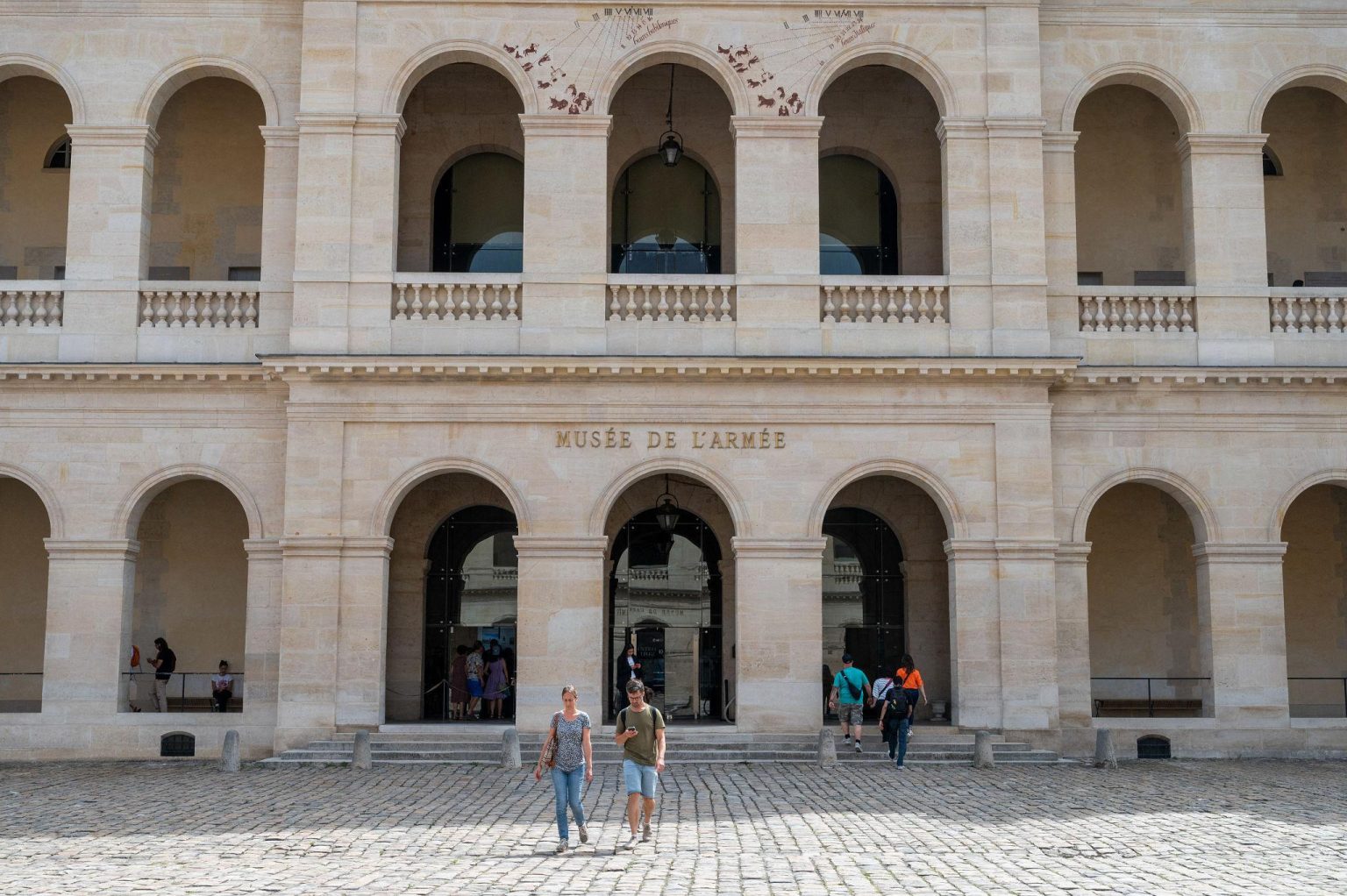
In the reserves of the Musée de l’Armée in Paris sits a manuscript that France and Guinea have both decided, this summer, they want to talk about. It is the personal Quran of Samory Touré, the Malinke cleric and general who fought the French army across West Africa for sixteen years before his capture in 1898. Conakry has filed a formal request to bring it home, along with his sabre, his war tunic and manuscripts scattered across French collections. On its face this is the restitution story the past decade taught us to applaud. Look closer and it is something more useful to study: how returning looted heritage is quietly becoming an instrument of power, wielded by both the state that stole and the state that reclaims.
Start with who is doing the reclaiming. The request comes from the government of Mamadi Doumbouya, the special-forces colonel who seized Guinea in a 2021 coup, pushed through a new constitution that let him run, and won 86.7 percent of the vote in a December 2025 election from which the leading opposition figures were barred. In March he dissolved 40 political parties, among them the ones best placed to challenge him at legislative elections due in May. Guinea’s main opposition leader, Cellou Dalein Diallo, watching from exile, calls it the scaffolding of a “nascent one-party state”. Doumbouya’s culture minister, Moussa Moïse Sylla, prefers the gentle vocabulary of partnership, asking for “cultural diplomacy, in mutual respect” rather than confrontation. It is a reasonable line. It is also a revealing one, because the object at the centre of it is the relic of a man who spent his life refusing to be governed by an unaccountable foreign power.
That is the transaction worth naming. A government dismantling its own citizens’ ability to choose their rulers is preparing to receive, from the former coloniser, the personal Quran of the region’s most celebrated symbol of resistance to domination. The regime does not need to engineer the symbolism. The machinery does it automatically. Once the manuscript lands in Conakry, Doumbouya becomes, in the official telling, the heir to Samory. The man who fought foreign conquest is conscripted, a century after his death, into the pageantry of a government his descendants can no longer vote against.
Guinea’s own past sharpens the irony. Samory is the claimed ancestor of Ahmed Sékou Touré, independent Guinea’s first president, who asked France for this same Holy Quran in 1968 and built a one-party state of his own around the memory of anti-colonial struggle. The relic has always been useful to whoever holds Conakry. What has changed is the machinery that now makes its return routine.
France built that machinery this year. After nearly a decade of stalled promises dating to Emmanuel Macron’s 2017 pledge in Ouagadougou, parliament passed a law this spring that lets the state hand back colonial-era objects by decree, sparing each one a separate act of parliament. Thirteen governments, most of them African, are already in the queue. A joint scientific committee screens each claim for provenance. Weapons and public archives are excluded, and only what was taken between 1815 and 1972 qualifies. One further condition: the receiving country must promise to preserve the object and put it on public display. Read that last one again. The test is whether a museum can control humidity and mount an exhibition. Nothing in the law asks whether the government receiving the relic answers to anyone.
France has its own reasons to move quickly, and conscience is not the main one. Its hard power in West Africa has collapsed. French troops have been pushed out of Mali, Burkina Faso and Niger in succession, their bases handed over as Russian paramilitaries moved into the vacuum. In that setting, cultural restitution is the cheapest influence Paris has left. Handing back a manuscript costs nothing and buys a photograph, a ceremony, a warm paragraph in the local press, and a claim to being the enlightened ex-empire while rivals offer only mercenaries. The 26 royal treasures returned to Benin in 2021 showed how well the choreography works. The new law puts it on a production line.
So two governments reach for the same object for opposite-seeming reasons, and shake hands over it. Paris looks generous as its soldiers retreat. Conakry gets a nationalist relief valve at the exact moment it is closing the political space its citizens might otherwise use. The manuscript changes hands. The public in whose name the whole exchange is conducted gets neither a vote nor, for now, the object itself: Guinea’s national museum has been shut for renovation since 2022, and the planned home for its written heritage, a museum of the book, is not due to open before 2030.
None of this is an argument against giving the Holy Quran back. The claim is old, the theft is real, and the objects belong in West Africa on any honest reading of how they left it. It is an argument about what the restitution movement has not reckoned with. Built as an ethics of repair between peoples, it runs in practice as a transfer between states, and it treats whoever controls the capital as the rightful voice of the nation. Across the Sahel’s belt of coups, that is an increasingly generous assumption. Juntas from Bamako to Ouagadougou have learned that anti-colonial symbolism is the surest domestic currency going, and a returned relic of resistance is symbolism a former coloniser will now supply on request, stamped with its own guilt.
Which leaves an uncomfortable choice for anyone who cares about both restitution and democracy. Condition returns on how the recipient government behaves, and you rebuild the paternalism the whole project set out to bury, with Paris once again ruling on which Africans are fit to hold their own heritage. Refuse to condition them, and Europe’s reckoning with its past doubles as a subsidy for the men now narrowing Africa’s future. Guinea’s request forces that question into the open, and a movement that has spent a decade celebrating each homecoming has barely begun to answer it. The Holy Quran will probably go home. The harder question is whose hands will be waiting to receive it.