Cyber security and digitalisation of the tourism sector will come firmly under the spotlight at a major industry event next month.
The World Tourism Forum is a key gathering of experts and stakeholders who will converge on Brussels on 9/10 November at the city’s Royal Museum of Fine Arts.
It will look at how the industry is evolving and possible challenges it faces in the coming years.
One of numerous issues on what is a packed programme is that of cybersecurity which has hit the headlines in recent times.
A session will be devoted to this, aiming to also reflect how central digital systems have become to hotels, airlines and booking platforms, and the shared responsibility across the industry for protecting them.
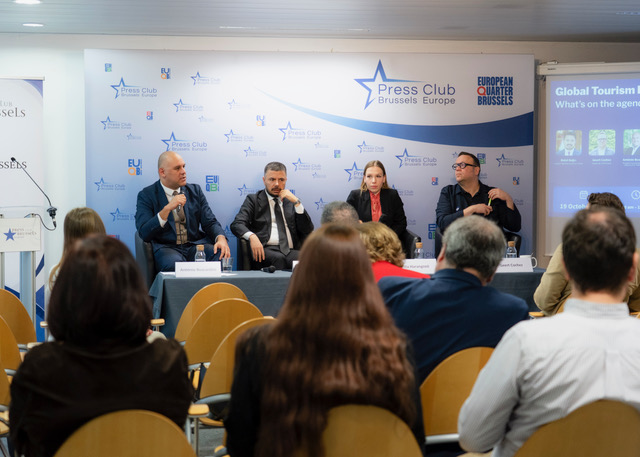
A briefing was held at Brussels press club on Monday (19 October) where this and other issues on the Forum’s agenda were outlined.
Bulut Bağcı, President of the World Tourism Forum Institute, the event organisers, said tourism is a “gateway to international cooperation”.
The forum, he reminded the audience, was launched back in 2010 as a local event in Turkey but was later rebranded because, he said, it was clear the industry was fast evolving.
The aim at the outset was to help promote destinations but the event itself quickly expanded and was moved to Brussels. It is seen, not as an expo, but an investment platform and the most recent Institute event, a summit in Angola, was attended by some 2,000 delegates.
“The main issue we see in tourism,” he said, “is that it is still largely regarded as ‘one step back’ for most governments.”
But he added that the Institute’s investment summit in Angola in June, produced “multiple and concrete results.”
At the briefing, Lilla Harangozó, head of office at Capital European Affairs, a Brussels based NGO, presented a preview of the different sessions due to be held at the two day forum.
The first day, she said, will look at investment and security issues, adding, “The future of tourism depends on both and we want to explain the conditions that can make tourism attractive to investors.”
The forum will seek to spell out how the potential of tourism can be turned into concrete projects. One panel will discuss the hospitality sector and the need for more “diverse” tourism while another will look at connectivity and cross border travel.
Climate resilience, heat and extreme weather and their impact on tourism – all things that can disrupt travel and tourism itself – will come under the spotlight in another panel, she said.
“On day two we change the lens but not the underlying issue or the message,” said Harangozó.
Senior EU Commission officials will give a keynote address on security, safe states and effective border controls.
Harangozó said, “For most travellers today the travel experience begins on a screen, for example, booking the flight and accommodation, and a failure in one means the whole system can go sideways. Trust can be lost as a result of poor information, a communication breakdown or when things go unexpectedly wrong. So the digital issue is a core element of travel and tourism.”
She added, “If there is one idea we want people to take away from this whole event it is that the future of tourism will be shaped not just by where we invest but how confidently people can travel.”
Another speaker will be Geert Cochez, deputy CEO of visit.brussels, the body that promotes tourism for the Belgian capital.
He showed a short video highlighting Brussels’ role in the tourism sector and why it is important for the “Capital of Europe” to host events such as next month’s forum.
He said, “Some 100 languages are spoken in Brussels, there are 180 nationalities living here and it has more than 200 venues for events like this.This makes this city very well connected.”
There was, he added,also the economic added value: some 53percent of over night stays in Brussels are business related while 66percent of participants in the events and conferences it hosts come from abroad.
Each participant at an event spends an average €465 on top of the €416 spent by the event organiser.
Csilla Mezösi, Secretary General of the European Spas Association (ESPA), which represents medical spas, is also one of the main speakers at the forum and, speaking from Hungary, she said, “When you talk about the future of tourism, one of the clearest investment opportunities for the industry should bce health and well-being tourism, which offer stability, high value and year round demand.
“This is what I will want to highlight: that medical tourism is not seasonal tourism but a year-round business. For investors it is like gold. It is not niche anymore.”
Antonio Buscardini, publisher of Travel Tomorrow, moderated the briefing and is also a speaker at the forum.He told reporters the conference will bring together key decision makers from Europe and worldwide and, Buscardini said, brings “real added value.”
He noted that tourism represents some 10pc of EU GDP, supports one in ten jobs and is worth €4.6m for the industry, many of them SMEs.
“Tourism creates jobs, provides visibility and deserves more attention in Brussels where it is often left behind. But now we have an EU commissioner in charge of the industry so it is hoped this will signal that something has changed.”
He noted recent media reports that the EU’s much anticipated “strategy on tourism” might be released to coincide with the forum.
He said the draft strategy has key political importance, adding that it is the first time the EU will have such a strategy and this represents “real EU commitment” on the issue.
Others also welcomed this with Lilla Harangozó saying, “I have heard it may be be published in November but, yes, this strategy will have strategic importance and will set the agenda of where the EC stands on sustainable tourism.It will set a course of direction for the sector and where we need to go. We really need this and the hope is that the EU will understand this.”
Geert Cochez agreed and said, “We also keenly await this strategy as it is something that has been missing for decades. I hope it can be announced before the forum starts as that would further enrich the debate.”
In a Q&A, Harangozó predicted that AI and the digitalisation of the sector will have a major influence in the years to come, saying “we live in an age when digitalisation is not something we can avoid so we need to live with and ensure we are able to cope with it all.”
At the forum, experts will “walk us through how these things can be handled” and how the policy landscape might look in the future.
Bulut Bağcı forecast that “old style” travel agents will not survive beyond the next ten years as digitalisation of the travel and tourism industry continues apace.
But this also gave rise to some questions, he said, about personal passenger data and threats posed by hackers.
“What is certain is that the travel industry will continue to evolve rapidly in next ten years.”
Geert Cochez aded, “We should welcome AI because it will transform the way we travel but,yes, this also comes with many risks.”