
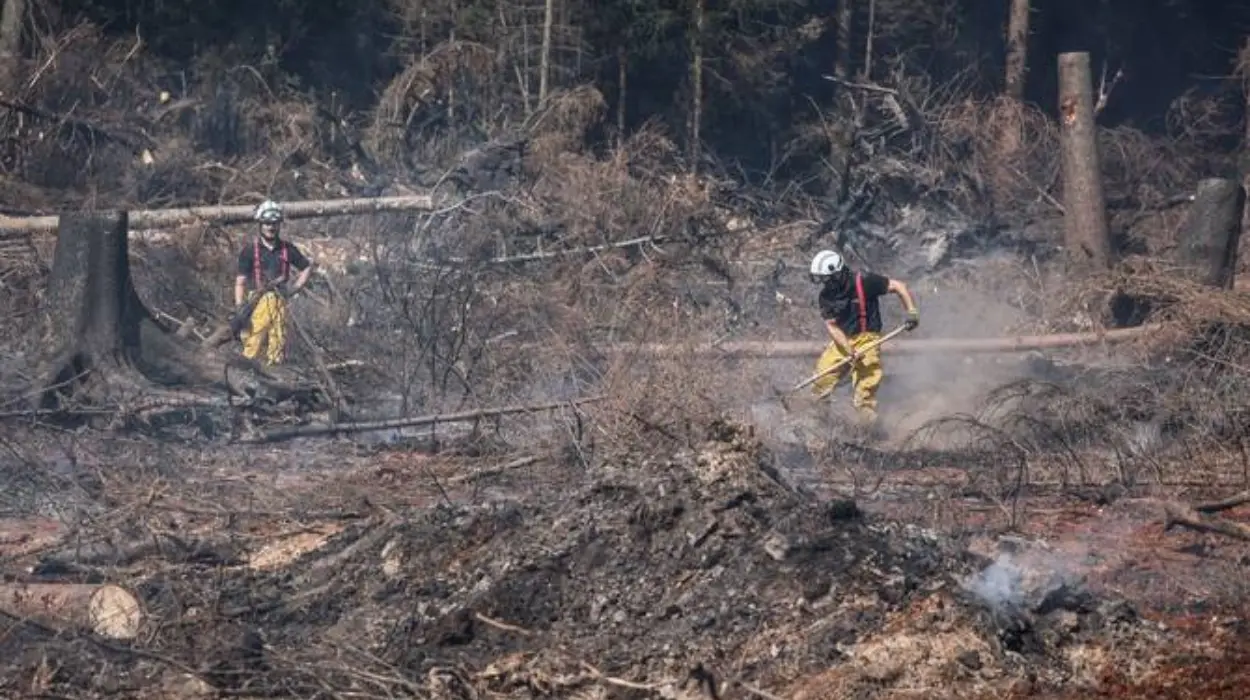
Brussels (Brussels Morning Newspaper) – The serious outbreak of wildfires in Europe in 2026 has brought to light a dark past associated with the burning Belgian forests, where there have been explosions due to bombs and mines from World War II being set off by the heat of fires and peat fires below the surface of the soil. In the High Fens (Hoge Venen/Hohe Venn) nature park, situated in Elsenborn and Bütgenbach, the fire, which spread across an area of more than 3,000 hectares out of 5,000, led to intermittent blasts of explosions.
What exactly happened in the High Fens?
The fire, the biggest in Belgium’s recent history, was raging in deep peat beds, creating underground fires that will go on burning for days or even weeks. With the destruction of vegetation and top soil, all kinds of rusted shells, mines and other ordnance scattered in some of the bloodiest battles on the Western Front were brought up by the fire or heated to the point of explosion.
“We hear a few sporadic explosions,”
explained Liège province Governor Hervé Jamar, who added that fire fighters are not under any threat in spite of possible presence of UXO, while the fire brigade is changing tactics in view of buried weapons.
One Belgian media outlet published an image of a fireman holding a rusted bomb, which means that this danger is close at hand. The peat fire, according to foresters, burns “without oxygen and without smoke.”
Why are wildfires making old bombs more dangerous?
Not only do forest fires damage trees but change the thermal and physical environment of buried explosives. Fires at the surface and subterranean peat fires transfer thermal energy to the soil, which may lead to ignition of explosive charges and munitions that remained dormant for years. On the other hand, flames destroy vegetation and topsoil cover, making bombs and mines visible to the workers.
Jonas Tepe, a spokesperson for North Rhine‑Westphalia in Germany, which shares similar battlefield terrain, stated that unexploded ordnance is
“even more dangerous around wildfires because heat can trigger the explosives.”
Researchers Christina Greene and Sarah Njeri described the dynamic as climate change “unburying and reactivating” previously stable wartime legacies by creating hotter, drier conditions and longer fire seasons.
How big is Belgium’s unexploded ordnance problem?
For Belgium, there is an ongoing “iron harvest” of war detritus, especially in old WWI territories like Ypres, as well as in WWII battlefields like the High Fens and the Ardennes. On average, Belgium’s Department of Ordnance Disposal and Destruction (DOVO) receives around 10 calls per day on a weekly basis—that is, 3,000–3,500 calls each year—for historical munition, mainly from the two world wars.
On average, each year the DOVO detonates and destroys around 200–250 tons of unexploded ordnance. The problem can be traced back to the First World War, where, during four years of fighting, the two opposing armies used around 1.5 billion shells, of which 5% were chemical munition. Poor quality control made many of them become duds, leaving an immense amount of work for the coming decades.
Have similar wildfire‑UXO incidents occurred before?
Yes. In July 2022, a large-scale wildfire in Slovenia, burning through former World War I frontlines, caused over 500 explosions of unexploded WWI munitions. On July 22, 2022, the heat of the fire triggered a bomb explosion with shrapnel being flung at firefighters; luckily, no one was injured, and the clearance team managed to disarm 821 explosive remnants of war (about 4,630 lbs). In the summer of 2022, a large-scale wildfire in Le Porge near Bordeaux in southwest France unearthed WWII-era shells; several bombs detonated due to the extreme heat, with shrapnel being thrown into buildings.
More than 400 shells and munitions were recovered during a single bomb-disposal operation; at first, crews removed visible surface hazards and plan a full clearance afterward. In Germany, a wildfire in Müritz National Park in July 2026 forced bomb-disposal units to work together with firefighters due to the contamination of the forest soil with Cold War-era munitions. A different wildfire in Hürtgen Forest (a WWII battlefield) included unexploded ordnance that was detected by the sound of the bomb explosion during firefighting operations.