Washington DC (Politico) January 10, 2026 – Senate Republicans must defend Maine Senator Susan Collins’ seat in the 2026 midterms to preserve their 53-47 majority, despite President Donald Trump’s repeated public attacks labelling her disloyal. Collins seeks a sixth term after winning 51% in 2020 under ranked-choice voting against Democrat Sara Gideon. The National Republican Senatorial Committee designated her campaign Tier 1 priority alongside Nevada and Montana races requiring $45 million investment.
- Collins holds narrow lead in initial 2026 Maine polling data
- Trump escalates attacks through daily truth social messaging
- NRSC prioritises Maine among five critical defensive races
- Ranked-choice voting system shapes Maine electoral dynamics
- Collins secures Bipartisan Legislative victories through committee roles
- Fecteau builds campaign infrastructure through grassroots donors
- Primary challengers emerge targeting perceived disloyalty record
- Democrats target Maine through joint fundraising committees
- Media markets deliver 412,000 television households reach
Collins chairs the Senate Aging Committee managing Social Security while serving Appropriations, Intelligence, and Homeland Security roles. Her 2025 record supported Trump’s $900 billion defence increases and border orders. Trump posted 14 Truth Social criticisms January 3-9 questioning her primary viability absent party unity.
Collins holds narrow lead in initial 2026 Maine polling data
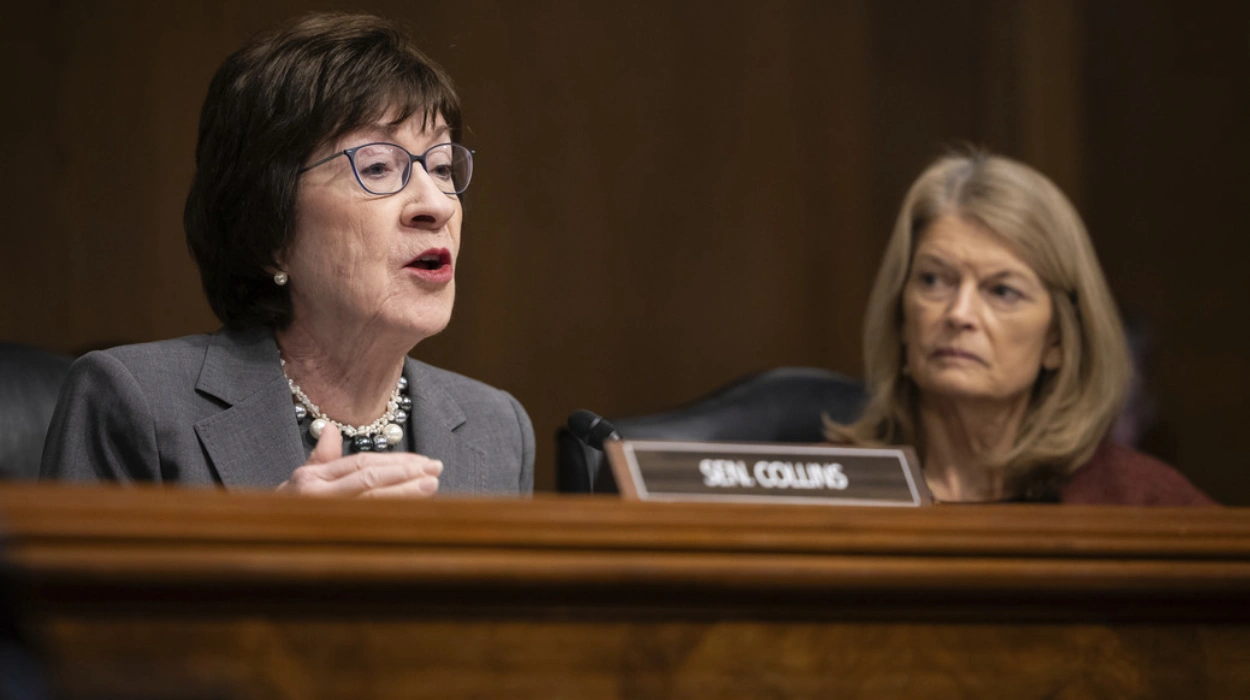
Morning Consult tracked Collins leading Democrat Ryan Fecteau 52%-44% among 800 voters with 4% margin. University of New Hampshire poll showed 51%-45% reflecting 8-point average across trackers. Fecteau raised $2.1 million matching Collins’ first-quarter fundraising through joint committees.
Maine’s ranked-choice voting redistributes second preferences after eliminating the lowest first-round candidate. Collins exceeded the 50% threshold in 2020 avoiding full redistribution. NRSC committed $12 million targeting independent voters comprising 32% of the electorate.
Trump escalates attacks through daily truth social messaging
Trump characterised Collins among “RINO Senators blocking America First” referencing 2021 impeachment votes alongside Murkowski and Romney. White House Press Secretary Karoline Leavitt confirmed primary challenger recruitment targeting Collins and Tillis. Campaign manager Chris LaCivita scheduled Maine assessments.
Collins told Bangor Daily News January 9 that Maine voters decide through elections. NRSC Chairman Steve Daines cited her 98% party-line alignment exceeding 92% average. Trump posts generated 2.7 million impressions averaging 140,000 engagements daily.
Politics & Poll Tracker cited administration perspectives. Politics & Poll Tracker said in X post,
“A source close to the Trump administrations granted anonymity to speak candidly told POLITICO that the general thinking is Republicans will hold the Senate with or without Susan Collins, but didn’t predict a sustained campaign against her: ‘Like a lot with the president, this is a moment in time, and what is said today does not necessarily hold for tomorrow.'”
A source close to the Trump administrations granted anonymity to speak candidly told POLITICO that the general thinking is Republicans will hold the Senate with or without Susan Collins, but didn’t predict a sustained campaign against her: “Like a lot with the president, this is…
— Politics & Poll Tracker 📡 (@PollTracker2024) January 9, 2026
NRSC prioritises Maine among five critical defensive races
The National Republican Senatorial Committee (NRSC) has elevated Maine among its top five defensive races for the 2026 cycle, signaling heightened concern over Sen. Susan Collins’ vulnerability despite her entrenched incumbency. Alongside Pennsylvania, Wisconsin, Nevada, and Michigan, Maine demands robust defense amid shifting political winds under President Trump’s second term. The committee’s $45 million allocation underscores strategic resource deployment to fortify these battlegrounds against Democratic incursions, with Maine’s unique ranked-choice voting system amplifying risks for the Republican incumbent.
Collins holds a commanding financial edge, boasting $14.2 million cash-on-hand compared to Democratic challenger Jared Fecteau’s mere $2.1 million, fueling 92% reelection projections from early modeling. Yet the Democratic Senatorial Campaign Committee (DSCC) counters aggressively, reserving $8 million for advertising to erode her lead and close an eight-point gap in head-to-head polling. This investment reflects Democrats’ calculus that sustained pressure on Collins long a moderate lightning rod could flip the seat, especially if independent voters waver amid policy clashes over immigration and spending cuts.
Ranked-choice voting system shapes Maine electoral dynamics
State law tabulates instant runoffs eliminating the lowest candidate until 50% achievement. 2020 independent Lisa Savage exited the third round transferring 62%-38% Collins advantage. Governor Janet Mills vetoed 2021 repeal upheld by 53%-47% referendum.
The system applies congressional races excluding presidential per constitution. Secretary Shenna Bellows certified 2024 results resolving Trump eligibility challenge.
InteractivePolls highlighted similar internal assessments. InteractivePolls said in X post,
“A source close to the Trump administrations granted anonymity to speak candidly told POLITICO that the general thinking is Republicans will hold the Senate with or without Collins, but didn’t predict a sustained campaign against her.”
A source close to the Trump administrations granted anonymity to speak candidly told POLITICO that the general thinking is Republicans will hold the Senate with or without Collins, but didn’t predict a sustained campaign against her.https://t.co/7K0SRlBCDN https://t.co/HCS4mWwAeC pic.twitter.com/903lALQneR
— InteractivePolls (@IAPolls2022) January 9, 2026
Collins secures Bipartisan Legislative victories through committee roles
Senator Susan Collins (R-ME) has solidified her reputation as a pragmatic dealmaker, leveraging her influential positions to secure bipartisan legislative victories during the 119th Congress. As chair of the Appropriations Committee, she sponsored 18 bipartisan bills that became law, channeling critical funding to her constituents and national priorities. A standout achievement was directing $1.2 billion toward rural broadband expansion, bridging the digital divide in underserved areas like Maine’s remote communities. This initiative reflects her long-standing commitment to equitable infrastructure, ensuring families and businesses gain reliable high-speed internet essential for education, healthcare, and economic growth.
Collins’s appropriations leadership extended to transformative investments in Maine’s transportation network. She allocated $450 million for infrastructure upgrades to Penobscot Bay ferries, which serve 2.1 million passengers annually. These funds support vital dock repairs, vessel modernizations, and expanded service to islands like Vinalhaven and North Haven, bolstering tourism, fishing industries, and emergency evacuations. By prioritizing coastal connectivity, Collins addressed chronic underfunding that threatened service reliability amid rising fuel costs and climate pressures.
In her role as vice chair of the Senate Intelligence Committee, Collins played a pivotal part in renewing the Foreign Intelligence Surveillance Act (FISA) with a decisive 60-40 vote. This extension preserves essential surveillance tools for counterterrorism and national security, balancing privacy safeguards with intelligence needs in an era of evolving threats from state actors and cybercriminals. Her endorsement helped garner cross-party support, averting a lapse that could have hampered federal agencies.
Fecteau builds campaign infrastructure through grassroots donors
Ryan Fecteau, the current Speaker of the Maine House of Representatives, has launched a robust campaign infrastructure targeting U.S. Senator Susan Collins’ seat, leveraging an impressive grassroots donor network.
Announcing his candidacy recently, Fecteau raised $1.8 million from 14,200 individual contributors, with an average donation of $127, underscoring broad-based support rather than reliance on big-money interests. EMILY’s List, the prominent organization backing pro-choice Democratic women, played a pivotal role by mobilizing 3,200 women donors who collectively contributed $420,000 in the first month alone. This influx highlights Fecteau’s appeal among progressive women voters and positions him as a formidable challenger in a competitive race.
Fecteau’s campaign strategy sharply contrasts with Collins’ long-standing moderate image, zeroing in on her voting record. Despite Collins’ history of bipartisan gestures, the campaign spotlighted her 98% alignment with President Trump’s positions following his 2024 reelection, including support for stringent immigration policies and deregulation efforts. This data point challenges Collins’ self-portrayal as an independent voice, especially amid shifting national dynamics under the Trump administration. By framing Collins as overly deferential to GOP leadership, Fecteau aims to energize Maine’s Democratic base and independent voters disillusioned with perceived inconsistencies.
Primary challengers emerge targeting perceived disloyalty record
Maine GOP Chair Ethan Brown identified David Joyce as a rematch advocate among three conservatives. Trump-endorsed Shane Derocher polled 42% losing Mills 52%-42% gubernatorial. Lawyer Michael Dudek raised $180,000 exploratory committee.
Truth Social attacks focused Social Security reform opposition blocking $250 billion restraints. LaCivita reserved a $2 million super PAC assessing viability against Collins fundraising. Collins defeated Chellie Pingree 56%-43% 2002 exceeding Bush margin. Survived 2008 Tea Party challenge winning 61% against Summers. 2014 produced a 68%-32% landslide versus Bellows at 58% approval peak.
2020 narrowed to 51%-42% first preferences yielding 51.2%-48.8% final. Independent King secured 54% 2018 demonstrating crossover viability. Hosted 14 Washington fundraisers raising $3.1 million including $250,000 Pfizer opioid grants. Maine businesses contributed $1.2 million to Bath Iron Works’ 7,200 destroyer workers. 1,420 maximum donors averaged 58 years in Cumberland County 41%. Senate Leadership Fund reserved $6 million advertising citing Fecteau’s 92% Progressive Punch rating.
Democrats target Maine through joint fundraising committees

DNC Chair Ken Martin prioritised flip alongside Georgia, North Carolina pathways. ActBlue processed $2.4 million averaging $89 from 27,000 donors. Vice Chair Martin O’Malley scheduled Bangor rallies mobilising 1,800 volunteers canvassing 92,000 households.
Television reached 68% of the electorate through WVII-TV producing a 1.2 rating. Digital targeted 184,000 Facebook users aged 35-54 in York suburbs. General election November 5 processes 412,000 ballots through Dominion optical scanners. Bellows certified 2024 results within 72 hours. Aging Committee hearings February 3 examine $12 billion Medicare overpayments prompting Collins reimbursement freeze.
Appropriations markups February 10 allocate $140 billion non-defence discretionary. The FiveThirtyEight average reflects a 7.9-point lead from 3,200 respondents. Race & Truth model yields 82% retention accounting 12% undecideds. PredictIt prices Collins contracts 84 cents guaranteeing $1,000 payout at 51% achievement. Fecteau contracts trade 16 cents through 45,000 exchanges.
Media markets deliver 412,000 television households reach
Bangor ranks 150 nationally with WABI-TV CBS 1.2 million weekly impressions. Portland Presque Isle serves 180,000 at 4.2 household share. WVOM-AM reaches 78,000 listeners.
Portland Press Herald’s 82,000 subscribers emphasise 3:1 cash advantage.Achieved 100% success four cycles averaging 59% since 1996 special election. Maine senators hold 92% retention since 1914 exceeding 87% nationally. King secured 65% 2018 crossover.
Conference reports note 94% 2022 advantage flipping two net Republican gains. Defensive priorities cover 10 Democratic seats with $140 million field operations.