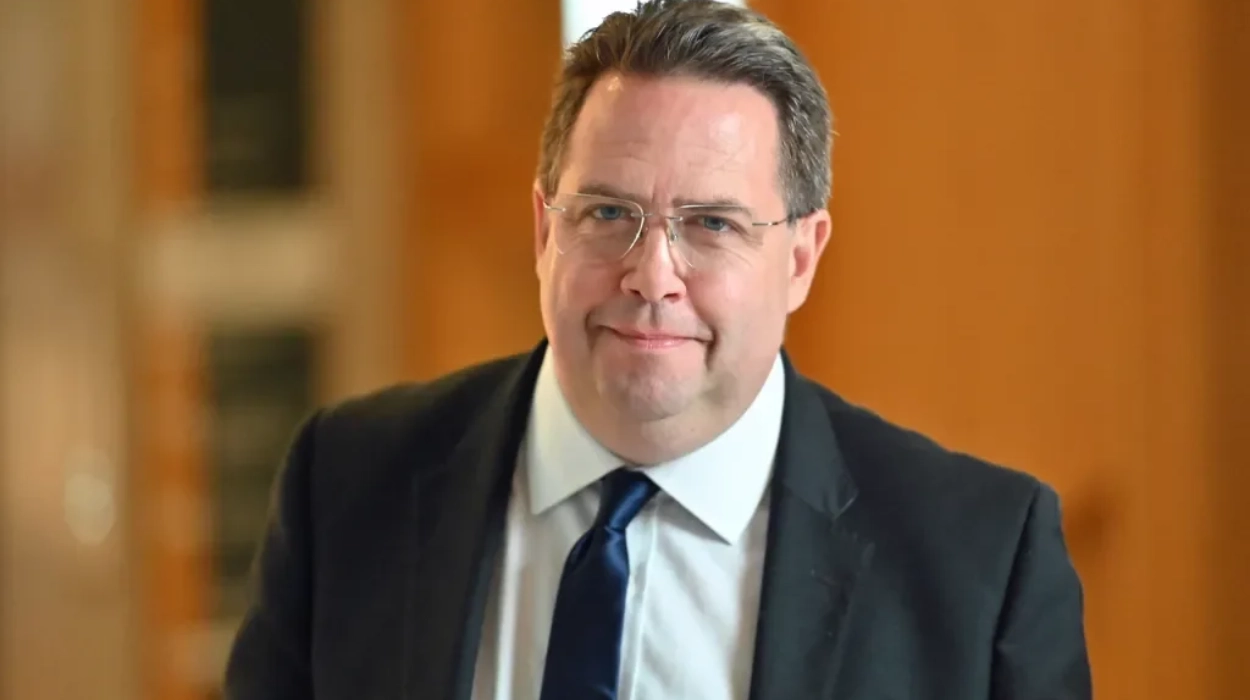
Craig Hoy, the Scottish Conservatives’ finance spokesman, says Scotland should stop funding Rwanda. His call lands in a week when Washington sanctioned Rwanda’s defence ministry and moved to strip it of trade benefits.
A senior Scottish Conservative MSP has called on First Minister John Swinney to scrap Scottish aid to Rwanda, as Kigali continues to sponsor some of Europe’s biggest football clubs and prepares to fund a brand-new Formula 1 circuit – arguing the deal offers poor value for money for Scottish taxpayers.
Hoy calls for Scotland to scrap Rwanda aid
Writing in the Scottish Daily Express on 31 October, Craig Hoy, the party’s finance spokesman at Holyrood, said the money should be redirected to public services at home. He accused the Scottish Government of indirectly funding Rwanda’s image-building, writing:
“It is John Swinney facilitating the reputation laundering.”
Hoy said the SNP had allowed more than £16m of aid to flow to Rwanda, as one of the Scottish Government’s international development partner countries.
In mid-October, Rwanda signed a 10-year deal to host an African Grand Prix from the early 2030s at a purpose-built circuit in Bugesera, around 40km south of Kigali. Reports suggest the new track will cost more than £200m to build, while the full bill could approach as much as £1bn.
He also pointed to Rwanda’s “Visit Rwanda” shirt deals with Arsenal, Paris Saint-Germain and Aston Villa, the last reportedly worth about £20m a year. Criticising the Scottish First Minister, Hoy cited Human Rights Watch, which described the F1 deal as a sportswashing tactic designed to “distract from its abysmal human rights record”.
A bad week for Rwanda
The Scottish spat came amid a challenging week for Rwanda, after the US Treasury sanctioned Rwanda’s Ministry of Defence and Zigama Credit and Savings Society, a financial institution serving the security forces, for supporting the M23 rebel group in eastern Democratic Republic of Congo.
Washington accused Zigama of financing weapons purchases for the Rwanda Defence Force and said one of its branches helped move gold from M23-held territory into Rwanda. The measures build on US sanctions imposed in March on the Rwanda Defence Force and four senior officials.
Five days later came a second blow from Washington, as US Trade Representative Jamieson Greer announced that Rwanda would lose duty-free access to the US market under the African Growth and Opportunity Act (AGOA) from1 January 2027. In his statement, she cited US concerns over trade barriers, the rule of law and human rights.
Migration talks bring fresh scrutiny
This week one apparent bright spot for Rwanda came on the same day as the US sanctions. The Financial Times reported that Germany, Austria, Greece, the Netherlands and Denmark were close to a deal to send rejected asylum seekers to Rwanda, possibly using facilities built for Britain’s abandoned scheme.
While the US moves to isolate Kigali, five European governments are seeking to strike a deal. But the talks have revived the same human-rights-centred questions that hung over Britain’s scheme. In November 2023, the UK Supreme Court ruled unanimously that Rwanda was not a safe country, citing the risk that refugees could be returned to places where they faced persecution.
Two MEPs, both of whom have visited Rwanda, told the FT they are worried about the plan. Tineke Strik, a Dutch Green MEP, warned that deportees would struggle to find work in a country with high unemployment. She told the Financial Times:
“We really fear for people getting stuck in a legal limbo there.”
Anna Strolenberg, a Volt MEP in the Greens/EFA group, said governments would do better to invest in their own asylum systems.
Zobel Behalal of the Global Initiative against Transnational Organised Crime told the FT that Rwanda was seizing a favourable moment to escape isolation and win back European favour.
Yet, in February 2025, the European Parliament urged the Commission and Council to immediately suspend the EU’s raw materials partnership with Rwanda until it ended all interference in Congo, including the export of minerals from M23-held areas.
What comes next
Pressure on Rwanda is set to build in the coming weeks, as some expect the five EU governments to unveil their Rwanda deal at a migration conference in Vienna in mid-November. Greece’s migration minister has said an agreement could be signed by January, with the first returns possibly as early as April or May.
The US trade suspension takes effect on the 1 January 2027, while the Bugesera circuit has yet to be built. For Holyrood, Hoy’s demand raises a pointed question as Washington tightens the screws, should Scottish taxpayers still be underwriting Kigali amid a slew of human rights concerns?