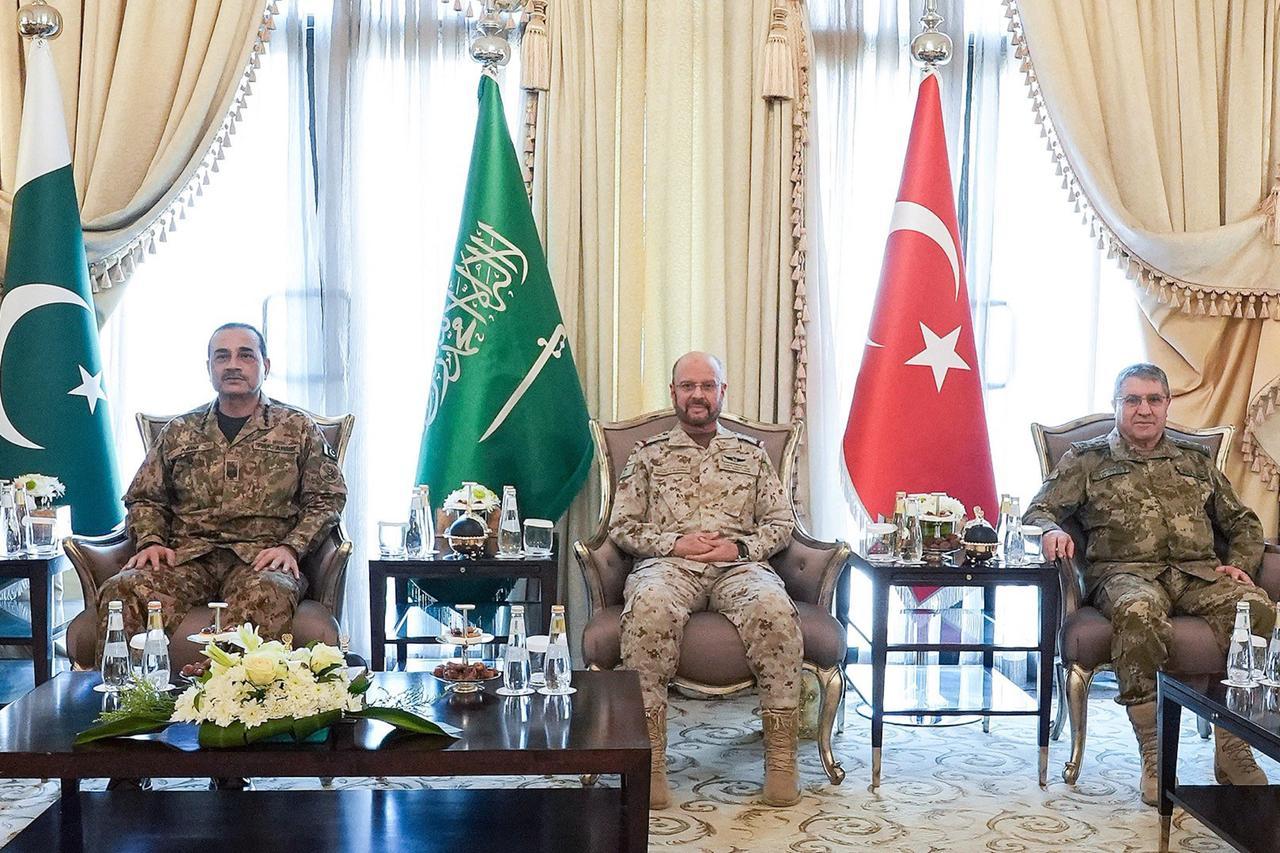
On Monday, while the defence and foreign ministers of Saudi Arabia, Pakistan and Turkey sat in an emergency meeting in Riyadh, Houthi drones and missiles hit Jazan and Najran airports, wounding three people. The ministers answered by activating, for the first time, the collective deterrence measures of the Mecca defence pact they signed on August 7, and promised the rapid deployment of forces. Seven months into the Iran war, the first collective deterrence move has come from the neighbourhood itself.
The Strait of Hormuz has been largely blocked since February 28, and at the weekend Iran’s parliament speaker, Mohammad Bagher Ghalibaf, said it would stay shut until seven conditions are met. That has made the Red Sea the Gulf’s lifeline and Saudi Arabia’s East-West pipeline its most exposed asset. The Houthis know it. In September they took stretches of Yemen’s coast and Perim Island in the Bab al-Mandeb, and on Monday they claimed strikes on Aramco sites in Riyadh and Khurais. The pipeline is running above 80 percent of capacity again, yet Brent was back above $101 on Wednesday. Aramco’s chief executive, Amin Nasser, calls the world’s supply cushion “scarily thin”; he puts global inventories below 6 billion barrels, down from about 10 billion before the war.
For fifty years the Gulf’s security arrived with an American return address. Riyadh no longer writes to it first. American power in the region is pointed at Iran, and none of that machinery was built to stop a cruise missile over a refinery on the Red Sea coast. The Saudis learned as much in September 2019, when drones and missiles knocked out half their oil output at Abqaiq and Khurais and Washington declined to strike back. Secretary of State Marco Rubio’s response this week, that Riyadh and the Yemeni government have a right to defend themselves, is support of a kind. It is not a guarantee.
Pakistan is what makes the new arrangement credible. Its officers have trained Saudi personnel since 1967. A declassified 1985 CIA assessment counted 13,000 to 14,000 Pakistanis in Saudi service, including an armoured brigade at Tabuk. The September 2025 defence pact turned that history into treaty law, and in April Pakistani fighter and support jets landed at King Abdulaziz airbase. On Monday the pact got its own machinery: Lieutenant General (retd) Nauman Mahmood of Pakistan was named its first secretary general for three years.
Islamabad brings something else no other member can. It has spent the year as the main channel between Washington and Tehran. It brokered the April ceasefire, and in June the American and Iranian presidents signed the Islamabad Memorandum. Ghalibaf’s seven conditions are anchored in that text. A government that distrusts American intentions keeps citing a document Pakistan helped write.
That standing is why the line to Tehran has stayed open while Pakistani forces head for Saudi Arabia. On October 2, Dar said Iran had distanced itself from the Houthis and that President Masoud Pezeshkian and Foreign Minister Abbas Araghchi wanted the matter settled. Tehran’s foreign ministry spokesman, Esmaeil Baghaei, said he hoped reports of a Pakistani deployment for war in Yemen were untrue. The distinction Iran is drawing, between guarding Saudi installations and joining an offensive, is one Pakistan’s own account already respects. Defence Minister Khawaja Asif put it plainly in Riyadh: Pakistan and Turkey have a presence, reconnaissance among it, “but the army fighting is that of Saudi Arabia.”
The harder test is coming, and Pakistan has sat it before. In 2015 its parliament unanimously resolved to stay neutral in Yemen while pledging to stand with Saudi Arabia if its territory or the holy sites were threatened. Shehbaz Sharif repeated the second half at the UN in September, calling any threat to Mecca and Medina a red line. Riyadh says the Houthis tried to strike Mecca; the Houthis call that a lie. The war next door is widening. Yemeni government forces say they have retaken Mocha under cover of 100 coalition jets, and their “Operation Dawn of Yemen” names Sanaa as its goal. The WHO has counted at least 959 dead since fighting resumed in July. Islamabad’s Institute of Policy Studies expects Pakistan’s contribution to stay specialised, air defence above all, rather than a large ground force. If the push toward Sanaa grinds on into winter, pressure to blur that line will grow. That is the point to watch.
The pact’s structure helps. Monday’s statement ties deployment to the national legislation of each party, so every capital keeps its own constitutional gate. Turkey’s constitution gives parliament the power to send troops abroad, and parliament has not ratified the pact. I read that as design, not weakness. A pact that binds members to respond while leaving each free to choose the instrument will last longer in a long war than one that demands everything on day one. Dar says more than six countries already want to join.
Abu Dhabi has stayed outside, and that looks like a crack until you check the calendar. On September 29, Sheikh Mansour bin Zayed met Mohammed bin Salman in Riyadh, the first senior Emirati visit since the two fell out over Yemen. The UAE can help with air defence and maritime threats without signing anything in Mecca. A Saudi, Pakistani and Turkish core with Emirati support at the edges is the nearest thing the Gulf has to a collective answer.
The G7 is releasing 100 million barrels from emergency stocks, and still every Houthi launch ends up on a fuel bill in Manila or Karachi. A Pakistani household has as much reason as any Gulf capital to want the Red Sea open and Hormuz reopened, which may be why Islamabad is working both ends of the problem at once.
The Mecca pact will be judged on a narrow question. Does the next Houthi salvo come later, and land softer, because Pakistani and Turkish crews are on Saudi soil? If it does, and Pakistan is still taking Tehran’s calls when it comes, Gulf capitals will have learned that a neighbour with a stake in the outcome can guard a refinery better than a superpower with a different war to win.