A Belgium conservation centre has chalked up a world first.
With the birth of two Lear’s macaws, Pairi Daiza has become the only nature conservation centre open to the public in the world to have successfully bred all three species of blue macaw on Earth: the hyacinth macaw, the Spix’s macaw and the Lear’s macaw.
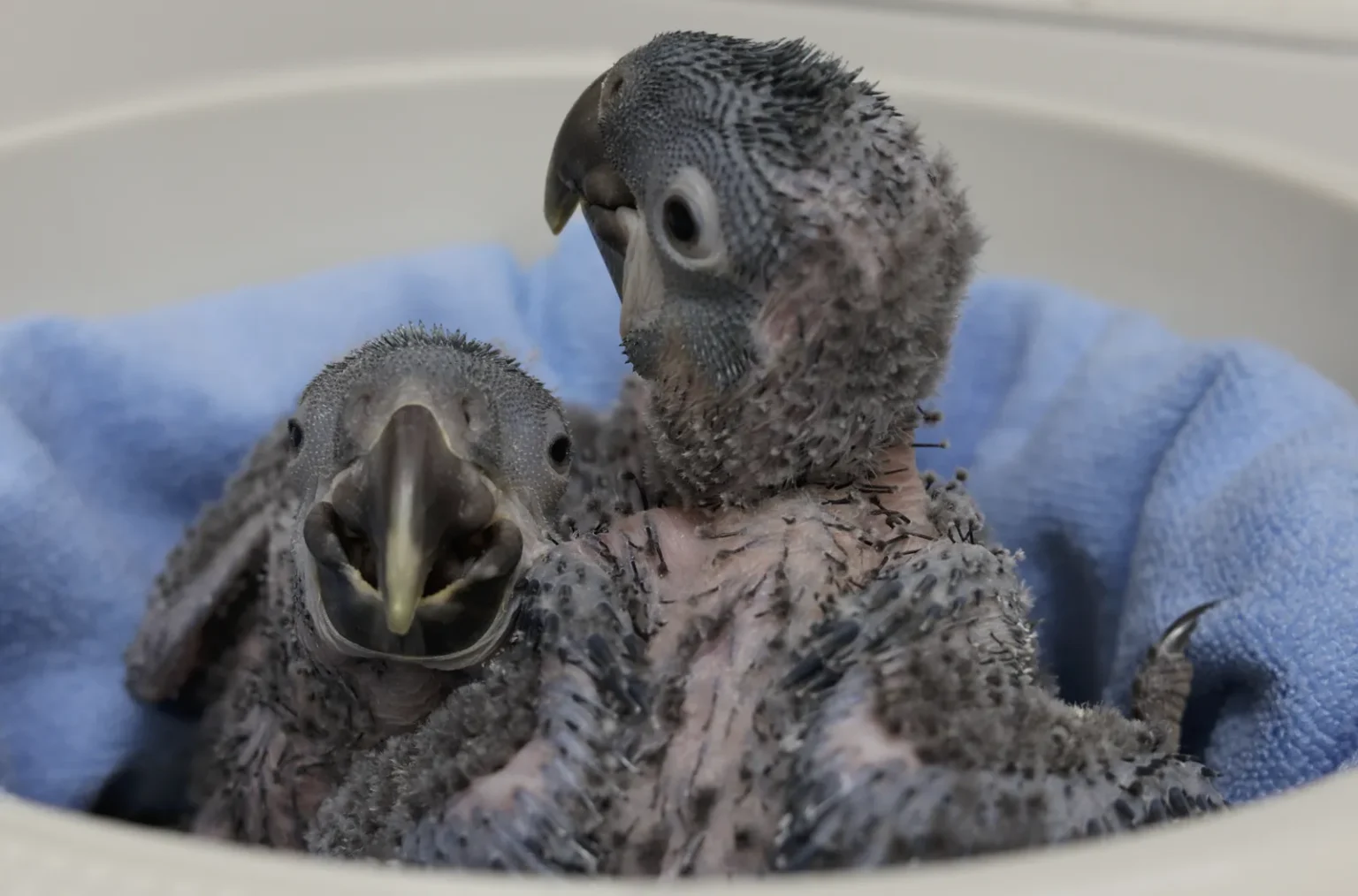
On 1 and 3 July, two Lear’s macaws (Anodorhynchus leari) were born at Pairi Daiza’s Centre for the Conservation of Rare Birds.
A single birth is sometimes an event in itself, for this species, every chick counts: the Lear’s macaw is listed as ‘Endangered’ on the International Union for Conservation of Nature (IUCN) Red List and is now found in the wild only in a semi-arid region in north-eastern Brazil.
Only a handful of conservation centres worldwide have succeeded in breeding this species.
A delighted Steffen Patzwahl, curator at Pairi Daiza, said, “Our satisfaction stems not only from the birth of these two chicks. It stems above all from the fact that we can learn from them.
“For such a rare species, every observation counts. By gaining a better understanding of their reproduction, development and behaviour, we can enrich the available knowledge and then share it with the international teams who are also committed to the conservation of this species,” said Patzwahl.
The two chicks were born on 1 and 3 July.
They are the first offspring of a breeding pair consisting of a male, born in June 2014, and a female, born in July 2017.
Last year, their first attempt at breeding ended in disappointment: the pair broke their only egg.
This situation is relatively common among young parents. The zoological teams subsequently revised their strategy.
Pairi Daiza is home to five Lear’s macaws: the breeding pair and three males.
In the wild, this species breeds in colonies.
To replicate this social atmosphere whilst preventing the breeding pair from coming under pressure from the single males, the keepers housed the latter group in adjacent aviaries. Without direct contact, their mere proximity ensured that the species’ natural breeding conditions were successfully replicated.
A few months after this adjustment, two eggs were laid. Two fertilised eggs. Two hatchlings.
The eggs were transferred to the park’s incubation room after the young parents had damaged their nest box. The teams opted for constant monitoring of the parents and eggs to maximise the chances of survival.
The two chicks, now three weeks old, are hand-fed five times a day (compared with twelve times a day during their first few days) and carers keep a constant watch over them. Their distinctive blue plumage will only become visible in a few weeks’ time.
With these two births, Pairi Daiza has reached a milestone that it says no other nature conservation centre open to the public has achieved to date: the successful breeding of all three species of blue macaw: the hyacinth macaw (Anodorhynchus hyacinthinus), the Spix’s macaw (Cyanopsitta spixii) and now also the Lear’s macaw (Anodorhynchus leari).
A spokesman for the park said, “There are no definitive victories in the field of conservation.
“Only milestones which, when taken together, can enable a species to continue its history. Today, these two young Lear’s macaws are writing a new chapter/future to that history.”