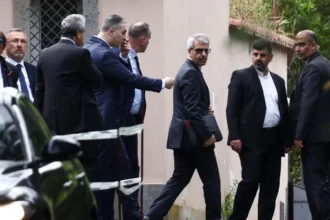
Tehran (Brussels Morning Newspaper) – Iranian Foreign Minister Abbas Araghchi will address the nation’s nuclear program and the case of an Iranian citizen detained in France during a visit to Paris this week, the foreign ministry announced Tuesday.
Araghchi and his French counterpart Jean Noel Barrot will meet following France’s support of a resolution urging Iran to grant the International Atomic Energy Agency (IAEA) access to important nuclear sites, including those that were bombed during the 12-day conflict with Israel in June.
In a statement, Iran’s foreign ministry stated the country’s nuclear programme, along with
“the case of Iranian national Mahdieh Esfandiari, as well as regional and international developments,”
will be consulted.
How will Araghchi address the Esfandiari detainee case?
The case of Esfandiari, a 40-year-old Iranian who was detained in France in February on suspicion of encouraging terrorism and subsequently freed on bail in October, will also be discussed.
The French couple Cecile Kohler, 41, and Jacques Paris, 72, who had been detained in Iran for over three years, were to be exchanged for Esfandiari in negotiations between France and Iran. Iran announced earlier this month that it had conditionally freed Kohler and Paris, who were taken right away by French diplomats to France’s mission in Tehran and were awaiting authorisation to return to France.
Why is Iran refusing IAEA access to nuclear facilities?
In mid-June, Israel initiated an unprecedented bombing campaign against Iran, leading to a 12-day conflict that the United States briefly joined by targeting critical Iranian nuclear sites.
Since the war, Iran has prohibited IAEA inspectors from visiting the bombed sites. Last week, it officially ended a cooperation framework agreement it had previously agreed with the agency. Tehran also stated that a new framework is necessary to access the bombed sites, citing concerns over “safety and security risks”.
Since October, Iran has maintained that the agreement was invalid after Britain, Germany, and France, also known as E3, reinstated UN sanctions originally lifted under the now-defunct 2015 nuclear deal. In a published interview last week, Araghchi stated that discussions with European governments were “no longer useful” following their activation of the snapback sanctions.
What led the E3 to decide on imposing snapback sanctions?
In August 2025, sources indicated that talks between Iran and the E3 nations did not yield significant commitments from Iran, but they saw potential for ongoing diplomatic efforts in the coming weeks.
The talks failed to yield sufficient concrete commitments from Tehran. Consequently, the E3 decided to trigger the snapback of U.N. sanctions, citing accusations that Iran breached the 2015 agreement aimed at preventing nuclear weapons development, according to diplomats.