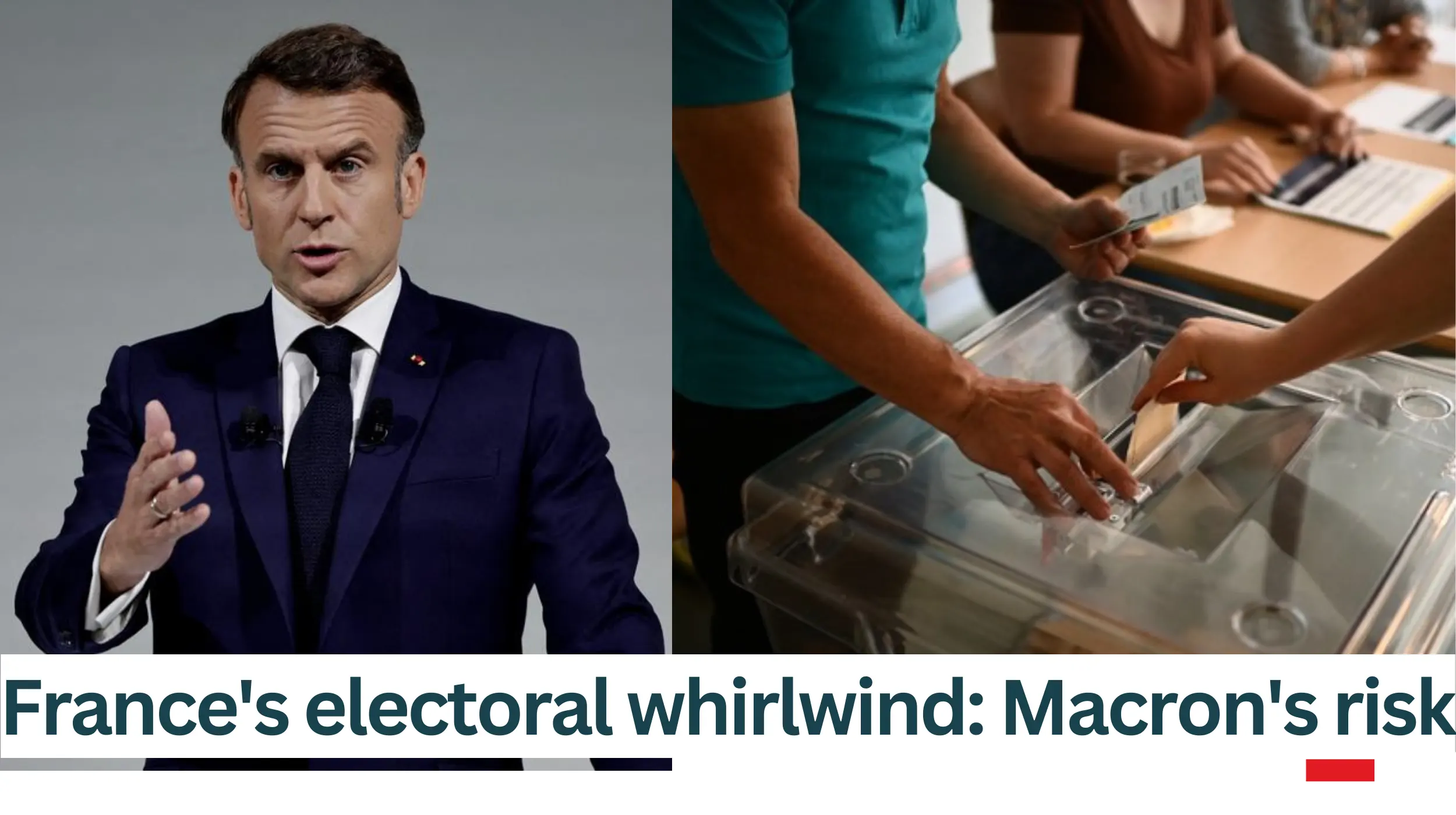
Belgium (Brussels Morning Newspaper) – President Emmanuel Macron has dissolved the French National Assembly, initiating new elections amid a tense political climate. This bold move, driven by domestic political challenges and the upcoming Paris Olympics, risks empowering either the far-right National Rally or the radical left Popular Front. Macron’s decision follows a series of electoral and legislative setbacks, reflecting the volatility and urgency of contemporary French politics. Critics argue that this gamble, aimed at securing Macron’s legacy, may instead destabilize the country’s political landscape and undermine efforts to curb extremist influences.
ePresident Emmanuel Macron’s recent decision to dissolve the National Assembly and call for new elections marks a bold and risky maneuver in the midst of a tumultuous political landscape in France. With the Paris Olympic Games on the horizon, Macron’s gamble risks ceding power to either the far-right National Rally or the radical left Popular Front, both of which could significantly alter France’s political direction. This move comes as France grapples with economic challenges, rising living costs, and social unrest, raising critical questions about the country’s future and Macron’s legacy.
Macron’s High-Stakes Political Gamble
By plunging France into an electoral whirlwind so close to the upcoming Paris Olympic Games, President Emanuel Macron has certainly taken the biggest gamble of his political career. This move risks ceding power to either the far right, with its well-known anxieties and uncertainties, or to the Popular Front, driven by the radical left. The latter has pledged sweeping reforms aimed at dismantling the Macron era and fortifying France against the resurgence of the far right.
As France braces for this crucial electoral battle, the potential for dramatic political realignment looms large, raising questions about the future direction of French politics. With the global spotlight on Paris, the outcome of this electoral sequence will resonate far beyond France’s borders, influencing its position on the world stage and its internal cohesion amidst a time of profound change. This bold decision underscores the volatility and urgency of contemporary French politics.
President Macron anticipates that upcoming French elections will differ significantly from the European ones. Despite widespread anger over the economy, cost of living crisis, soaring electricity bills, and street violence, Macron believes that expressing this discontent by supporting the Far Right remains a step too far for most French voters. Handing power to Marine Le Pen and Jordan Bardella seems improbable to him.
However, this confidence is not without its risks. For two decades, ruling liberal and centrist parties have relied on the assumption that voters won’t shift dramatically to the Far Right. Although they have consistently won, their margins have become alarmingly thin. With tensions rising, the narrow buffer that has protected mainstream parties may finally vanish in the coming weeks.
President Macron’s decision to dissolve parliament and expedite the electoral agenda has caused significant internal party fractures and external reverberations. Three major shocks have emerged. First, Eric Ciotti’s Republican party experienced a public rift over forming an electoral alliance with Marine Le Pen and Jordan Bardella’s National Rally. Simultaneously, Eric Zemmour’s Reconquest party fragmented as Marion Marechal and its European deputies allied with the National Rally, which Zemmour denounced as a great betrayal. The third shock was within the left-wing factions.
Despite their divisions and egos, they united rapidly to form a popular front. This front aims to replace the Republican front that historically blocked Jean-Marie Le Pen and his daughter Marine from the presidency — once against Jacques Chirac and twice against Macron. The left’s swift unification underscores their urgent response to the high probability of the far right gaining power in the imminent legislative elections. This sense of urgency reveals the depth of concern gripping the left in the face of rising far-right momentum in France.
On June 9, French voters delivered a historic victory to Marine Le Pen’s far-right National Rally (RN) in the European elections. Her party garnered an unprecedented 31.5% of the vote, doubling the tally of the centrist alliance supported by President Emmanuel Macron. Additionally, a separate far-right list led by Le Pen’s niece, Marion Maréchal, secured another 5% of the vote. Apparently, this electoral drubbing – and expected no confidence motion over the next budget – prompted Macron to take a drastic step by dissolving the National Assembly, aiming to call for new elections on his own terms rather than playing defense later.
It seems plausible that Macron’s gambit aims to outflank the far right, even though they initially demanded the early election. Alternatively, his strategy might be to allow the RN to assume political responsibility, hoping that their governance will disappoint public opinion, diminishing their influence by the 2027 presidential election. By doing so, Macron could pave the way for a successor from outside the far right to occupy the Elysée. This high-stakes maneuver underscores the struggle to contain the far-right surge.
Macron’s Risky Election Gamble
Macron seems delusionally proud of his latest political gambit. But is this the right moment for such a risky maneuver, merely to secure the Macron legacy? A three-week election campaign is dangerously short, especially given the stakes and potential chaos ahead. Regardless of his intentions, treating the country like a roulette table reveals a concerning disregard for the fate of millions of French citizens. Macron’s gamble, in his quest to outwit the far right, reflects a troubling prioritization of political gamesmanship.
In the wake of Macron’s decision to dissolve the assembly, questions arise about the sentiments of those who could become prime targets under a government aligned with a party co-founded by Nazi sympathizers, notably Jean-Marie Le Pen. Dissolving the assembly in such a climate presents an unprecedented chance for the extreme right to tighten its hold on parliament and, conceivably, steer the course of France. The ramifications of this move extend far beyond political strategy, raising concerns about the future direction of French governance and the potential erosion of democratic values in the face of resurgent extremism.
Despite the rebranding efforts and polished facade of the RN, its extremist ideology remains unchanged. Marine Le Pen’s strategic makeover, including relatable social media posts and public performances, aims to mask the party’s extremist beliefs. However, beneath the surface, the RN’s racist and xenophobic agenda persists, firmly situating it at the extreme end of the political spectrum.
Despite attempts to appear more mainstream, the party’s core values remain deeply rooted in intolerance and exclusion. The challenge lies in recognizing the stark dissonance between the RN’s public persona and its underlying ideology. Instead of confronting the far-right ideology, Macron has, over his two terms, tailored his policies to appeal to far-right voters. This strategic shift has, in part, normalized the far-right’s ideas, a move for which the Macron must bear some responsibility.
During the European election campaign, Macron attempted to frame the contest as a binary opposition between his party and the far-right, sidelining progressive voices. This maneuver not only amplified the far-right’s presence but also contributed to the marginalization of progressive ideas. Macron’s approach underscores a troubling trend in contemporary French politics, where extremist views gain legitimacy. After the 2022 elections, Macron’s camp and his coalition partners held a relative majority, allowing the government to pass laws without a vote using Article 49-3 of the constitution or to seek broader political support in the chamber.
However, with the far-right gaining popularity and anti-government sentiment rising, Macron’s team anticipates significant parliamentary disruption. A win for the National Rally could usher in another period of cohabitation, with the president and prime minister hailing from opposing political camps. RN President Jordan Bardella is campaigning as the party’s candidate for France’s new prime minister. France’s hyper-presidential-monarchical republic ensures that Macron would retain significant control over foreign policy and defense, even if forced to “cohabitate” with the far right. However, this political arrangement would severely compromise whatever remains of his gravitas. The potential shift underscores the fragility of Macron’s leadership and the profound impact a National Rally victory could have on France’s domestic and international standing.
Dear reader ,
Opinions expressed in the op-ed section are solely those of the individual author and do not represent the official stance of our newspaper. We believe in providing a platform for a wide range of voices and perspectives, even those that may challenge or differ from our own. We remain committed to providing our readers with high-quality, fair, and balanced journalism. Thank you for your continued support.