

Artificial intelligence (AI) is reshaping industries, governments, and daily life worldwide. As AI systems become more pervasive and impactful, the need for robust governance frameworks has grown urgent. The European Union (EU) has taken pioneering steps by introducing the EU AI Act, a comprehensive regulatory framework aimed at ensuring AI technologies are safe, trustworthy, and respect fundamental rights.
- Why the EU AI Act Matters
- Understanding the EU AI Act: Scope and Risk-Based Approach
- Key Provisions and Compliance Obligations
- Institutions and Enforcement Framework
- Global Significance and Influence
- Support for Businesses and Innovators
- Challenges and Critiques
- The Future of AI Regulation in the EU and Beyond
Why the EU AI Act Matters
The EU AI Act represents the first major attempt by a significant regulator to comprehensively regulate artificial intelligence. Drawing lessons from earlier regulations like the General Data Protection Regulation (GDPR), the Act seeks to balance innovation and protection by categorizing AI applications based on risk levels and imposing corresponding legal requirements.
AI now influences many facets of life from content recommendation algorithms shaping online experiences, to facial recognition technology in law enforcement, and diagnostic AI in healthcare. The importance of regulating such technologies responsibly cannot be overstated, as misuse could lead to violations of privacy, discrimination, or harm.
Understanding the EU AI Act: Scope and Risk-Based Approach
The EU AI Act classifies AI applications into three principal risk categories:
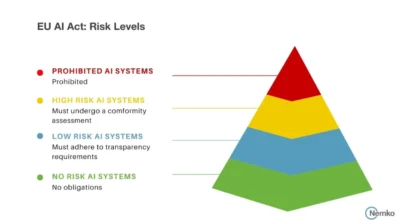
- Unacceptable Risk AI Systems: These include AI technologies banned outright due to their potential to severely violate fundamental rights. Examples include government-controlled social scoring systems akin to those implemented in China, which assign behavioral scores for social control. Such systems conflict with EU values and are prohibited.
- High-Risk AI Systems: These are AI applications that have significant implications for people’s safety or fundamental rights. High-risk systems include recruitment and CV-screening tools, biometric identification systems, and AI used in critical infrastructures. Such systems must comply with stringent requirements covering data governance, documentation, transparency, human oversight, and robustness.
- Low- or Minimal-Risk AI Systems: Applications not falling under the above categories receive lighter regulation or none at all, allowing for flexibility and innovation without compromising safety.
The risk-based framework ensures regulatory efforts are proportional and targeted, reducing barriers to adoption in low-risk domains while safeguarding against potential harms where stakes are high.
Key Provisions and Compliance Obligations
Transparency and Documentation

High-risk AI providers must maintain detailed technical documentation demonstrating compliance with the Act’s requirements. Transparency toward users is mandatory, including clear information about AI system capabilities and limitations.
Risk Management and Human Oversight
Obligations include implementing risk management systems to monitor potential harms and providing means for human oversight to prevent or intervene in AI-driven decisions.
Data Governance
Datasets must be relevant, representative, and free from biases to prevent discriminatory outcomes. Training data requirements and post-market monitoring ensure ongoing compliance and effectiveness.
Registration and Conformity Assessment
Providers of high-risk AI must perform conformity assessments and register their systems in an EU database overseen by the European AI Office (the new regulatory body established to implement and enforce the Act).
Institutions and Enforcement Framework
The EU AI Act introduces dedicated institutions to govern AI regulations. The European AI Office coordinates with national authorities in member states to monitor compliance, investigate violations, and issue sanctions if necessary.
This multilevel governance model promotes unified enforcement across the EU while ensuring national regulatory aspects are respected. It also provides a platform for dialogue between regulators and AI developers, enabling a balance between innovation promotion and ethical oversight.
Global Significance and Influence
The EU AI Act has implications far beyond Europe. Its design serves as a model for AI regulation worldwide, influencing countries such as Brazil, which passed foundational AI legislation inspired by EU norms.
By establishing rigorous standards for AI ethics, safety, and transparency, the EU sets a de facto global benchmark akin to how GDPR shaped data privacy regulations internationally. Companies aiming to operate in the EU market or globally often voluntarily adopt EU-aligned practices to ensure smooth market entry and demonstrate social responsibility.
Support for Businesses and Innovators
Recognizing the complexity of compliance, the EU AI Act includes resources like the AI Act Compliance Checker targeted at SMEs and startups to assess their obligations and voluntarily align with regulatory goals.
Furthermore, the Act encourages the development of AI literacy programs and regulatory sandboxes. Regulatory sandboxes permit developers to test AI innovations under close supervision, thus fostering safe experimentation while gradually integrating compliance requirements.
Challenges and Critiques
While groundbreaking, the EU AI Act faces practical and conceptual challenges:
- The pace of technological evolution risks outstripping regulatory updates.
- The complexity of categorizing AI may lead to regulatory uncertainties.
- Balancing innovation incentives with public safety and privacy is inherently difficult.
- Enforcement effectiveness depends on the capacity and coordination of regulatory bodies across member states.
These challenges require ongoing dialogue among policymakers, technologists, and civil society to ensure the regulation remains fit for purpose.
The Future of AI Regulation in the EU and Beyond
The EU AI Act embodies a pioneering approach to AI governance, aiming to harness AI’s benefits while mitigating risks. Its risk-based classification, combined with transparency, accountability, and enforcement measures, set a solid foundation for trustworthy AI systems.
As artificial intelligence becomes embedded in virtually every sector, having a coherent, ethical, and enforceable regulatory framework is essential to safeguard fundamental human rights and promote societal well-being.
The EU AI Act not only protects European citizens but also shapes a global conversation on how advanced technologies should be developed and used responsibly making it a vital milestone in the ongoing evolution of digital governance.
Dear reader,
Opinions expressed in the op-ed section are solely those of the individual author and do not represent the official stance of our newspaper. We believe in providing a platform for a wide range of voices and perspectives, even those that may challenge or differ from our own. We remain committed to providing our readers with high-quality, fair, and balanced journalism. Thank you for your continued support.