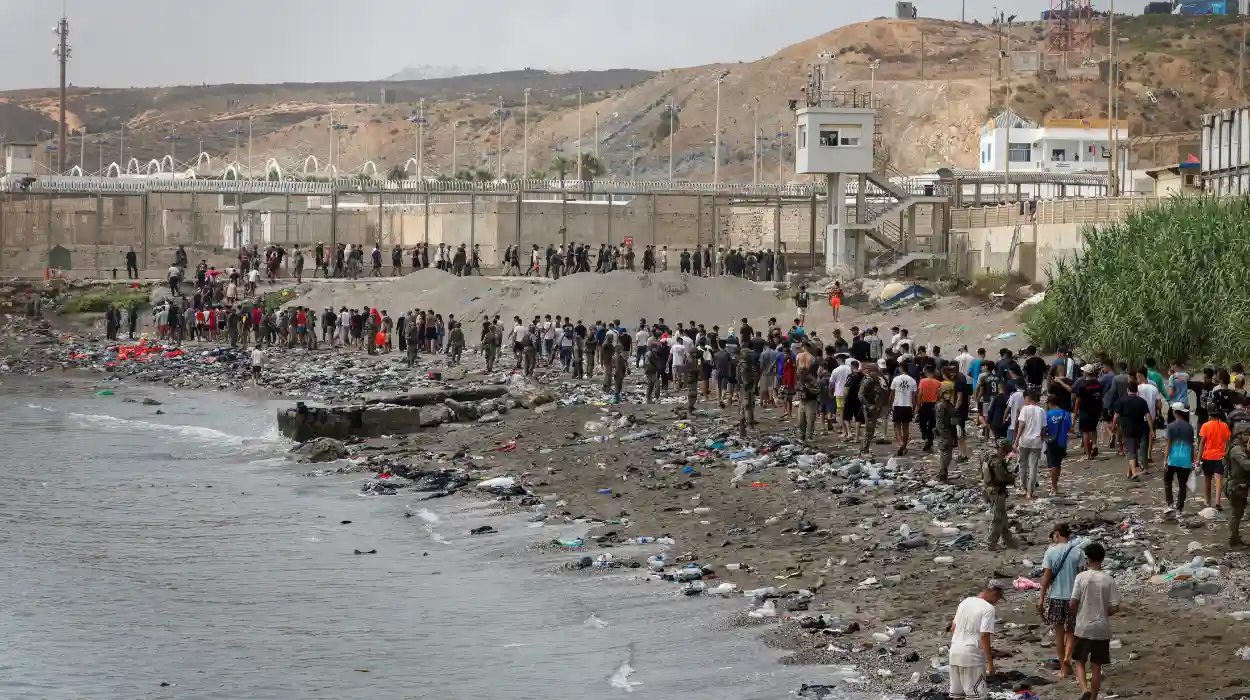
Strasbourg (Brussels Morning Newspaper) September 15, 2026 – European Commissioner for Interior and Migration Magnus Brunner emphasized on Tuesday that returning all irregular migrants to Morocco remains the European Union’s top priority following the influx into Ceuta on July 30 and 31. Addressing the European Parliament in Strasbourg, Brunner praised Morocco’s commitment to accepting returns while highlighting ongoing pressures in the autonomous city, including 2,000 unaccompanied minors. He reaffirmed that Schengen integrity was maintained and advocated for reinforced external borders through the European Migration Pact.
European Priority on Swift Expulsions and Bilateral Cooperation
The European Union has declared that its immediate objective regarding the recent border incidents in Ceuta is ensuring the rapid return to Morocco of all individuals who entered Spanish territory irregularly and lack legal grounds to remain.
Speaking before the plenary session of the European Parliament in Strasbourg, France, European Commissioner for Interior and Migration Magnus Brunner stated that finding an urgent resolution to the crisis in the North African autonomous city is paramount for the bloc. The parliamentary debate was convened to address recent hybrid challenges, the instrumentalisation of migrants along the border, and the requirement for a coordinated European response to secure the EU’s external frontiers.
During his address, Commissioner Brunner reiterated that the primary strategy of Brussels centers on swift deportation procedures. He acknowledged the cooperation of Moroccan authorities, noting their explicit commitment to accepting all individuals returned under bilateral and international frameworks.
Humanitarian Pressure and Public Order Challenges in Ceuta
The Austrian commissioner detailed the ongoing logistical and humanitarian challenges within the Spanish enclave, which encompasses an area of less than 20 square kilometres. Despite initial deportation efforts, thousands of migrants remain in Ceuta awaiting formal return processing. Among those remaining are approximately 2,000 unaccompanied minors. Brunner observed that this concentrated presence continues to create severe public order challenges and places immense strain on local infrastructure and municipal resources.
In his opening remarks, Brunner expressed formal solidarity with the residents of Ceuta. He described the events of late July as an unprecedented situation for the autonomous city, noting that the volume of arrivals over the two-day period was nearly equivalent to Ceuta’s total permanent population of approximately 80,000 residents.
The commissioner also conveyed official condolences to the families of migrants who lost their lives at sea while attempting the maritime crossing from the Moroccan coast. Addressing the role of human smuggling networks in the tragedy, Brunner stated that illicit trafficking operations directly endanger human lives and emphasized the imperative for international law enforcement to dismantle these operations.
Preserving Schengen Integrity and High-Level Ministerial Meetings
Reflecting on the operational impact of the July 30–31 border breaches, the European official acknowledged that the scale of the arrivals tested the operational resilience of the European Union, its institutional mechanisms, and its emergency response capacity. However, he underscored that emergency containment actions proved effective, with the majority of individuals who entered without authorization being processed and returned to Morocco within hours of their arrival.
A central focus of Brunner’s statement was the preservation of European territorial integrity. The commissioner explicitly confirmed that no individuals who entered Ceuta irregularly gained entry into the broader Schengen area, thereby preserving the integrity of the border-free zone. He attributed this outcome directly to the swift operational interventions carried out by Spanish security forces, supported by formal bilateral coordination with Moroccan border authorities.
Addressing political coordination, Brunner highlighted that the European Commission has maintained continuous contact with the Spanish government since the outbreak of the crisis. As part of this ongoing engagement, the commissioner announced upcoming high-level executive meetings scheduled in Madrid.
Brunner is set to hold consultations with key members of the Spanish Cabinet, including:
-
Ángel Víctor Torres, Minister of Territorial Policy and Democratic Memory;
-
Fernando Grande-Marlaska, Minister of the Interior;
-
Elma Saiz, Minister of Inclusion, Social Security and Migrations, who also serves as Government Spokesperson.
Reinforcement of EU Borders and External Frameworks
Turning to structural policy measures, Commissioner Brunner urged all EU member states to fully engage with and deploy the legislative mechanisms provided under the European Migration Pact. He argued that comprehensive implementation of the pact is essential to strengthening controls along all external European borders and accelerating formal return procedures for individuals whose asylum claims are denied or who enter unlawfully.
Brunner noted that while operational gaps remain to be addressed, the European Union must analyze and integrate the operational lessons learned from the Ceuta influx. Such structural adaptations are necessary to prevent similar coordinated or sudden border breaches from occurring elsewhere across the Union’s external limits.
Concluding his testimony to the European Parliament, the commissioner emphasized the necessity of projecting firm border security while reassuring European citizenry. He stated that both smuggling networks and irregular migrants must understand that the European Union will continually reinforce its defensive apparatus, concluding that European institutions must provide clear reassurance to the public that border management and security operations remain under full institutional control.