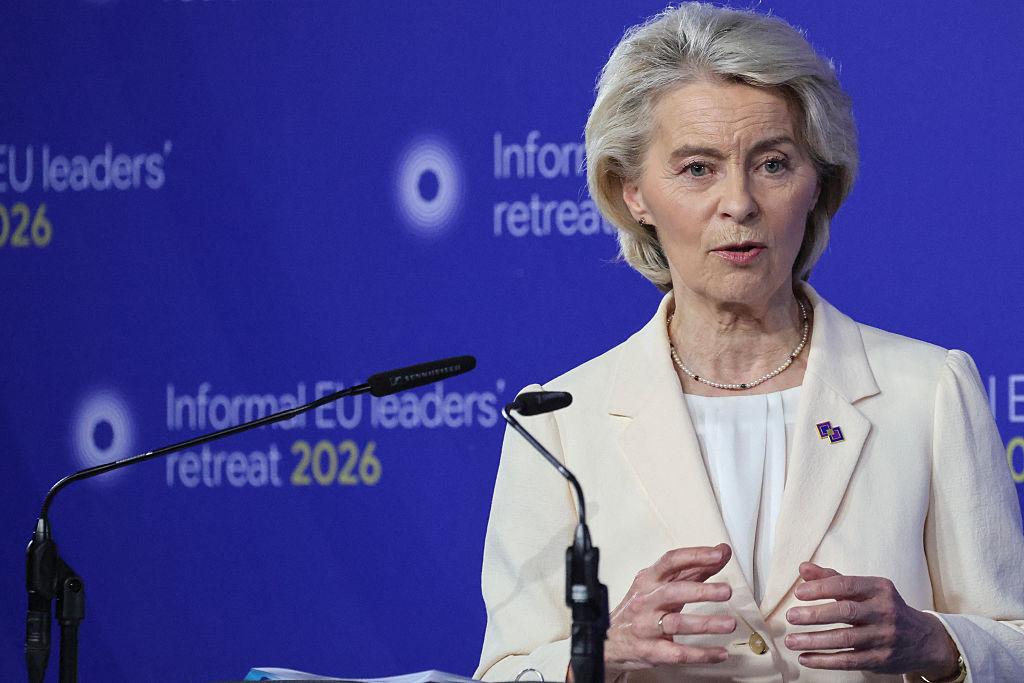
Alden Biesen, Belgium12 February 2026 at a pivotal moment for Europe’s economic future, António Costa emerged from the informal EU leaders’ retreat with a clear and forceful message: 2026 will be the year Europe delivers on competitiveness. Costa said in a press conference today.
Against a backdrop of intensifying global competition, trade tensions, technological disruption, and geopolitical instability, EU leaders gathered at the historic Alden Biesen Castle determined to chart a new course for prosperity, industrial innovation, and strategic autonomy.
What followed was not merely a discussion it was, in Costa’s words, a strategic turning point. With Mario Draghi and Enrico Letta shaping the intellectual framework of the debate, and strong interventions from Ursula von der Leyen and Emmanuel Macron, the retreat crystallized an urgent political consensus: Europe must move faster, invest more, protect its strategic interests, and complete its single market once and for all.
The March European Council is now set to transform these discussions into binding commitments, timelines, and legislative action.
A New Urgency Around Competitiveness
Opening the press conference, European Council President António Costa underscored a shared sense of urgency among leaders.
“Today’s discussions in Alden Biesen brought new energy and a shared sense of urgency,”
he said.
“Most importantly, today we paved the way to agree on concrete actions in the March European Council.”
The objective is clear: build a more competitive and resilient European economy capable of delivering:
⦁ Economic growth
⦁ Industrial innovation
⦁ High-quality jobs
⦁ Affordability for citizens and businesses
Costa framed competitiveness not as an abstract economic concept, but as the foundation of Europe’s prosperity and sovereignty in an increasingly hostile global environment.
Draghi’s Warning: Europe in a Harder World
The retreat’s first working session began with a presentation by former Italian Prime Minister Mario Draghi, whose influential report on European competitiveness has shaped much of the current debate.
Draghi laid out the stark realities of a shifting geopolitical and geoeconomic landscape. The EU, he argued, faces intensified economic coercion, growing trade imbalances, and fierce industrial competition from both the United States and China. Critical raw materials, advanced technologies, and strategic supply chains are now arenas of geopolitical power.
Leaders discussed how the EU should position itself in this environment where economic competition is not always fair, and dependencies can quickly turn into vulnerabilities.
Two priorities emerged:
⦁ Accelerating Europe’s trade agenda, with a focus on diversification.
⦁ Defending European companies, including through targeted protection in strategic sectors.
Rules allowing for “European preference” in specific areas and a systematic de-risking approach were widely acknowledged as necessary tools in the new global reality.
Draghi reportedly encouraged leaders to consider enhanced cooperation mechanisms to move reforms forward faster if unanimity proves elusive.
From 27 Markets to “One Europe, One Market”
If the first session addressed Europe’s external challenges, the second turned inward.
Enrico Letta, former Italian Prime Minister and author of a landmark report on the future of the single market, challenged leaders to move beyond what he called an “incomplete single market.”
Costa summarized the consensus succinctly:
“The Leaders accept Enrico Letta’s challenge to move from an incomplete single market to ‘one market for one Europe.’ This is urgent and must be done in 2026 and 2027.”
The fragmentation of Europe’s regulatory environment continues to hinder company growth, cross-border operations, and capital allocation. National barriers, diverging standards, and inconsistent implementation create friction that weakens Europe’s global position.
To address this, leaders endorsed several major initiatives:
The 28th Regime
A centerpiece of the discussion was the proposed “28th regime” a unified legal framework allowing companies to operate across all 27 member states under a single set of corporate rules.
The aim: eliminate fragmentation, simplify scaling up, and make Europe more attractive for investment.
Costa made clear that leaders want this regime to advance quickly this year. However, the political path forward remains delicate.
He emphasized his preference for unanimity among the 27 member states. But he also acknowledged that, if necessary, the EU’s enhanced cooperation mechanism which allows at least nine member states to proceed together could be used.
“We move forward with the speed of the slowest,”
Commission President Ursula von der Leyen remarked.
“Enhanced cooperation avoids that.”
Still, Costa stressed:
“Our first goal is to ensure that all 27 member states agree.”
Simplification: Cutting Red Tape to Unlock Growth
Unanimous support emerged for accelerating the EU’s regulatory simplification agenda, as outlined in Ursula von der Leyen’s recent letter to leaders.
Reducing bureaucratic burden, streamlining compliance requirements, and harmonizing standards are seen as essential to boosting investment and innovation.
Von der Leyen announced that she will present a “One Europe, One Market” roadmap at the March summit. The action plan will include detailed timelines, targets, and deadlines, structured around five building blocks:
⦁ Regulatory simplification
⦁ The single market
⦁ Energy
⦁ Digital
⦁ Trade
This roadmap is expected to serve as the operational blueprint for Europe’s competitiveness push.
Telecom Consolidation and European Champions
One of the more sensitive topics discussed was consolidation in key sectors such as telecommunications.
Costa confirmed that leaders broadly agree that in certain industries, Europe may need to allow greater consolidation to achieve the scale required for investment and innovation.
However, this would come with conditions what Costa described as a “social contract.”
Consolidated companies would be expected to:
⦁ Invest more
⦁ Innovate more
⦁ Strengthen Europe’s technological edge
The goal is the emergence of genuine European champions capable of competing globally in strategic sectors.
The ongoing review of EU merger guidelines will play a central role in shaping this approach.
Energy Prices and the Transition Imperative
High electricity prices remain a major concern for European industry and households.
Costa reaffirmed that the green energy transition is the best long-term strategy for lowering costs and achieving strategic autonomy. However, leaders also recognized the need for pragmatic short-term solutions.
Concrete measures tailored to the specific challenges of member states and energy-intensive sectors will be explored ahead of the March summit.
Energy affordability is directly tied to Europe’s industrial competitiveness a theme repeatedly emphasized throughout the retreat.
Protecting Strategic Industries and Reducing Dependencies
A broad consensus emerged around the need to protect and reinforce strategic sectors.
Among those cited:
⦁ Defence
⦁ Space
⦁ Cleantech
⦁ Quantum technologies
⦁ Artificial Intelligence
⦁ Payment systems
Leaders agreed to map Europe’s dependencies and pursue diversification strategies to reduce vulnerabilities.
On the sensitive issue of European preference, Costa indicated broad support for its targeted and proportionate use in selected strategic sectors but only after in-depth analysis.
This marks a significant evolution in EU thinking, reflecting a more assertive industrial policy posture.
Trade: Open, but Not Naïve
Despite growing protectionist pressures globally, leaders reaffirmed that Europe remains open for trade. However, openness must be paired with pragmatism.
An ambitious and diversified trade policy, combined with tools to defend against unfair competition, is now viewed as essential. Support for the European Commission’s ongoing trade negotiations and enforcement work was unanimous.
The Investment Gap: Private and Public Capital
Perhaps the most striking element of the retreat was the recognition that Europe suffers from a chronic investment shortfall.
“There will be no competitiveness without more investment,” Costa declared.
The focus is on mobilizing private capital through the acceleration of the Savings and Investment Union. Europe must better channel its vast pool of savings into productive investment within the continent.
A single and efficient financial system particularly deeper capital markets integration is considered crucial.
But public investment remains part of the equation.
As negotiations over the next Multiannual Financial Framework (MFF) approach, leaders will have to confront the question of European financial instruments.
The Eurobond Debate Resurfaces
French President Emmanuel Macron called for calm in the ongoing debate over joint European debt.
“There is no taboo on this topic,” he said.
Macron emphasized the need for public investment to finance innovation and competitiveness, referencing last December’s €90 billion joint loan to support Ukraine as precedent.
Germany and Italy favor prioritizing private investment, while France continues to advocate for joint borrowing mechanisms.
Macron set June as a deadline for agreeing on a package to relaunch the European economy, warning that enhanced cooperation may be necessary if progress stalls.
Enhanced Cooperation: A Tool of Last Resort?
Enhanced cooperation — requiring at least nine member states — has gained renewed attention.
It was recently used to issue the €90 billion Ukraine loan without Hungary, Slovakia, and the Czech Republic.
While Costa and von der Leyen prefer unity among all 27, both acknowledge that Treaty mechanisms exist to prevent paralysis.
In an era of mounting global pressure, the political appetite for moving ahead in smaller coalitions appears to be growing.
A Defining Year Ahead
As the retreat concluded, Costa sought to project confidence.
“In 2026, Europe will deliver,” he said. “We did on defence last year, we will on competitiveness this year.”
The March European Council will translate today’s strategic brainstorming into binding commitments and timelines. From there, the focus shifts to implementation.
The gathering at Alden Biesen was informal in format but decisive in tone. It marked the beginning of what could become one of the most consequential reform cycles in recent EU history.
The question now is not whether Europe recognizes the urgency — it does.
The question is whether it can match that urgency with political courage and execution.
If António Costa’s closing words are any indication, Europe’s leadership believes the moment demands nothing less.