
The relationship between the European Union and Canada is becoming closer, especially when it comes to security and defence. In the past, the EU and Canada worked together mainly on trade, economy and political issues. But the situation has changed, especially since Russia started its full-scale war against Ukraine. Today, security is one of the main issues bringing Canada and Europe closer together.
Canada is not a member of the European Union, but it is an important NATO member. At the same time, 23 EU countries are also members of NATO. This makes the relationship between Canada, the EU and NATO very important for European and transatlantic security.
In June 2025, Canada and the EU signed a Security and Defence Partnership. The agreement covers several areas, including support for Ukraine, military mobility, cybersecurity, maritime security, defence cooperation, space and new technologies.
For the EU, the war in Ukraine has shown that Europe needs to strengthen its defence capabilities. European countries are increasing defence spending and looking for ways to produce more military equipment inside Europe.
For Canada, cooperation with Europe is also becoming more important. Canada has been supporting Ukraine and continues to work closely with its NATO allies.
Why is Canada important for the EU?
Canada has a long history of working with European countries through NATO. It is one of NATO’s founding members. The EU is now trying to develop a stronger role in defence. But the EU is not trying to replace NATO. NATO remains the main organisation for collective defence for its members.
This is important because sometimes people see the EU’s new defence initiatives as competition with NATO. The reality is more complicated.
The EU can work on defence investment, industrial production, military mobility and other areas, while NATO remains responsible for collective defence and military planning among its members. The two organisations are therefore becoming more connected. Canada is part of this picture.
Ukraine brings them closer
Ukraine is one of the main reasons why European countries and Canada are working more closely together. Since Russia’s full-scale invasion in 2022, Canada and European countries have provided military, financial and humanitarian support to Ukraine. The EU-Canada Security and Defence Partnership also identifies Ukraine as an important area for cooperation.
NATO is also at the centre of this cooperation. Canada and European NATO members are supporting Ukraine through military assistance, training and other forms of support.
The war has also changed the way many European governments think about defence. For many years, defence was not the main political priority in Europe. Now the situation is different.
European governments are discussing how to produce more ammunition, weapons and military equipment and how to make sure their armed forces are ready. Canada is also increasing its attention to defence and security.
Defence industry and SAFE
One important development is Canada’s participation in the EU’s Security Action for Europe, known as SAFE. SAFE is an EU initiative designed to support defence investment and joint procurement. Canada became the first non-European country to participate in SAFE.
This is important because it creates new opportunities for cooperation between Canadian and European defence industries. It also shows that the EU’s defence policy is becoming more international.
Canada can work with European countries on defence projects, while European countries can benefit from stronger cooperation with a major NATO ally. But this cooperation will also have to be managed carefully.
The EU and NATO have said that European defence initiatives should complement NATO and should not unnecessarily duplicate what NATO be already doing.
Military mobility
Another important area is military mobility. This may sound like a technical issue, but it is very important for NATO. If NATO needs to move soldiers, tanks, weapons or other military equipment quickly from one European country to another, there can be many obstacles.
There are borders, railway systems, roads, ports, airports and different national rules. The EU can help make this movement easier. Canada has already participated in EU military mobility projects.
This cooperation can help NATO because faster military movement means that allied countries can respond more quickly if there is a crisis. So even when an EU project is not officially a NATO project, it can still have an important effect on NATO’s ability to operate.
Security is no longer only about soldiers
The EU and Canada are also looking at new types of security threats. Cybersecurity is one of them. A cyberattack can target government institutions, companies, hospitals, energy systems or other important infrastructure.
There are also concerns about attacks on undersea cables, satellites and communication systems. Artificial intelligence and new technologies are creating additional security questions.
This is why the EU-Canada partnership includes areas such as cybersecurity, space, artificial intelligence and hybrid threats. The idea of security has become much wider.
A country does not only need a strong army. It also needs secure communication systems, protected infrastructure, reliable energy supplies and the ability to respond to cyberattacks.
Canada and the changing transatlantic relationship
There is also a bigger political question behind the closer EU-Canada relationship. The transatlantic relationship is changing.
Canada has traditionally had very close relations with both the United States and Europe. It remains an important NATO ally of the United States. But Canada is now also building a stronger direct relationship with the European Union.
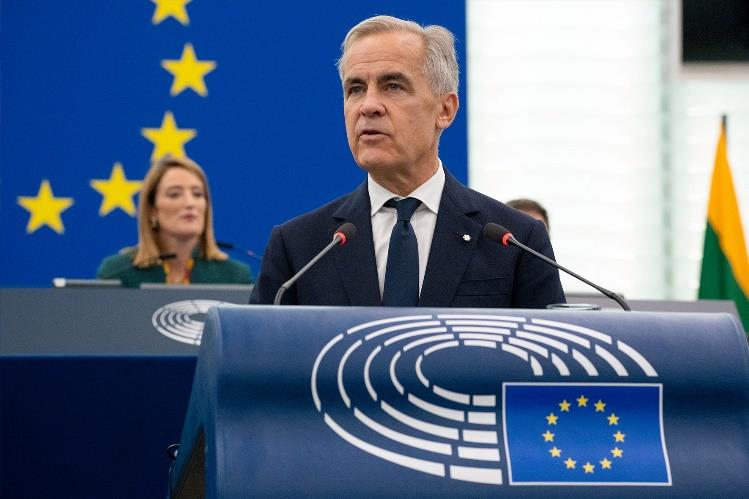
On September 17, 2026, Canadian Prime Minister Mark Carney told the European Parliament that Canada would make its own decisions about its international partnerships.
His comments came at a time when there are political tensions between Canada and the United States over several issues. At the same time, Canada is making clear that Europe is an important partner.
This does not necessarily mean that Canada is moving away from the United States or NATO. Instead, Canada appears to be trying to strengthen its relationships with several partners at the same time.
What does this mean for NATO?
For NATO, stronger EU-Canada cooperation can add another layer to the existing security system. Canada remains a NATO member. Most EU countries are also NATO members. And the EU itself has become more active in defence.
The challenge is making sure that these different structures work together. If the EU invests more in defence, this can also strengthen European NATO capabilities.
If Canada works more closely with European countries, it can also strengthen cooperation among NATO allies. But there are still questions about how European countries will organise their defence spending, how much equipment they will produce and how the EU and NATO will divide responsibilities. These questions will become more important in the coming years.
A relationship that is changing
The EU-Canada relationship is no longer only about trade and diplomacy. Security and defence are now becoming an important part of the partnership. The war in Ukraine has accelerated this change.
Canada wants stronger relations with Europe. The EU wants stronger defence capabilities. NATO needs European allies to increase their military capacity. And all sides are facing new threats in cyberspace, space and critical infrastructure.
For the moment, the EU, Canada and NATO are not replacing one another. They are creating a more connected security network. The important question now is whether these agreements will lead to real changes on the ground.
Will there be more joint defence projects? Will military equipment be produced faster? Will European countries be able to move forces more quickly? And will cooperation between Canada and Europe make NATO stronger?
These are questions that will become clearer over the next few years. What is already clear is that the old way of looking at the EU-Canada relationship is changing.
Canada is looking more towards Europe on security. Europe is looking for stronger defence cooperation. And NATO remains at the centre of the transatlantic security system.
The EU-Canada partnership is therefore not separate from NATO. It is becoming another important part of the wider security relationship between Europe and North America.