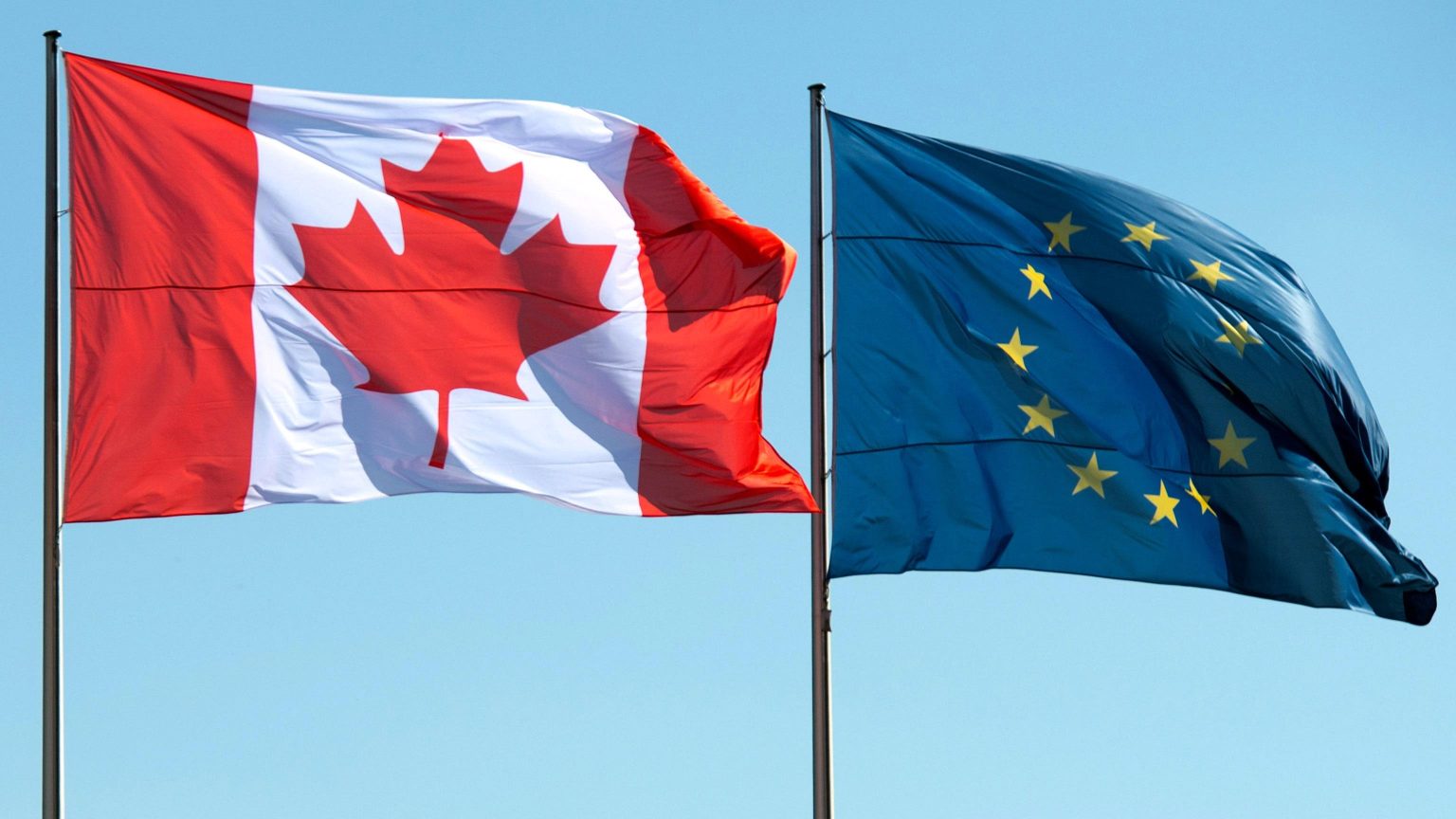
Strasbourg, France, 17 September, (Brussels Morning Newspaper) – EU-Canada alliance plans have gained further support from Canadian Prime Minister Mark Carney, who has called for closer cooperation between Canada and the European Union, saying the partners are “stronger together” after US President Donald Trump criticised efforts to deepen their relationship.
Carney addressed the European Parliament in Strasbourg on Thursday as Canada and the EU consider expanding cooperation in trade, defence, energy, technology and economic security.
His remarks followed European Commission President Ursula von der Leyen’s proposal to explore a new form of “associate membership” for Canada. Such a status does not currently exist under EU treaties, and no formal agreement establishing it has been reached.
Carney calls for closer Canada-EU cooperation
Carney said Canada and Europe have complementary economic and strategic strengths that could support greater resilience on both sides of the Atlantic.
Areas identified for closer cooperation include critical minerals, defence manufacturing, artificial intelligence, energy security, space, financial services and digital trade.
The Canadian government said Carney and von der Leyen discussed strengthening relations beyond the Comprehensive Economic and Trade Agreement, known as CETA, which already provides the main framework for economic ties between Canada and the EU.
Carney said the proposed EU-Canada alliance should not be viewed as an attempt to establish another geopolitical bloc.
“I want to be precise about what I am not proposing. I am not proposing a third bloc in order to become a great-power rival – only with better manners,” Carney said.
Trump criticises closer EU-Canada ties
Trump criticised the prospect of Canada developing a more integrated relationship with the European Union.
The US president described the proposed arrangement as “laughable” and raised the possibility of imposing tariffs on Europe if Washington considered the initiative harmful to US interests.
Trump also criticised Canada as a trading partner, adding to tensions between Washington and Ottawa over trade policy.
The European Commission rejected suggestions that closer relations with Canada were intended as a move against the United States, saying the initiative was focused on developing international partnerships.
Canada and EU expand trade and security relations
Canada and the European Union already have substantial economic ties.
According to the Canadian government, the EU was Canada’s second-largest trading partner for goods and services in 2025, with bilateral trade valued at approximately C$178 billion.
Security cooperation has also expanded. Canada and the EU established a Security and Defence Partnership in 2025.
Canada subsequently became the first non-European country to participate in the EU’s Security Action for Europe, or SAFE, initiative in February 2026, providing Canadian companies with additional opportunities to participate in European defence procurement.
Closer ties could diversify trade and supply chains
A deeper EU-Canada alliance could help Canada diversify its international trade while giving European countries greater access to Canadian resources and industrial capabilities.
Canada is an important producer of critical minerals and energy resources, while both sides have identified defence production and advanced technology as areas where greater cooperation could strengthen supply chains.
Carney described the objective as “collective resilience” rather than economic self-sufficiency.
The discussions come as Canada and European governments reassess trade relationships and strategic supply chains amid international tariff disputes and wider geopolitical uncertainty.
Canada and EU to continue partnership talks
No formal associate membership agreement has been approved, and the legal and institutional structure of any new relationship remains to be determined.
Canada and the EU are expected to continue discussions ahead of the Canada-EU Summit scheduled for 29-30 October 2026.
The summit is expected to provide another opportunity for officials to discuss trade, defence, technology, energy and economic security as the two sides consider the future scope of the EU-Canada alliance.