Brussels (Brussels Morning Newspaper) October 17, 2026 – Croatia secured crucial changes to European Council conclusions on Montenegro’s European Union accession process, successfully removing proposed deadlines for closing negotiating chapters while issuing a strict list of eight bilateral demands. The diplomatic intervention introduces new conditions for Montenegro, which had targeted EU membership by 2028, requiring Zagreb’s approval on issues spanning war crimes compensation, property disputes, and historical assets.
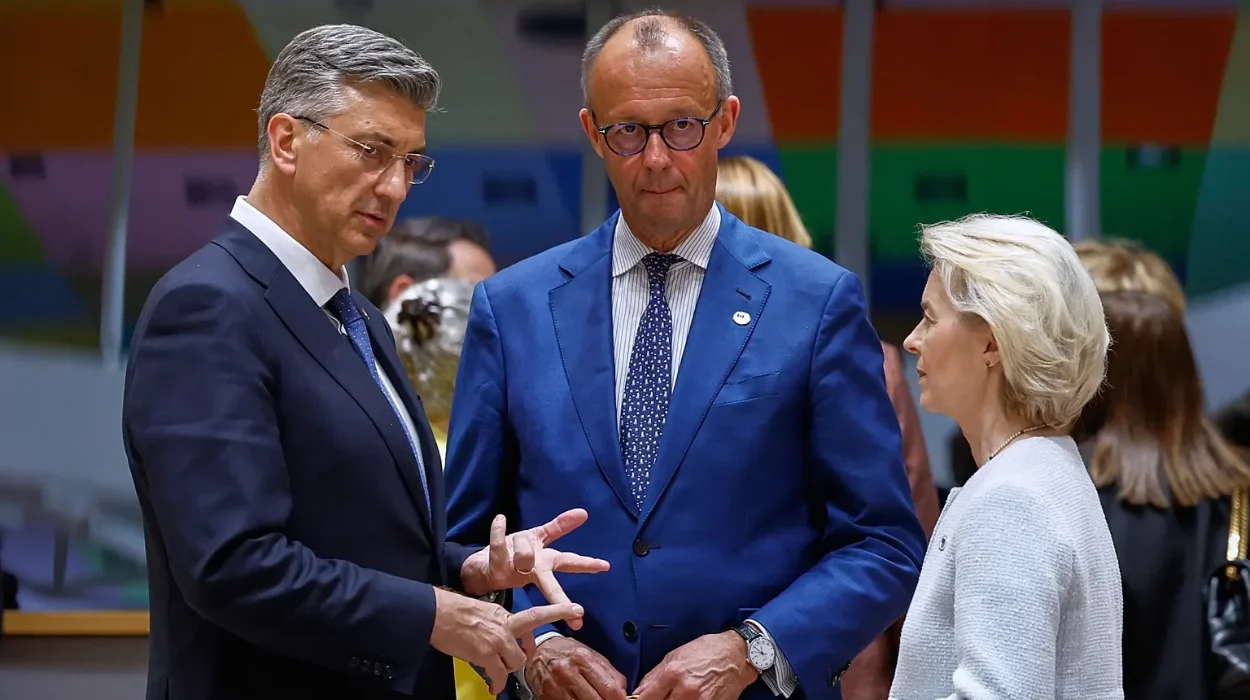
The diplomatic developments unfolded following discussions at the European Union headquarters in Brussels, where Croatian Prime Minister Andrej Plenkovic confirmed that Zagreb had successfully intervened to modify the wording of the European Council’s official text. An initial draft of the council conclusions had explicitly called for an agreement on the provisional closure of all negotiating chapters by the end of 2026, provided that Montenegro completed necessary structural reforms. Furthermore, that draft urged the rapid finalization of Montenegro’s accession treaty.
Following Croatia’s diplomatic maneuvers, those target deadlines were removed from the final conclusions. The revised text welcomes ongoing work on drafting the accession treaty and acknowledges the intention of the Irish presidency of the Council of the EU to pursue the provisional closure of negotiating chapters, provided reforms are successfully enacted. Croatian Prime Minister Andrej Plenkovic defended the move during a doorstep statement at the conclusion of the summit, asserting that candidate countries must satisfy all necessary conditions before advancing.
Background on Montenegro’s Accession and Zagreb’s Position
Montenegro remains widely regarded as a frontrunner among Western Balkan candidates seeking accession to the European Union. The country has set an ambitious timeline to complete the integration process and join the economic and political bloc by 2028. However, because EU accession protocols require unanimous agreement among member states, neighboring Croatia holds significant leverage over Podgorica’s integration trajectory.
Croatian officials have repeatedly emphasized that outstanding bilateral disputes stemming from the dissolution of the former Yugoslavia and the conflicts of the early 1990s must be fully resolved prior to the conclusion of Montenegro’s accession talks. To formalize these requirements, Zagreb submitted a comprehensive official document to EU member states, the European Commission, and the European Council. The document outlines eight specific demands that Croatia considers clearly defined and achievable, maintaining that the conditions are intended to facilitate rather than obstruct Montenegro’s path toward membership.
The underlying grievances trace back to military operations conducted by Yugoslav forces against Croatia during the early 1990s. Prime Minister Plenkovic noted that Croatia genuinely wishes to turn the page on this historical chapter and establish future-oriented relations, but insisted that outstanding legal, humanitarian, and territorial obligations must first be settled.
Categorisation of Demands Under EU Negotiation Chapters
Croatia’s eight demands are concentrated within specific clusters of the European Union’s acquis communautaire, primarily affecting Chapter 23, which governs judiciary and fundamental rights, and Chapter 31, which addresses foreign, security, and defense policy. Out of the eight demands outlined by Zagreb, six fall directly under Chapter 23, while the remaining two correspond to Chapter 31.
The integration of these bilateral issues into the formal EU accession framework ensures that Montenegro must address them to satisfy the benchmarks required for closing negotiating chapters. The breadth of the demands encompasses humanitarian concerns, historical preservation, property restitution, and military asset divisions.
Humanitarian Demands and Historical Preservation
Several key demands focus on historical remembrance and accountability related to the conflict period of the early 1990s. The first demand issued by Croatia requests financial compensation for more than 300 Croatian citizens who were detained at the Morinj camp located in Montenegro between October 1991 and August 1992.
The second demand requires the preservation of the memorial plaque installed at the former Morinj detention facility, insisting that its permanent visibility must be guaranteed. Reports indicate that a large metal frame has previously been erected around the plaque, permitting it to be concealed beneath a movable panel, an arrangement Zagreb wants permanently altered.
The third demand calls for the renaming of the municipal swimming pool in Kotor. The facility is currently named after Zoran Gopcevic, a former international water polo player who served as a guard at the Morinj camp. The designation has created friction within the sporting community, leading Croatian water polo clubs to refuse participation in matches hosted at the venue.
The fourth demand mandates Montenegro’s full and unreserved cooperation in determining the fate of 14 Croatian citizens who disappeared during military operations in the early 1990s. The fifth demand focuses on accountability, requiring the prosecution of individuals responsible for war crimes committed during the conflict, including those who may bear criminal liability under the legal doctrine of command responsibility.
Property Rights and Territorial Disputes
Economic and property restitution comprise the sixth item on Croatia’s list. This demand addresses long-standing property disputes originating in the early 1990s, during which Croatian families were allegedly unlawfully deprived of real estate and assets. The Croatian document notes that while certain properties have been returned to former owners—predominantly members of Montenegro’s Albanian minority—the disparate outcomes raise concerns regarding equitable treatment and legal consistency for all claimants.
The seventh demand concerns a high-profile territorial and asset dispute over the historic training ship Jadran, or Adriatic. The vessel was a part of the former Yugoslav military fleet and was traditionally based in Split. When hostilities erupted in 1991, the ship was undergoing maintenance work in Montenegro and has remained there ever since. Zagreb maintains that the vessel rightfully belongs to Croatia under the distribution of former federal military assets.
Furthermore, the document broadens this dispute to include other military equipment seized from Croatian territory that remains in Montenegrin possession. Croatia estimates the total financial value of these disputed military assets to be approximately $2.7 billion, making the matter one of the most contentious bilateral issues between the two governments.
Border Demarcation and Ongoing Diplomatic Dialogue
The eighth and final demand focuses on finalizing the official border demarcation between the two neighbouring states. Zagreb is pressing Podgorica to formally confirm the former internal boundary established between the constituent Yugoslav republics, as defined by the Arbitration Commission of the Conference on Yugoslavia, widely known as the Badinter Commission. The commission played an essential legal role in establishing the criteria governing the dissolution of the federation and the recognition of successor states.
Croatian authorities maintain that formalizing this border agreement is an indispensable prerequisite for the complete normalization of diplomatic relations. While the removal of the 2026 deadline from the European Council conclusions alters the immediate timeframe for closing negotiating chapters, the establishment of these eight criteria guarantees that Montenegro’s progress will remain closely tied to bilateral negotiations with Zagreb.
As the diplomatic process continues, Montenegrin officials face the task of engaging directly with Croatia to reconcile these outstanding points of contention. The outcome of these bilateral talks will heavily influence the pace at which Montenegro can fulfill the stringent criteria required for eventual integration into the European Union.