
The international order, already frayed by years of shifting alliances and economic nationalism, appears to have reached a definitive breaking point in the opening days of 2026. While the world was still processing the sudden and dramatic American military intervention in Venezuela, the focus of the White House has pivoted with startling speed toward the Arctic.
President Donald Trump’s renewed and intensified demands for the “acquisition” of Greenland are no longer being dismissed as the eccentric whims of a real estate mogul turned politician. In the wake of “Operation Absolute Resolve” in Caracas, the rhetoric emanating from Washington has taken on a predatory quality that challenges the very foundations of Westphalian sovereignty.
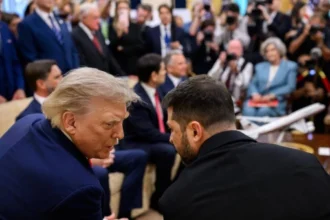
The situation has escalated into a full-scale diplomatic crisis between the United States and its oldest allies. The narrative coming from the Oval Office is simple yet transformative. President Trump argues that Greenland is a “national security necessity” that Denmark is “incapable” of defending against the increasing strategic presence of other global powers.
By mocking the Danish defense posture as little more than a “dog sled” arsenal, the U.S. administration is attempting to establish a new standard for territorial integrity: that sovereignty is not an inherent right, but a privilege contingent upon a nation’s ability to project military power.
This “Don-roe Doctrine,” a blunt and aggressive evolution of the 19th-century Monroe Doctrine, suggests that the Western Hemisphere is not merely a sphere of influence, but a zone of potential American jurisdiction. The message to the international community is unmistakable.
If the United States deems a territory strategically vital or rich in the minerals necessary for the high-tech arms race, the traditional boundaries of international law will not be allowed to stand in the way.
The reaction from Nuuk and Copenhagen has been one of principled defiance mixed with genuine alarm. A joint statement from Greenland’s five major political parties today was unequivocal: they wish to be neither American nor Danish, but Greenlandic. This sentiment is echoed by a wary public. Recent polling in Denmark indicates that nearly 40 percent of the population now believes a U.S. invasion is a plausible scenario. This fear is not born of paranoia but of observation.
The capture of Nicolás Maduro has demonstrated that the current U.S. administration is willing to use its military as a tool of eminent domain to secure resources and “stabilize” regions it deems essential to its interests.
The economic dimension of this gambit is equally transparent. Greenland sits atop 25 of the 34 critical minerals identified as essential by the U.S. Geological Survey. As global demand for these minerals accelerates to fuel the green energy transition, the Trump administration views Greenland not as a country, but as a warehouse of strategic commodities.
The appointment of Jeff Landry as a special envoy – a nod to the Louisiana Purchase – underscores the transactional nature of this policy. However, treating a democratic, autonomous territory as a commodity to be bought or seized is a dangerous regression to an imperial era that the world supposedly moved past in 1945.
Danish Prime Minister Mette Frederiksen has warned that any move toward annexation would signify the “end of everything,” specifically the NATO alliance and the post-war security structure. This is not hyperbole. If the leading member of a collective defense pact threatens the territorial integrity of a fellow member, the alliance loses its reason for being. The security guarantee that has anchored European and global stability for eight decades is being traded for a gamble on Arctic minerals.
Rather than following this path of unilateral escalation, there is a clear need for a multilateral alternative. Japan, as a leader in diversifying mineral supply chains and a staunch defender of international law, could play a pivotal role. A collaborative framework – a “Global Commons” approach to the Arctic – would secure the necessary resources through partnership rather than coercion. Such a model would respect the self-determination of the Greenlandic people while ensuring that the Arctic remains a zone of scientific and commercial cooperation rather than a theater of conflict.
The coming weeks will be a test of whether the international community can restrain this new era of “transactional imperialism.” If the world remains silent as the U.S. applies the “Venezuela model” to the Arctic, it will be signaling that the era of law is over, and the era of might has returned. For a nation like Japan, which exists at the intersection of great power rivalries, the survival of the rule of law is not an academic concern; it is a matter of national survival.
Dear reader,
Opinions expressed in the op-ed section are solely those of the individual author and do not represent the official stance of our newspaper. We believe in providing a platform for a wide range of voices and perspectives, even those that may challenge or differ from our own. We remain committed to providing our readers with high-quality, fair, and balanced journalism. Thank you for your continued support.