He would be the first to admit that as a young boy growing up in Antwerp, he had some very strong obsessions. From an early age he was infatuated with the natural world of animals and travel and later in life with film, photography and cultural anthropology. His passions would go a long way into how we view animal welfare, conservation and the environment today. Meet Armand Denis …
Armand Denis (1896-1971) was born in Brussels into a family of Flemish stock. Soon after his birth the family moved to Antwerp where his father was a judge. Armand would describe his father as “something of a puritan and a disciplinarian with a strong sense of individuality.” His mother, well aware of her son’s fascination with the natural world and travel, was very encouraging. Armand would label his childhood as “stable and happy.”
At age 3 yrs, Armand was known to breed flies and insects in a matchbox. By age 5, his collection of lizards was quite prolific. By age 7 and 8 yrs. he would travel on his own by railroad around Belgium noting wildlife, their environments and acquiring basic skills in photography. At age 17 he enrolled at Oxford as a “refugee student” (more about that later) where he studied chemistry and engineering. After World War I he took on a number of engineering jobs in France ,Belgium and the United States. As an engineer Armand invented a feedback circuit system called Automatic Volume Control (AVC) that changed the world of radio—an industry that was in its heyday. The substantial royalties he received for his AVC invention and patent transformed his life. Armand now had the financial independence to abandon his career in engineering and pursue his passions which were never far from the surface — namely the study of animals, their habitats, and their well-being through documentary filmmaking.
First stop? The island of Bali in Southeast Asia. With second -hand cameras and used equipment, he set out for the Dutch East Indies island of Bali. Originally intending to film a documentary about the Bali’s animal life, his adventure took on a life of its own. Rather than a “standard” documentary, Armand became infatuated with Balinese culture. The resulting film titled Goona Goona, used an all native cast in capturing the magic of the religious temples, ceremonies, intricate dances and inter-social customs (read: the sex life) in Balinese daily life. Goona Goona soon became an international sensation as it romanticized island life to the western world— kickstarting Bali’s first major wave of tourism.
The popularity of Goona Goona got the attention of prominent Hollywood film makers. An offer was made for Armand to team up with box office sensation Frank Buck to direct an “adventure movie”. Buck was a Hollywood legend known for his swashbuckling swagger as an animal trapper. The film Wild Cargo (1934) was filmed in Singapore, Ceylon and India and depicted Buck capturing exotic animals (e.g. leopards, rhinos, giant pythons, orangutans, water buffalos, etc.). Wild Cargo was a moderate success but did once again give Armand the financial freedom to grow and pursue his passions.
The experience of working with a Hollywood movie star and filming of a staged, scripted plot line was anathema to Armand’s idea of creativity. He believed filming animals in the wild was a more accurate (and exciting!) way to inform an audience. He started to plan various African expeditions of his own. Sponsored in part by the Belgian government and backed by the Dodge Motor Company U.S.A, Armand began his African odyssey. The film crew traveled overland from Belgium, crossed into Spanish Morocco, pushed through the Sahara Desert, the Belgian Congo and eventually across to Kenya and the Indian Ocean. The resulting documentary called Wheels Across Africa resulted in an “Indiana-Jones” type production replete with animal close-ups, new filming techniques with a synchronized recording of the music and conversation of the tribes of Central Africa. Wheels Across Africa introduced to its viewers African geography and anthropology. The film featured highstakes dramatic adventures and the wildlife encounters that were in real time and not scripted. These wildlife sequences were among the earliest in cinematic history.
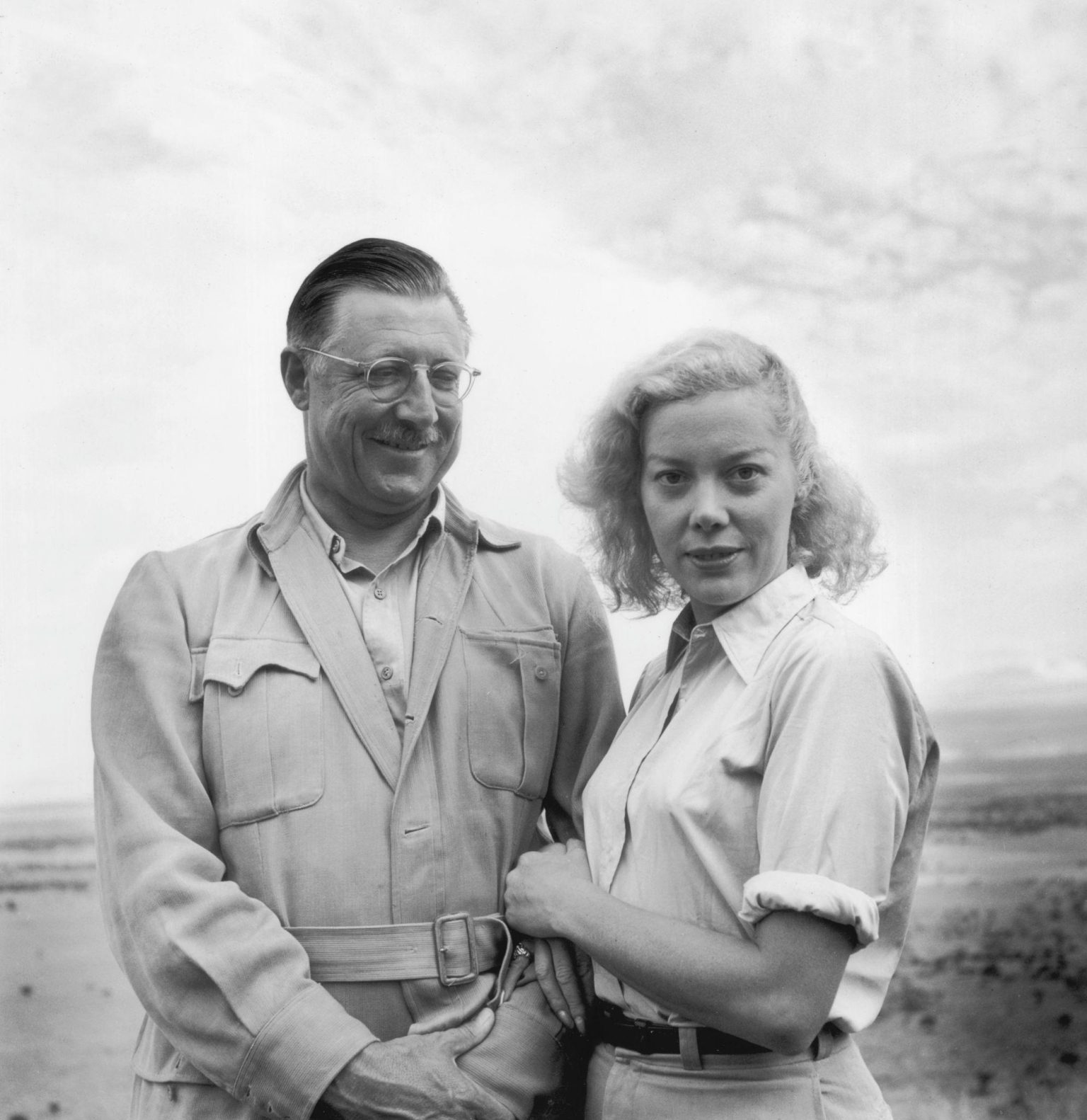
In 1953 Armand and his wife Michaela produced, directed and narrated a more detailed—first of its kind— documentary titled Below the Sahara. Trekking south of sub-Saharan Africa, the couple: met various African tribes (head-hunters, Pigmies, Watusi, etc.), visited animal farms, learned how cheetahs chase down their prey, and accompanied natives on gorilla hunts. Viewers, many for the first time, experienced the grandeur of African vistas replete with real time footage of wildlife including crocodiles, gazelles elephants, antelopes hippopotamus, water buffalos, gorillas, and an array of bird life.
Over the next few decades, Armand’s body of work was the gold standard in innovative pioneering work The originality and quality of Armand’s film making struck a chord with the public— especially the British public. He became a fixture on BBC television during the 1950s and 60s literally revolutionizing wildlife documentaries. and had a long running television series called Armand and Michaela on Safari.
The 20th Century has no shortage of individuals who have contributed to the study of animals. For example, Jane Goodall revolutionized the study of chimpanzees. She was best known for six decades of field research on their social and family life. Diane Fossey was an American primatologist and conservationist known for her extensive study of gorilla groups in the mountain forests of Rwanda. Margret Mead was a cultural anthropologist who traveled the world analyzing the characteristics of different peoples. Countless celebrities have advocated for animal welfare, protecting endangered species, and legislative reform. Notable advocates include Steve Irwin as a television personality known as aka the Crocodile Hunter”, was an Australian wildlife educator, zookeeper and environmentalist. Joaquin Phoenix, Leonardo DiCaprio, Betty White and Alicia Silverstone have all used their celebrity status to promote wildlife conservation.
Armand Denis did all these things and more. He was an inventor ,an innovative film maker, animal behaviorist, advocate for wildlife preservation, a cultural anthropologist and a television personality… and to think his passions began with breeding flies in a match box in Antwerp!
FUN FACTS
— Armand’s first cinematographic work Goona Goona was considered “semi-pornographic” by the strict American censors of the 1920s. The genre was considered scandalous which ironically made it popular with American and European audiences.
— At age 17 yrs. Armand joined the Belgian Army the very day German armies invaded Belgium. Shortly thereafter he was captured and sent to a German internment camp. At a height of 2m (6ft 6”), and with no prison uniform big enough to fit, he “escaped” to England in his civilian clothes by walking out the door. He briefly joined the Belgian resistance in London and was able to enroll in Oxford as a refugee student.
— Armand was a prolific writer as well. Although synonymous with travel and animal welfare, he also wrote a best-seller Taboo which explores that of the sexual habits in primitive and not so primitive societies. — Wheels Across Africa covered a footprint of over 40,000 miles over rough African roads. Dodge Motors USA, a sponsor, showcased their rugged designed trucks.
There were no mechanical breakdowns! The documentary served as a milestone in automotive marketing in advertising in adventure and travel film making. — Michaela Davis, Armand’s second wife, was no stranger to wildlife adventure. She acted as a Hollywood stunt double and never failed to bring her trademark beauty and glamor to the screen. She once famously said “ I couldn’t possibly get into the water with crocodiles until I had put om my eyebrow pencil.”
— In the early days of radio broadcasting, listeners had to deal with inconsistent signal strengths which resulted in wildly fluctuating volume control. Armand developed a feedback circuit system (his AVC invention)that sensed signal strengths resulting in a more consistent audio volume. His invention freed him financially from the “long hours in the laboratory” (his words) and allowed him to travel and to create.