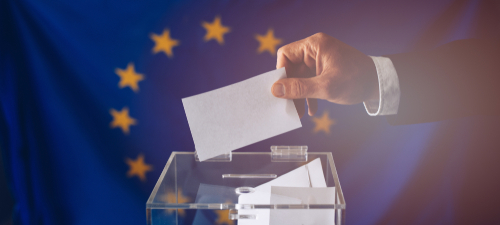
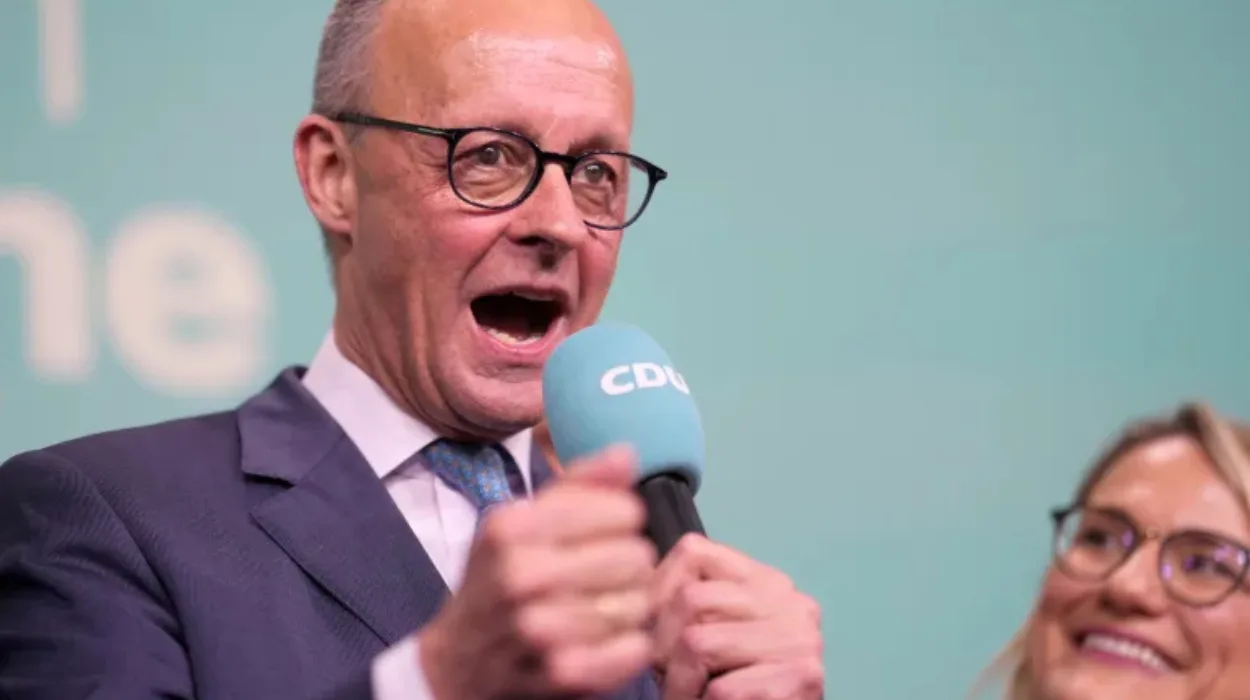
Recent German elections were one of the most awaited since the future of European politics depended on its results. Despite the fact that one of the most provocative and, as it was expected, cherished party, the Alternative for Germany, didn’t take the majority in the parliament, some critics are suspecting the winner, CDU/CSU to rig the votes. Nevertheless, due to the official data, CDU/CSU took 208 seats and AfD 152, what makes the first one the winner. Consequently, the new leader of the Federal Republic of Germany will be Friedrich Merz, but what do we know about him?
Friedrich Merz
Merz was raised in a conservative, Catholic family. His father, Joachim Merz, was a judge and a member of the CDU until 2007. His mother, Paula Merz (née Sauvigny), hailed from a notable family in Brilon; her father, Josef Paul Sauvigny, served as the town’s mayor from 1917 to 1937. After completing his Abitur in 1975 and fulfilling his military service, Merz pursued law studies at the University of Bonn and the University of Marburg. He completed his legal training in 1985 and briefly served as a judge in Saarbrücken before transitioning to the private sector as a corporate lawyer.
Merz’s political journey began in 1989 when he was elected to the European Parliament, serving until 1994. He then became a member of the German Bundestag, representing the CDU from 1994 to 2009. During this period, he held the position of chairman of the CDU/CSU parliamentary group from 2000 to 2002. After a hiatus from frontline politics, during which he worked in the private sector, including a role as chairman of BlackRock’s German operations, Merz returned to the political arena. In December 2021, he was elected as the leader of the CDU, officially assuming the role on January 31, 2022.
Known for his conservative views, Merz advocates for tax cuts, deregulation, and stricter immigration policies. He contrasts with his centrist predecessors, Angela Merkel and Olaf Scholz, by promoting a shift to the right within the CDU. Merz underscores the need for Europe to strengthen its defence capabilities and reduce dependence on external allies, particularly in response to evolving global dynamics.
Why CDU/CSU and not the AfD?
Despite the AfD’s significant gain, doubling its vote share to 20.8%, their far-right positions remained polarizing. Many voters were apprehensive about the AfD’s policies and potential impact on Germany’s international standing, leading them to favor the more centrist CDU. The AfD’s platform includes a fundamental denial of human-induced climate change. The party opposes policies aimed at reducing CO₂ emissions and has called for the abolition of renewable energy initiatives, advocating instead for the continued use of coal and nuclear energy. If from one point, Germany thanks to coal and nuclear energy will be more self-sufficient, that does not mean that everyone agrees with that policy of AfD.
Prominent AfD figures have made statements that have been widely condemned as antisemitic. For instance, Björn Höcke referred to Berlin’s Holocaust Memorial as a “monument of shame” and suggested a need to change Germany’s approach to remembering its past. Some part of German society sees these statements as the reference to Nazi Germany, what is not very much cherished nowadays.
AfD has also been calling for Dexit-leaving the EU, what has been received negatively not only by German public, but by vast majority of EU member states. Above from that, AfD was critical of NATO, often expressing pro-Russian sentiments.
AfD’s stance on migration is another focal point. The party has discussed plans to encourage or enforce the return of immigrants, including naturalized citizens, to their countries of origin. This includes proposals for large-scale deportations, sometimes referred to as “remigration” initiatives. German society received this proposition negatively saying that vast majority of workers in Germany are immigrants and it is inhuman to deport people, who are already integrated into German society. Before the elections, more and more videos showing how many migrants are actually working in Germany and how the country depends on them, started to appear on social media, what also made some people to change their political views. Consequently, Germans have chosen a less radical version of AfD-CDU/CSU.
Germane lections have shown not only how “fed up is” the German society with the empty promises and worsening level of life (of the country that once was a “promised land” for every European citizen and migrant from the East), but how still German society is divided on West and East.
How CDU can change European politics
the Christian Democratic Union regains long-term leadership in German, EU needs to prepare for some significant changes.
Firstly, Germany as the leading country of the union, will probably tighter European immigration policy, including faster deportation of the rejected asylum seekers, stronger external border control and “a fairer distribution of migrants” among member states.
Secondly, CDU can change EU economic policy, calling for stricter spending policy and the reduction of foreign debts. It could mean less financial support for the weaker member states (especially Southern and Balkan countries)
And the last but not least, stronger defence policy. After Trump’s statements about abandoning the NATO, EU leaders started to realize that from that moment forward European countries will need to reduce their reliance on the North-Atlantic Treaty Organisation and US themselves.
The last and the most important issue nowadays is Germany’s stance in Russian-Ukraine war. Despite the fact that Merz in December pledged to provide Ukraine with long-range Taurus missiles if elected, he also pleaged to include European voices in any negotiations related to the conflict, ensuring that European security concerns are adequately addressed. Considering the fact that Merz will be more focused on German politics it may result in German non-participation in any pro-Ukraine’s actions.
Summarizing, German elections definitely impressed not only its citizens but the whole European public making its question the EU’s future and to wait for the major changes. Although the election results are already known internationally, the consequences of these elections will be visible months later…
Dear reader,
Opinions expressed in the op-ed section are solely those of the individual author and do not represent the official stance of our newspaper. We believe in providing a platform for a wide range of voices and perspectives, even those that may challenge or differ from our own. We remain committed to providing our readers with high-quality, fair, and balanced journalism. Thank you for your continued support.