
Brussels, Belgium, 28 October, (Brussels Morning Newspaper) – The European Union has raised serious concerns over Ukraine’s projected €70 billion financing shortfall for 2027, warning that existing international commitments will not cover the country’s growing military and economic requirements. The Ukraine funding gap has intensified pressure on Brussels to secure additional contributions from international allies as Russia’s invasion continues.
European Commission officials confirmed that the estimated shortfall remains despite €45 billion already earmarked by the EU for next year. European leaders are now examining additional financing arrangements ahead of a crucial summit in November.
European Commission Warns of Serious Financial Shortfall
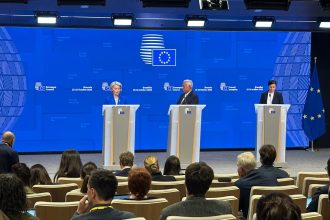
The European Commission outlined the scale of Ukraine’s financing difficulties during a press briefing in Brussels on 19 October.
Commission spokesperson Balázs Ujvári confirmed that current financial commitments would leave approximately €70 billion in unmet requirements for 2027.
The estimate includes existing EU assistance and financial pledges from international partners.
Ujvári emphasised that European governments could not shoulder the additional burden without wider international participation.
“We cannot do this all alone.”
He urged international partners to provide firm financial commitments and fulfil their existing promises.
The Commission is examining possible mechanisms to address the shortfall, although no final financing arrangement has been approved.
Ukraine Calls for Stronger European Financial Support
Ukrainian President Volodymyr Zelenskyy highlighted the country’s financial requirements during the European Council meeting in Brussels on 15–16 October.
He warned that continuing Russian military operations would place substantial pressure on Ukraine’s defence capabilities and economic stability.
Addressing European leaders, Zelenskyy said:
“We really need at least €70 billion additionally for next year.”
The Ukrainian president argued that additional assistance would help sustain defence operations, strengthen domestic weapons production and maintain the country’s resilience.
European Commission President Ursula von der Leyen subsequently acknowledged the financing shortfall and stressed that international partners would need to contribute.
European Council President António Costa also confirmed that EU leaders had requested concrete proposals from the Commission.
EU Faces Growing Pressure Over Ukraine Assistance
The European Union has provided substantial financial and military assistance to Ukraine since Russia launched its full-scale invasion in February 2022.
A €90 billion EU support loan covering 2026 and 2027 was designed to provide greater financial stability.
Of that amount, €45 billion is earmarked for 2027, but the prolonged conflict has increased Ukraine’s estimated requirements.
Brussels had expected additional contributions from countries including Britain, Canada, Japan, Norway and Switzerland.
However, EU officials have indicated that not all anticipated financial commitments have materialised.
The Ukraine funding gap is also creating challenges for European governments negotiating the bloc’s next long-term budget for 2028–2034.
Financial Shortfall Raises Concerns for European Governments
The financing challenge has renewed discussions about additional borrowing, international contributions and potential funding mechanisms involving immobilised Russian sovereign assets.
No agreement has been reached on a new financing package.
For Ukraine, reliable international assistance remains essential to maintaining public services, economic stability and military operations.
For EU governments, further commitments could create additional budgetary pressures at a time when several member states face competing domestic spending priorities.
EU Leaders Prepare for Crucial November Summit
European leaders are scheduled to meet on 26–27 November to discuss Ukraine’s financial requirements and the EU’s next long-term budget.
The European Commission is expected to continue examining financing options before those discussions.
Officials are also pressing international partners to clarify their financial commitments for 2027.
Any new EU borrowing arrangement or additional financial package would require the relevant political and legal approvals.
The November summit will provide an important opportunity for European governments to determine how Ukraine’s projected financing shortfall could be addressed.
Until an agreement is reached, the additional €70 billion remains an unresolved challenge for Kyiv and its international supporters.