
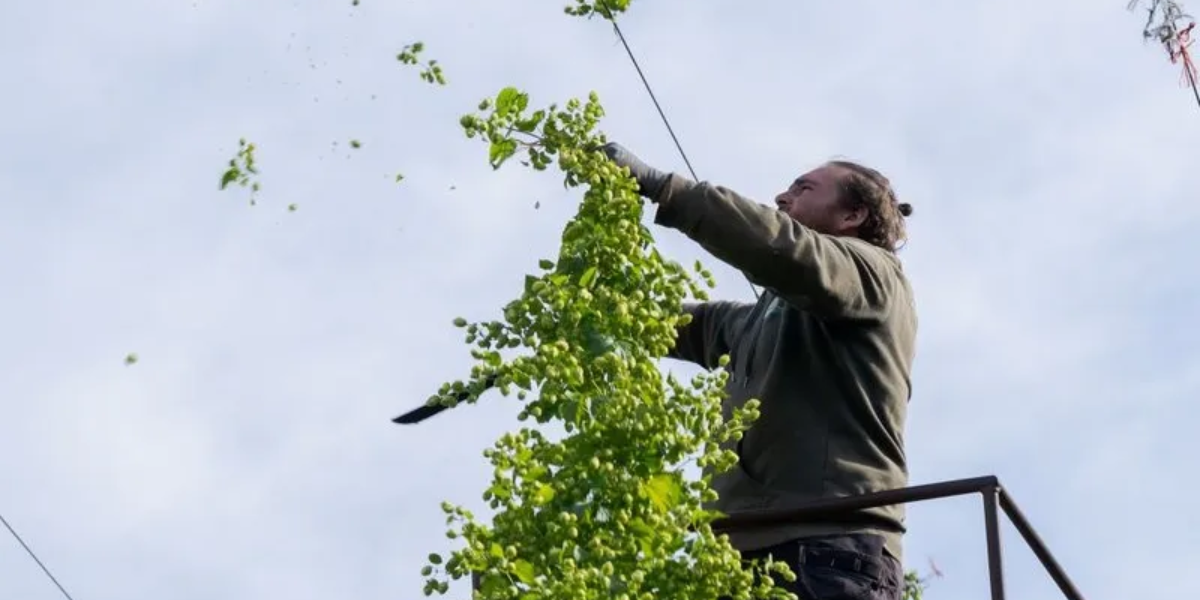
Aalst (The Brussels Morning Newspaper) – October 15, 2026 – Hops and hop shoots grown in the Aalst, Affligem and Asse region have received recognition as a Flemish regional product. The designation highlights the area’s longstanding hop-growing tradition and the contribution of local farmers and producers. The recognition is intended to raise awareness of regional agricultural products and encourage breweries to consider using locally grown hops in beer production.
- Regional Recognition Highlights Centuries of Hop Cultivation
- How Could Recognition Encourage Breweries to Use Local Hops?
- What Is the Historical Importance of Hop Growing in the Region?
- How Does the Recognition Fit Into Belgium’s Existing Hop Labels?
- What Challenges Does the Flemish Hop Sector Face?
- What Role Does VLAM Play in Regional Product Recognition?
- What Happens Next for Regional Hop Producers and Breweries?
- Background: Belgium’s Hop-Growing and Brewing Heritage
Regional Recognition Highlights Centuries of Hop Cultivation
Hops and hop shoots from the Aalst, Affligem and Asse area have been recognised as a Flemish regional product by the Flemish Centre for Agricultural and Fisheries Marketing, known as VLAM. The designation acknowledges the area’s agricultural heritage and the continued work of local growers and producers.
According to reporting by VRT NWS, hop cultivation in the region dates back to the 15th century. The crop has a longstanding connection with local agriculture and brewing, with hops serving as an important ingredient in beer production.
The recognition covers both hops and hop shoots. While hops are widely used by brewers, hop shoots are the young edible growth of the plant and are associated with regional food traditions.
The designation places these products within Flanders’ regional food heritage. It also provides a way to identify agricultural products connected to a particular area and the people who continue to produce them.
TV Oost reported that the recognition represents acknowledgement for local farmers and producers who have maintained this longstanding tradition. The broadcaster also noted that the designation could encourage regional breweries to use locally grown hops in their beers.
How Could Recognition Encourage Breweries to Use Local Hops?
One of the stated aims associated with the recognition is to encourage breweries in the region to consider using hops grown nearby.
Hops are used during brewing to contribute bitterness, aroma and flavour. The varieties selected and the quantities used influence the characteristics of the finished beer.
For breweries, sourcing decisions depend on the ingredients required for individual recipes and the availability of suitable supplies. Recognition of regional hops can make their local origin more visible to producers and consumers.
However, the announcement does not establish that breweries will change their purchasing arrangements or that a particular volume of locally grown hops will be used following the designation.
Instead, the recognition provides an opportunity to draw attention to the regional crop and the growers behind it. Whether individual breweries increase their use of local hops will depend on their own sourcing decisions and production requirements.
The designation also highlights the connection between agricultural production and the brewing sector. Hop growers supply a key ingredient, while breweries transform agricultural raw materials into finished products associated with Belgium’s established beer culture.
What Is the Historical Importance of Hop Growing in the Region?
The reported history of hop cultivation in the Aalst, Affligem and Asse area extends to the 15th century. That long history forms an important part of the recognition granted to the regional products.
Agricultural traditions can connect present-day production with the history of local communities. In this case, hop cultivation links farming with brewing and regional food culture.
The new designation recognises the continued presence of the crop and the contribution of the people who grow and produce it. It also distinguishes the area’s agricultural identity within the wider Flemish food landscape.
The recognition does not mean that all Belgian hops originate in this region. Hop production takes place in other parts of Belgium, and different growing areas have their own agricultural histories.
Instead, the designation relates specifically to hops and hop shoots associated with the Aalst, Affligem and Asse area.
How Does the Recognition Fit Into Belgium’s Existing Hop Labels?
Belgium already has a national initiative designed to identify beer made with Belgian-grown hops.
According to the official Belgian Hops organisation, the Belgische hop – Belgian hops logo was introduced in 2011 to promote the use of hops produced in Belgium. Breweries can use the standard logo when they officially confirm that at least 50 per cent of the hops used in the relevant beer are Belgian in origin.
A gold version of the logo was introduced in January 2017 for beers made with 100 per cent Belgian hops. Hop growers also signed a specification agreement in 2017 setting out quality requirements for the label.
The Flemish regional-product recognition for the Aalst, Affligem and Asse area is distinct from this national logo. One identifies products associated with a particular region, while the other provides information about the Belgian origin of hops used in beer.
Both initiatives draw attention to the provenance of agricultural ingredients, although their criteria and purposes differ.
The existing Belgian Hops scheme demonstrates that origin-based labelling is already used in the country’s brewing sector. The newly reported regional designation adds further recognition for a specific hop-growing area.
What Challenges Does the Flemish Hop Sector Face?
The recognition comes as hop growers in Flanders face challenges affecting production and the wider market.
During a Flemish Parliament committee meeting on 7 October 2026, MP Loes Vandromme raised concerns about the sector’s circumstances. She said the 2026 hop harvest in Poperinge had started later following high temperatures during the preceding months. She also referred to an estimate from the Hop Overkoepelende Producentenvereniging, or H.O.P. vzw, that yields could be 20 per cent lower because some hop flowers had been damaged by the sun.
The parliamentary discussion also identified US tariffs, the continuing effects of the coronavirus crisis and excess hop production in Germany and the United States among the pressures facing growers.
These remarks concerned the broader Flemish hop sector, particularly Poperinge, and should not be interpreted as evidence that the same production conditions or estimated losses apply to the Aalst, Affligem and Asse area.
The discussion nevertheless illustrates the wider agricultural and market context in which Belgian hop producers operate. Recognition of regional products is one way of raising their profile, but it does not by itself resolve issues involving weather, competition, production costs or demand.
What Role Does VLAM Play in Regional Product Recognition?
The Flemish Centre for Agricultural and Fisheries Marketing, known as VLAM, promotes agricultural, horticultural, fisheries and food products associated with Flanders.
In the case of the Aalst, Affligem and Asse hop-growing area, the organisation’s regional-product designation formally draws attention to the origin of the hops and hop shoots.
Such recognition can help consumers and businesses identify products linked to a specific place and its agricultural traditions. It can also give local producers a recognised way to communicate the history and origin of their goods.
The reported announcement does not provide detailed figures for the number of growers covered, the total area under cultivation, annual production volumes or the expected financial value of the designation.
It also does not set out a quantified target for additional brewery purchases. Consequently, the immediate significance of the recognition lies in acknowledging the regional product and highlighting the possibility of stronger links between local growers and breweries.
What Happens Next for Regional Hop Producers and Breweries?
The recognition gives the Aalst, Affligem and Asse hop-growing tradition additional visibility and provides a basis for promoting the area’s agricultural heritage.
For growers, the designation acknowledges their role in maintaining a crop with a history stretching back several centuries. For breweries, it brings renewed attention to the availability of locally grown hops as an ingredient.
The extent to which the recognition leads to increased local sourcing remains unconfirmed. No specific commitments from breweries, purchasing targets or projected increases in sales were included in the available reports.
Further information about participation by individual producers, the volume of hops grown in the region and brewery purchasing arrangements would be needed to assess any measurable commercial effects.
Background: Belgium’s Hop-Growing and Brewing Heritage
Hops are a key raw material in beer production, and their origin can form part of a beer’s identity. Belgium’s brewing traditions are supported by agricultural producers, breweries and initiatives that communicate the origin and quality of ingredients.
The Belgian Hops logo, introduced in 2011, provides one established mechanism for identifying beers made with Belgian-grown hops. The separate gold label, introduced in 2017, identifies beers for which breweries confirm that all hops used are Belgian.
The recognition of hops and hop shoots from Aalst, Affligem and Asse adds a regional dimension to this wider context. Its historical significance rests on the area’s longstanding cultivation of the crop and the contribution of local producers.