Conference “Breaking the Silence: 1996–2026” puts reparations, truth and justice before MEPs. Organisers want the EU to move beyond resolutions to action.
BRUSSELS, 14 October 2026 — Mamy Kahambu lost her husband in the M23’s takeover of Goma in January 2025. Today she warned MEPs that failing to act may, in some way, make them complicit. She was among the survivors, Congolese officials and legal scholars who urged the European Parliament to recognise the genocides committed in eastern Democratic Republic of the Congo (DRC).
“As you see me standing here, I represent thousands of victims who have been through the same thing,”
Ms Kahambu told MEPs and their staffers.
“Now that you have been informed, now that you know, it is time to act. Failing to act may, in some way, make you complicit in what we are living through in our country… I am a victim today, but I will not let myself remain a victim. I must act to save future generations.”
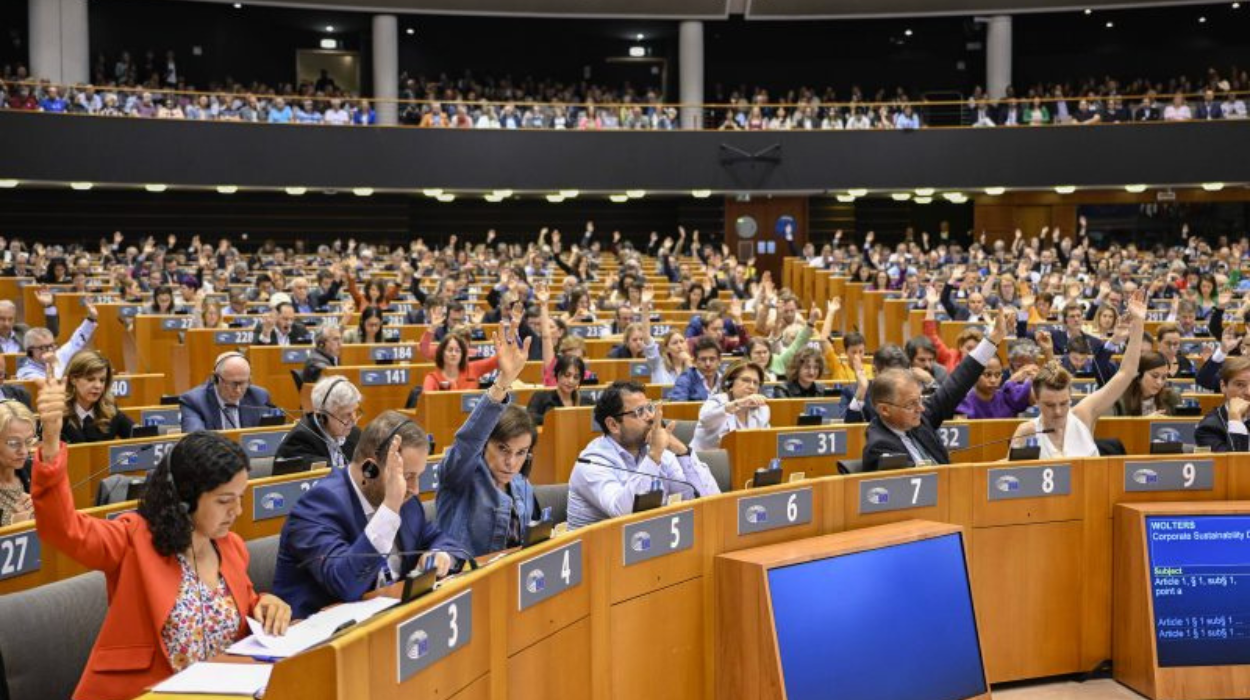
The conference, entitled “Breaking the Silence: 1996–2026,” was chaired by French Member of European Parliament Thierry Mariani. It brought together officials from Congolese reparations and transitional justice bodies, a legal expert on genocide and survivors of sexual violence and mass atrocity. Their appeal to European lawmakers was direct: demand for EU action on the economic and military drivers of the conflict.
Mr Mariani opened by arguing that the international community has largely failed to answer the violence in eastern DRC. The International Rescue Committee estimates that more than six million people have died there since the mid-1990s. Congolese authorities put the toll at about ten million lives lost, directly or indirectly, under the national “Genocost” framework.
“For thirty years, eastern Democratic Republic of the Congo has been enduring an unprecedented tragedy and slaughter – the deadliest crisis since the Second World War. And yet the whole world remains silent,”
he told the chamber. He also accused the world of a double standard over which conflicts it chooses to notice.
“There are peoples spoken of every evening, and others who have been massacred for three decades amid almost total indifference. This double standard shocks me.”
At the conference Professor Serge Makaya made the legal case for genocidal intent to MEPs. He presented massacres from 1996 to 2025, including Rutshuru, Kasika, Makobola, Mwenga, Kiwanja, Shalio, Masisi, Kishishe and Binza. The pattern, he argued, shows ethnic targeting, repetition, organisation and attacks on the survival of the targeted groups. That meets the threshold the International Court of Justice applies when inferring genocidal intent from a pattern of conduct.
Patrick Fata, Director-General of the National Fund for the Reparation of Victims (FONAREV), then described the scale of FONAREV’s work on reparations, community programmes, legal programmes, and victim identification. It is financed partly by national mining royalties which he noted carries symbolic weight because competition for the same natural resources has often fuelled the conflict:
“Turning the wealth of the Congo into an instrument for rebuilding the victims of the Congo: that too is reparation.”
François Kakese, Executive Coordinator of the Interinstitutional Commission for Victim Support and Reform Assistance (CIA-VAR), pointed to memory and institutional weight. He explained the DRC’s Transitional Justice Policy, adopted in May 2025, and “Genocost” initiatives, which preserves the memory of mass violence since 1996. It does not assert that every documented crime amounts in law to genocide, but centres survivors.
The question, Mr Kakese told MEPs, is how to gain institutional weight beyond the DRC.
He paralleled that on 30 October 2025, the African Commission on Human and Peoples’ Rights, the African Union’s human rights body, adopted Resolution 643 (LXXXV) 2025. It condemned genocide among the international crimes committed in the DRC. It called for a response founded on truth, justice, reparation and non-recurrence. On 26 June 2026, he added, the DRC brought a case against Rwanda at the International Court of Justice. It alleges breaches of the 1948 Genocide Convention and other international obligations.
“A lasting peace is built neither against the memory of victims nor in place of justice, but together with them,”
he said. He closed with a direct challenge to the chamber:
“Now that you know, what will you do?”
Speakers returned repeatedly to the gap between European resolutions and action on the ground. The European Parliament passed its own resolution on 13 February 2025. The UN Security Council unanimously adopted Resolution 2773 on 21 February 2025. Both demanded the unconditional withdrawal of Rwandan forces. Fighting and occupation have continued.
“These resolutions protect against neither Kagame’s militias, nor the M23, nor the massacres, since the occupation and the killing continue. This must stop – and this conference is also here to say so,”
Mr Mariani said.
This event followed an event in Paris in May where FONAREV and CIA-VAR launched a petition on Change.org which has now gained over 190,000 signatures.