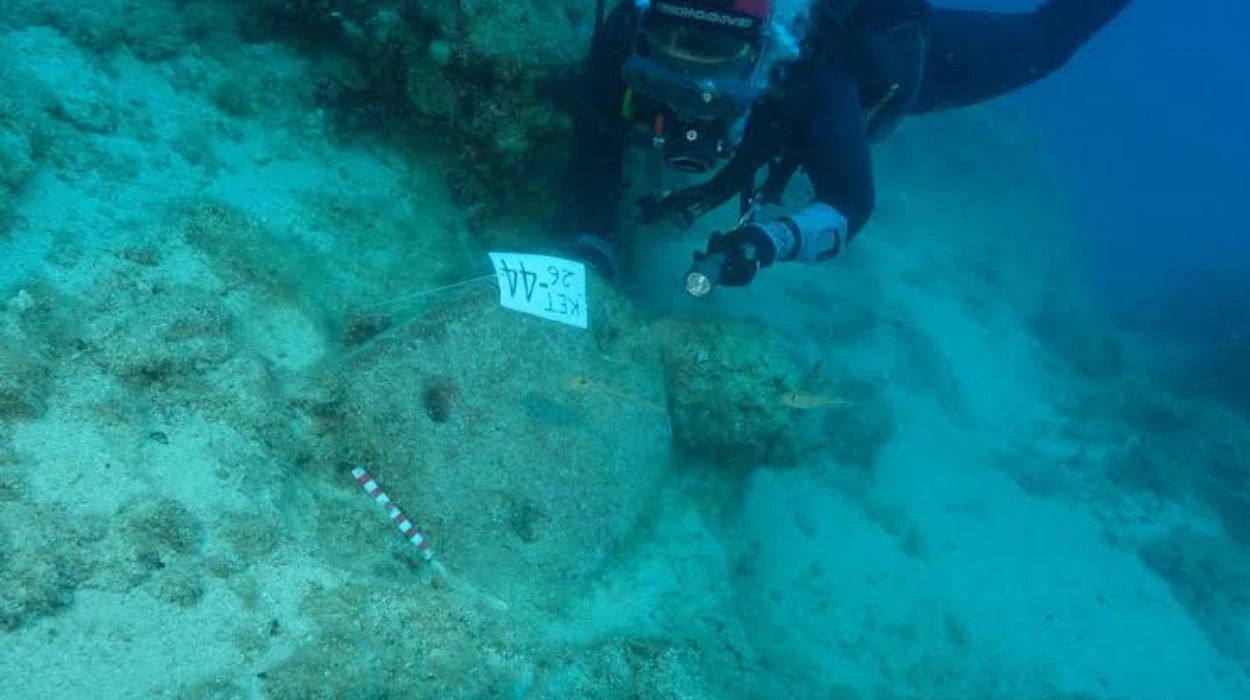
Antalya (Brussels Morning Newspaper) October 14, 2026 – Archaeologists have discovered what is believed to be the world’s oldest known shipwreck, dating back approximately 4,400 to 4,700 years to the Early Bronze Age. Located off the coast of Kekova Island in Turkey’s southern Antalya province, the vessel sank during the era when the Great Pyramid of Giza was being constructed in Egypt. The find comprises more than 30 ceramic storage vessels and three large stone anchors, offering unprecedented insight into ancient Mediterranean trade networks.
The discovery was made by a team from the Mediterranean Archaeology Association led by Professor Hakan Öniz of Turkey’s Akdeniz University. While the organic wooden structure of the vessel has completely disintegrated over the millennia, the scattered cargo on the seabed has survived intact. Researchers note that the site acts as an underwater time capsule, preserving archaeological evidence from a formative period of maritime commerce and human history in the eastern Mediterranean.
Archaeological Significance of the Early Bronze Age Vessel
The newly uncovered shipwreck predates previous notable ancient finds, surpassing the historical benchmark previously set by the Dokos shipwreck near Greece, which is estimated to be around 4,200 years old. Because no organic timber survived for traditional radiocarbon testing, archaeologists verified the age of the site by thoroughly analysing the morphology and decorative techniques of the ceramic storage jars, known as amphorae.
Professor Öniz confirmed that the design features—characterised by dual handles, a central ridge, and a flat base—match 100 percent with Early Bronze Age amphorae previously documented in Egypt and across the Middle East. Turkey’s Culture and Tourism Minister, Mehmet Nuri Ersoy, stated that analysis of the clay used in the containers indicates they may have originated from manufacturing workshops situated within the Jordan Valley. Furthermore, similar ceramic styles have been unearthed near the Egyptian pyramids at Giza, Saqqara, and Abusir, as well as at ancient Troy and on the Greek island of Crete.
Cargo Composition and Artifact Analysis on the Seabed
Resting at a depth of approximately 30 metres beneath the surface of the Mediterranean Sea, the site contains more than 30 distinct ceramic storage vessels alongside three massive stone anchors. Due to the 30-metre depth constraint, scientific divers were limited to strict 30-minute operational windows to carefully record, map, and recover the fragile artefacts without causing structural damage.
Several of the recovered ceramic vessels still contain residual traces of their original contents, which researchers believe were likely commodities such as olive oil or wine. Among the artefacts is a specialized vessel featuring two holes and marked with nine distinct symbols. Archaeologists and specialists are currently examining this specific piece to determine whether it was utilised in ancient food processing methods, such as the production of cheese or butter.
Reconstructing Ancient Trade Routes and Maritime Navigation
Historians and maritime experts suggest that the 10-metre-long vessel was actively engaged in commerce across the eastern Mediterranean. Based on the geographic distribution of its cargo and prevailing maritime patterns, researchers hypothesise that the ship had departed from a port on the Levantine coast and was navigating north towards Troy or west toward the Minoan civilization on Crete when it met its demise.
The waters surrounding Kekova Island have historically presented severe hazards to mariners due to powerful local winds and treacherous currents. Hundreds of historic shipwrecks are documented across the region, reflecting centuries of maritime activity along vital coastal shipping corridors. Professor Öniz emphasized the profound human element tied to the excavation, noting that the research team represents the first humans to physically touch these objects in nearly 5,000 years. Researchers have expressed a deep connection to the ancient sailors, the artisans who crafted the amphorae, the labourers who carried them to the deck, and the families who awaited their return.
Preservation Plans and Future Archaeological Research
The recovered artifacts are currently undergoing comprehensive conservation treatment and scientific examination under the supervision of Turkish authorities. Ownership of the material rests with the Turkish Ministry of Culture and Tourism, and plans are underway to display the items publicly at the upcoming Mediterranean Underwater Archaeology Museum in Antalya.
Turkey’s Mediterranean coastline has emerged as a prominent global centre for underwater archaeological research. According to data shared by Professor Öniz, more than 430 shipwrecks of varying historical periods have been documented along the country’s coastline. Officials and researchers anticipate that ongoing analysis of the Kekova Island shipwreck will yield broader data regarding how early civilisations established trade networks, exchanged commodities, and advanced seafaring technology thousands of years before the advent of modern navigation.